







Skip to the main content.

What We Offer

ICX helps companies grow revenue and profitability by connecting customer experience, sales, pricing, CRM and automation into one commercial system.

Customer Experience

We design memorable, customer-centered experiences that drive loyalty, enhance support, and optimize every stage of the journey. From maturity frameworks and experience maps to loyalty programs, service design, and feedback analysis, we help brands deeply connect with users and grow sustainably.

Marketing & Sales

We drive marketing and sales strategies that combine technology, creativity, and analytics to accelerate growth. From value proposition design and AI-driven automation to inbound, ABM, and sales enablement strategies, we help businesses attract, convert, and retain customers effectively and profitably.

Pricing & Revenue

We optimize pricing and revenue through data-driven strategies and integrated planning. From profitability modeling and margin analysis to demand management and sales forecasting, we help maximize financial performance and business competitiveness.

Digital Transformation

We accelerate digital transformation by aligning strategy, processes and technology. From operating model definition and intelligent automation to CRM implementation, artificial intelligence and digital channels, we help organizations adapt, scale and lead in changing and competitive environments.


Operational Efficiency  

We enhance operational efficiency through process optimization, intelligent automation, and cost control. From cost reduction strategies and process redesign to RPA and value analysis, we help businesses boost productivity, agility, and sustainable profitability.

Customer Experience

chevron-right-1

Marketing & Sales

chevron-right-1

Pricing & Revenue

chevron-right-1

Digital Transformation

chevron-right-1

Operational Efficiency 

chevron-right-1

9 min read

UX: a lever that drives the entire sales cycle

9 min read

UX: a lever that drives the entire sales cycle

User experience, or UX, is the discipline that improves the usability of a product, service or system, meaning its efficiency, effectiveness and the satisfaction of the person using it. Applied to selling, it treats every step of the sales cycle, from the first contact to the moment after purchase, as an experience that either builds or erodes the customer's willingness to buy again.

Imagine the Thursday review of a commercial director at an industrial supplier. Web traffic is healthy, the catalog is complete and the sales team is busy, yet quotes take three days to reach prospects and half of them ask the same clarifying questions on the phone. The product is not the problem and neither is price. Buyers are simply finding the company hard to deal with, and they are quietly choosing the competitor whose process feels easier. That is a UX problem, and it sits inside the sales cycle, not in a design studio.

This article explains what UX is and how it works through its stages, why a company should invest in it, how the sales cycle unfolds and how to apply UX to each step so that the process raises revenue instead of leaking it. It is written for executives who own growth, because the places where experience is lost are rarely in the department that has the word experience in its name.

Team working together on a user experience project

What is UX, and how is it different from design?

Nielsen Norman Group, the research firm that helped define the field, states that "user experience" encompasses all aspects of the end user's interaction with the company, its services and its products, and adds that a true user experience goes far beyond giving customers what they say they want or providing checklist features, as set out in its definition of user experience. In practical terms UX is in charge of how a product looks and, above all, how it feels to use. It is as much about whether a buyer can request a quote without calling as it is about the color of a button.

That breadth explains why UX matters outside technology companies. Everything that surrounds us has been designed, and every designed thing creates an experience before, during and after use. A bank branch, an invoice, an onboarding email and a delivery notification are all experiences, and each one either helps the customer or adds friction. Companies that treat UX as a screen-level exercise miss the larger point, which is that it is a method for understanding how people actually try to get something done.

What are the stages of a UX study?

A UX study works through a series of phases that run from before the use of an object to after it. It begins with the user's needs, since the first thing to determine is why a person needs the product, service or system and whether that need is being met. From those needs come the product requirements, so that what is built or improved answers everything the user is trying to achieve.

The third phase is the investigation of the context of use. With the help of similar objects or systems, or even the one the company already sells, the team determines how the user uses it, where, at what time, which features matter, and how the experience feels. That evaluation reveals the improvements worth making, which are then turned into proposals that meet the requirements and raise the quality of the experience. Potential users evaluate those proposals, which shows what works and what does not, and a prototype is created, tested and refined until a final version is ready to be implemented.

The cycle does not end at launch. The evaluation of the user experience never ends, because the digital world and people's expectations keep changing. Readers who want to understand how the research behind these stages works in practice can read what UX research is and why it is important.

Why should a company use UX?

Because experience has become part of what customers buy. To compete, a company cannot rely only on the product. Users also judge how satisfied they feel when performing tasks with it and the emotions it produces, from satisfaction to frustration. A user with an outstanding experience wants to use the product or service again and recommends it. A user with a poor one does the opposite, and when that happens at scale sales decline and revenue falls. The author's warning that this can threaten the survival of a company is blunt, and while the extreme outcome depends on many other factors, the direction of the effect is consistent with the evidence.

Business growth driven by better customer experience

The financial case has been measured. McKinsey tracked the design practices of 300 publicly listed companies over five years and found that those in the top quartile of its Design Index had 32 percentage points higher revenue growth and 56 percentage points higher total returns to shareholders than their industry counterparts, according to The business value of design. One of the four themes that separated those leaders was user experience itself, defined as breaking down the internal barriers between physical, digital and service design, which is a reminder that the customer does not see an organizational chart. The consequence for executives is that UX is a growth variable and should be reviewed with the same rigor as pipeline and margin.

What is the sales cycle?

A sales cycle is the sequence of steps followed to sell a product, service or system, from knowing who the potential customers are to closing the sale. It is useful to examine it step by step, because the experience is created or destroyed in the small moments between steps.

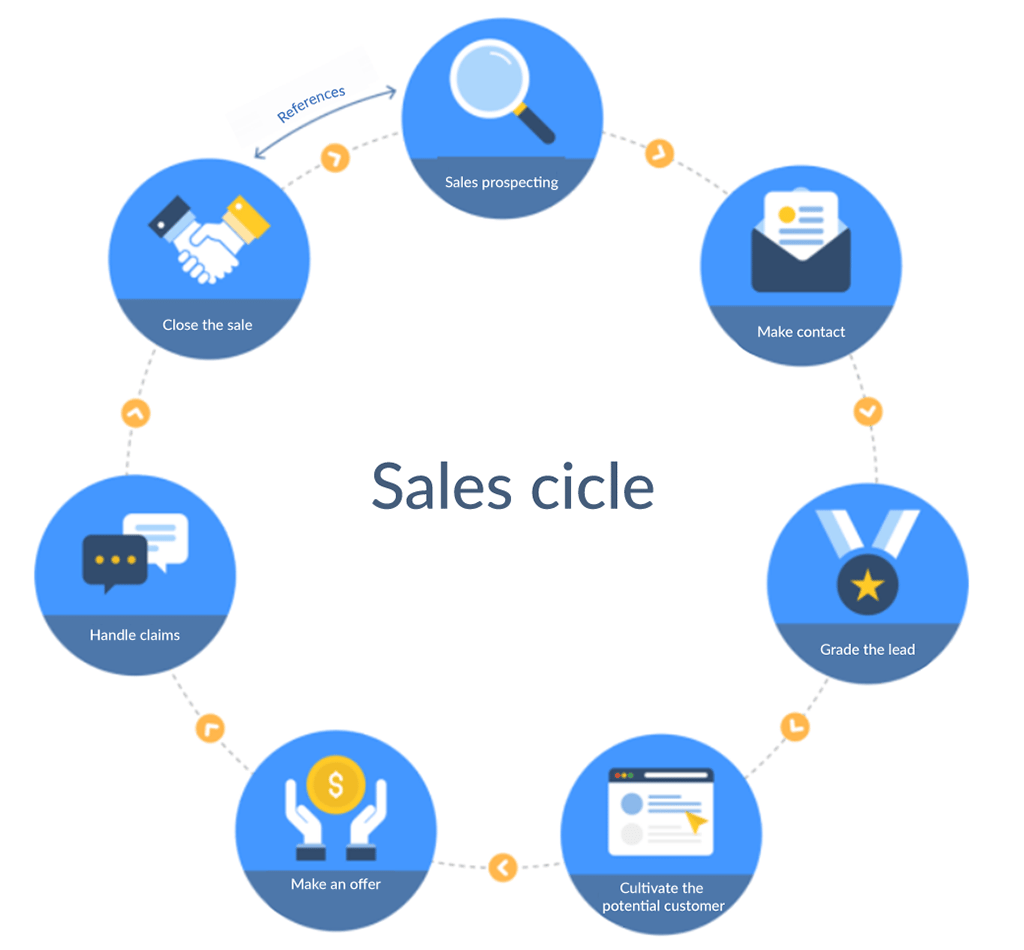
Diagram of the sales cycle from prospecting to closing the sale

The cycle starts with sales prospecting, where customer prospects are evaluated, their profiles are determined, potential customers are identified and strategies are set to contact them. Contact follows. Once the company has potential customers it approaches them in the way they made the first contact and establishes what stage of the purchase they are in. Then the lead is qualified, which means establishing the type of customer and the purpose for which they want the product, along with characteristics such as budget, job position, urgency and needs.

With a qualified lead the company cultivates the potential customer, presenting the product through email, social networks and other marketing channels and showing how it solves their need. When the customer is ready, the company makes an offer based on the information gathered. Claims and objections come next, and the seller must know how to handle them and convince the customer that this product, service or system is the best option. The cycle closes with the sale itself, where the seller defines how assertive to be according to everything learned in the process and answers any remaining questions. If you want a complete walkthrough of building this sequence, see the ultimate guide to creating a sales process.

Why implement UX in the sales cycle?

Because every step above is an experience for the buyer, and most companies design it from the seller's point of view. The prospecting message that ignores the buyer's context, the qualification form that asks eleven questions before offering anything, the proposal that arrives as a forty-page attachment and the objection that is answered with a discount instead of an explanation are all UX failures. Each one is invisible in the sales dashboard, because the dashboard measures activity and not the effort the customer has to make.

Consider three industries. A regional bank onboarding small businesses can lose a promising client because a loan application requires the same documents to be uploaded three times. A hotel group can win corporate accounts by letting travel managers see availability and negotiated rates without waiting for an email reply. A B2B software firm can shorten its cycle by replacing a generic demo with a guided trial based on the prospect's own data. In each case the product did not change. The ease of dealing with the company did, and so did the conversion rate.

The cost of ignoring this is rarely visible in a single quarter. It accumulates as a slightly lower close rate, a slightly longer cycle and a steady stream of customers who buy once and never return, and executives often attribute the pattern to market conditions. A review of the cycle from the buyer's side separates what the market is doing from what the company is doing to itself, and that distinction is where the fastest gains tend to be found.

How is UX implemented in sales?

Since UX considers the experience throughout the entire process, the evaluation should begin when the company first contacts the customer and continue through the time the user is using the product, service or system. It should maintain constant improvement of the process and build a real relationship with users, so that they feel loyalty to the brand and the buying experience is the best possible. Evidence from the sales cycle itself is the raw material. Where do prospects go silent, which questions are repeated in every call, how long does each handoff take, and which objections signal a confusing offer rather than a real disagreement?

Corporate negotiation between a seller and a client

The practical translation of each stage is straightforward. In prospecting, UX means defining who the customer really is before choosing the channel. In contact and qualification, it means asking only what is needed and giving something useful in return. In cultivation, it means showing the product solving the customer's problem rather than listing features. In the offer and objection stages, it means clear proposals and answers adapted to the personality and position of the person across the table. At the close, it means making the next step easy, and afterwards it means checking that the product delivers on what was promised, since the evaluation of the product feeds improvement and the next sale.

How do you measure whether UX is improving sales?

Experience improvements need metrics that the finance team respects, otherwise they remain an opinion. The most useful are the conversion rate between each pair of stages in the cycle, the time a deal spends in each stage, the number of touches required to close, the share of proposals accepted without renegotiation and the rate of repeat purchase or renewal after the sale. Each of them can be tracked in a CRM without new tools, and each can be traced back to a specific experience decision such as a shorter form, a clearer proposal or a faster response.

It is equally important to acknowledge the trade-offs. Removing friction can reduce the information a seller receives, and a faster qualification step can let weaker leads through. The answer is to test changes with a small group first and to compare the quality of what enters the pipeline, not only its volume. Companies that treat the experience of the buyer and the discipline of the seller as complementary, and not as competing goals, tend to see both conversion and deal quality improve together.

What this means for the C-level

For the CEO and the commercial director, UX in the sales cycle is a way to find revenue that is already paid for. The company has generated the lead, spent the marketing budget and assigned a seller, and the opportunity is lost because the process was hard to follow. Reviewing the cycle through the buyer's eyes tends to reveal conversion gains that no new campaign could deliver at the same cost. It also shortens the cycle, which improves cash flow and forecast reliability.

The CFO should read the same exercise as an efficiency lever, since fewer repeated questions, fewer manual quotes and fewer lost deals lower the cost of acquisition and the cost to serve. The service and customer experience leaders gain a common map with sales of where the relationship is made or broken, and the effort to retain and build loyalty begins before the contract is signed. Companies that connect these views typically find that the customer who had an easy purchase is the one who renews and recommends, which is where the author's point about recommendation becomes a financial result.

How to start on Monday morning

Begin by experiencing your own sales cycle as a customer would. Ask a colleague who does not work in sales to request a quote through your website and phone line, and record every point of confusion, delay and repetition. Then listen to five recorded sales calls and write down every question that a well-designed website, proposal or follow-up message should have answered in advance. Those two exercises, which take a few hours, usually give a sharper list of priorities than months of internal debate.

From there, pick the one step of the cycle where customers are most likely to drop out and redesign it with a small group of sellers and two or three customers, testing the new version with real prospects before rolling it out. Measure the change in conversion and time to close at that step, and only then move to the next. The discipline is the same one a UX team applies to a product, which is to learn from users, prototype, evaluate and repeat. A heuristic evaluation is a good first tool, and our heuristic tests toolkit shows how to run one with your own team.

Revenue and monetization growth from a better sales experience

How ICX Consulting helps

ICX Consulting approaches UX as part of commercial strategy. Our UX research and usability and accessibility work identifies where customers struggle, and our sales strategy practice redesigns the sales cycle around what we learn. When the redesign is ready, we help implement it in the CRM and digital channels that your teams use every day, so the improved experience becomes the standard way of working.

Download the ICX heuristic tests toolkit

Bring this topic to your company

An ICX Consulting advisor will assess where your organization stands today and which decisions can move your commercial and customer experience results.

Request a diagnostic with an ICX consultant

Frequently asked questions

Is UX only about websites and apps?

No. UX covers every interaction a person has with a company, including the quote process, the contract, the invoice and the follow-up call. Digital channels are where it is most visible and measurable, but the principles apply equally to a branch, a field visit or a service line.

How can a company tell that UX is hurting its sales?

Look for symptoms such as long quote times, repeated questions in every call, prospects who go silent after receiving a proposal, and abandoned forms or shopping carts. These patterns usually point to friction in the process rather than a weak product, and session recordings, call reviews and short interviews with lost prospects confirm the cause.

Who should own UX in the sales process?

Ownership works best when it is shared. Sales leaders own the cycle, marketing and service own key touchpoints, and a UX or customer experience lead provides the method and the research. An executive sponsor ensures that findings turn into changes to the process and the budget.

How long does it take to see results?

Improvements to a single step, such as simplifying a form or rewriting a proposal template, can show results in conversion within weeks. A full redesign of the cycle takes longer, typically a few quarters, because it requires changes in tools, training and habits. Start with one step and expand with evidence.

If your sales team works hard and still loses deals that should have been won, the difficulty may lie in how it feels to buy from you. Request a diagnostic with an ICX consultant and we will map your sales cycle through the eyes of your customer and show you where experience is costing you revenue.

Content added to ICX Folder
Default Save Save Article Quit Article

Save for later

Print-Icon Default Print-Icon Hover

Print

Subscribe-Icon Default Subscribe-Icon Hover

Subscribe

Start-Icon Default Start-Icon Hover

Start here

Suggested Insights For You

What is UX Research and what is its importance?

What is UX Research and what is its importance?

UX research is the systematic study of what users need, how they behave and in what context they use a product or service, carried out before, during...

Importance of User Experience in Website Development

Importance of User Experience in Website Development

User experience matters in website development because it decides whether visitors find what they need, trust the company and take the next step. A...

Benefits of User Experience in Your Company's Ecommerce

Benefits of User Experience in Your Company's Ecommerce

The benefits of user experience (UX) in e-commerce are measurable: customers find what they need faster, complete more purchases, return more often...

What's next?

ARE YOU READY?

ICX SUBSCRIPTION
Stay ahead with exclusive insights from our senior consultants. Subscribe for the latest thinking on CX, growth, and digital transformation.