





Lead Generation Strategies, From Your Website to Your CRM
A lead generation strategy from your website to your CRM turns anonymous visits into identified, scored and routed opportunities. It works by mapping...

By Role
By Industry
By Target Customer
What We Offer
ICX helps companies grow revenue and profitability by connecting customer experience, sales, pricing, CRM and automation into one commercial system.
Customer Experience
We design memorable, customer-centered experiences that drive loyalty, enhance support, and optimize every stage of the journey. From maturity frameworks and experience maps to loyalty programs, service design, and feedback analysis, we help brands deeply connect with users and grow sustainably.
Marketing & Sales
We drive marketing and sales strategies that combine technology, creativity, and analytics to accelerate growth. From value proposition design and AI-driven automation to inbound, ABM, and sales enablement strategies, we help businesses attract, convert, and retain customers effectively and profitably.
Pricing & Revenue
We optimize pricing and revenue through data-driven strategies and integrated planning. From profitability modeling and margin analysis to demand management and sales forecasting, we help maximize financial performance and business competitiveness.
Digital Transformation
We accelerate digital transformation by aligning strategy, processes and technology. From operating model definition and intelligent automation to CRM implementation, artificial intelligence and digital channels, we help organizations adapt, scale and lead in changing and competitive environments.
Operational Efficiency
We enhance operational efficiency through process optimization, intelligent automation, and cost control. From cost reduction strategies and process redesign to RPA and value analysis, we help businesses boost productivity, agility, and sustainable profitability.
Customer Experience
Marketing & Sales
Pricing & Revenue
Digital Transformation
Operational Efficiency
To maximize lead conversions, match every piece of content and every offer to the stage of the funnel where the buyer actually is. Educate visitors at the top, build credibility with qualified leads in the middle, and give ready buyers a low-risk way to say yes at the bottom, such as a demo, a consultation or a clear price.
Imagine a software company whose marketing team proudly reports 12,000 new leads in a quarter. The sales director, however, says that the team is chasing people who downloaded an ebook and have never heard of the product, while three prospects who asked for a price waited more than a week for an answer and bought from a competitor. Both executives are telling the truth. The company has been producing plenty of content for people who are exploring and almost none for people who are ready to decide, and it has no agreed rule for when a lead moves from one team to the other. The result is a funnel that looks full at the top and leaks at the bottom. This article explains how to fix that by aligning content to the stages of the buyer's journey, with particular attention to the bottom of the funnel, where most of the revenue is decided.
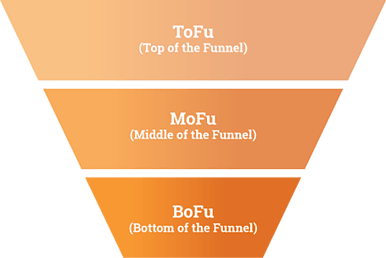
Every step in the inbound methodology requires a consistent alignment between the customer and the stage in the buyer's journey that he or she is in. Likewise, the buyer's journey must be in line with the inbound marketing and sales funnel, so that every piece of content you create has a positive impact on your lead and helps convert him or her into a customer. ToFu, MoFu and BoFu refer to the top, middle and bottom of the funnel, respectively. To carry out a successful inbound marketing strategy, it is essential to understand these concepts and learn how to produce the right content for each stage, so that your lead nurturing is efficient and optimal.

It helps to think of the funnel as a conversation that matures. A person who has just discovered a problem does not want a sales call, and a person who has compared three vendors does not want another introductory article. Content that arrives at the wrong moment is either ignored or irritating. Content that arrives at the right moment feels like service. HubSpot's own guidance on content by funnel stage makes the same point, noting that the goal at the top is to help people recognize and name a problem and not to sell, that the middle builds credibility and helps buyers compare options, and that the bottom reduces risk so that buyers can say yes (HubSpot Blog, how to make the right content for each funnel stage). The same article warns that buyer journeys are rarely linear, so the funnel is best used as a planning tool and not as a strict sequence. That is a useful caution for executives, because it means the funnel is a way to organize content and measure gaps and not a script that every customer follows.
ToFu offers are targeted to the visitors you attracted to your site. They are people who are discovering you and researching your products or services. To convert those visitors into leads, create content such as blog posts, infographics, videos and podcasts, all of which should be educational and provide readers and viewers with knowledgeable information. Create striking calls to action that lead visitors to landing pages with forms, where they are encouraged to share personal information such as a name and email address in exchange for the content you are providing. That information opens the door to email marketing, which you can leverage strongly. Social media posts are also a great tool for reaching people in the ToFu stage, since social platforms are a great pathway to gain brand awareness.
The executive question at this stage is about quality of attention and not quantity. A thousand visitors who match your ideal customer are worth more than ten thousand who do not. That is why the topics at the top of the funnel should come from the real problems your buyers describe, and why the forms should ask for only what you need to continue the conversation, usually a name and an email address. Every additional field lowers the number of people who complete the form, and early in the relationship the trade is rarely worth it.
Ebooks, guides, webinars, case studies and templates are all great resources for your marketing qualified leads (MQL) and sales qualified leads (SQL) in the MoFu. Your content should continue to provide valuable information, but it should also offer potential solutions to their challenges. Use the content in this stage to nurture your leads and to build and enhance your credibility. The calls to action on MoFu content should lead to landing pages with forms that ask for more detailed information, such as the company name and country of residence.
A note on terms is useful for leaders who need their teams to speak the same language. In many organizations, marketing qualified leads are those that marketing has judged ready for sales, and sales qualified leads are those that sales has accepted as potential customers, often based on signals such as requesting a demo (Zapier, lead lifecycle stages). Because the sales-qualified step usually sits closer to the sales conversation, some companies place SQLs between the middle and the bottom of the funnel. The author groups both under the MoFu, which is a workable simplification, and what matters is that your company writes down its own definitions. The same source recommends a two-way service level agreement, in which marketing commits to deliver a number of qualified leads and sales commits to follow up within a set time. The example it gives is a thousand qualified leads a month and contact within twenty-four hours. That arrangement would have prevented the scene at the start of this article.
BoFu offers are perhaps the most important ones, since their purpose is to convert leads into customers. These offers can be free trials or consultations, promo codes and discounts, customer testimonials, demos and detailed information about prices, for example. BoFu offers are the most personalized, and many involve one-on-one interaction between the customer and your business. The information gathered through BoFu offers is more specific than what was collected before. It may include a phone number, job title, website address and the number of employees or company size.
The reason this stage is so important is that the buyer has already done most of the research. Industry research cited by HubSpot's guidance, from a 2024 G2 report, finds that 69 percent of business-to-business buyers engage salespeople only after they have already decided, which means content must do much of the persuading before a conversation begins (HubSpot Blog, content for each funnel stage). We cite that figure as reported by HubSpot's article and recommend that readers check the original G2 report before using it in a board paper. If it holds in your market, a buyer who reaches you at the bottom of the funnel is looking for reassurance. The most useful bottom-of-funnel assets answer the questions that remain, such as what it will cost, how long implementation takes, who else has done it and what happens if it does not work. Customer testimonials, ROI calculators, clear pricing information, live demos and consultations are all designed to reduce risk, and the faster a qualified lead can reach one of them, the lower the chance that a competitor fills the gap.
The personal nature of these offers also changes the operating model. A BoFu lead that asks for a consultation or a demo is a moment of truth, and the response time, the quality of the first conversation and the relevance of the follow-up determine whether the lead converts. Companies sometimes invest heavily in attracting traffic and then fail to staff the last step. Funnel performance is only as strong as its weakest stage, and the weakest stage is usually the handoff.
Determining which customers belong to which part of the funnel, and aligning your content accordingly, may be tricky, especially if you are beginning your journey with inbound marketing. A practical approach is to use signals your system already captures. Pages visited, content downloaded, emails opened, forms submitted and demo requests all indicate how far along a person is. A visitor who reads a single blog post is at the top. A contact who downloads a comparison guide and returns to the pricing page is in the middle or lower. A contact who requests a demo has told you where they are.
From those signals, companies define lifecycle stages and rules. The usual sequence runs from subscriber to lead, marketing qualified lead, sales qualified lead, opportunity and customer, with marketing generally responsible for the first stages and sales for the later ones (Zapier, lead lifecycle stages). The definitions are not universal, and each company sets its own criteria. The point for leadership is to make them explicit and to review them regularly against actual results, so that a lead scored as qualified is one that sales also finds worth calling.
Two additional habits improve accuracy. The first is to review closed deals and ask what content the buyers consumed before they converted, since the answers reveal which assets belong at which stage. The second is to look at lost or stalled leads and ask what they were missing. If many prospects stall after the middle of the funnel, the company may need stronger comparison material or case studies. If they stall at the bottom, the issue may be price clarity, response time or the offer itself.
A funnel is only useful if it is measured stage by stage. The simplest set of indicators is the conversion rate between consecutive stages, the average time a lead spends in each stage and the number of leads lost at each transition. Together they show where the process leaks and how fast it moves. A company that tracks only the number of new leads cannot tell whether a poor quarter was caused by weak attraction, weak nurturing or a slow handoff to sales.
Consider a professional services firm that finds, after one quarter of measurement, that 40 percent of its top-of-funnel contacts become leads, but only a small fraction of its qualified leads request a consultation. The diagnosis points to the middle and the bottom of the funnel, not to traffic. The firm adds two case studies, a short comparison guide and a prominent consultation offer on its pricing page, and it commits to answering every request within one business day. The next quarter's measurement shows whether the changes worked. This is the discipline the inbound methodology asks for, in which every change is a hypothesis and the funnel numbers are the test. Remember that figures like these are illustrative, and each company should establish its own baseline before setting targets.
For the chief executive, a well-aligned funnel is a revenue forecasting tool. When each stage has a clear definition, a conversion rate and an owner, the pipeline can be projected with more confidence, and surprises become the exception. The question to ask is whether leadership can see how many leads sit at each stage, how long they stay and what share advances.
For the chief marketing officer, the challenge is to balance the content portfolio. Many teams produce too much top-of-funnel content because it is easier to create and measure in traffic, and too little for the middle and the bottom, where the money is. For the chief sales officer, the priority is a disciplined response to qualified leads and a shared definition of what a qualified lead is. For the chief financial officer, the funnel provides the basis for cost per lead, cost per customer and payback by channel, and these figures are only reliable if the stages are consistently defined. For the chief information officer, the work is to make sure the customer relationship system records the stages and actions that the other leaders rely on.
Start with an audit of what you already have. Gather the content your company has published or offered in the last year, ask the team to place each piece in the top, middle or bottom of the funnel, and count. In most companies the distribution is lopsided, and the gap at the bottom becomes obvious. Then ask sales and marketing together to write down, in one page, the definitions of a lead, a marketing qualified lead and a sales qualified lead, along with the time within which sales will respond to each. If they cannot agree, you have found the first thing to fix.
Next, choose one gap and fill it. If there is nothing for people who are ready to decide, create a simple bottom-of-funnel offer such as a consultation, a demo or a clear pricing guide, and make sure someone owns the response. If the middle is thin, publish two or three case studies and a comparison guide built around the criteria buyers use. Measure conversion from stage to stage for a quarter and adjust. To map the content and the touchpoints to each moment of the buyer's journey, your team can use the ICX Customer Journey toolkit, which gives a structure for documenting what customers do, think and need at each step, and where the company should respond.
ICX Consulting is a customer experience and commercial strategy firm headquartered in Miami that serves companies in the United States and Latin America. We help companies align marketing and sales around a shared funnel, define lifecycle stages, design the content and offers for each stage and set up the reporting that shows where leads are won and lost. Our work on lead conversion, supported by the HubSpot methodology, focuses on moving leads through the bottom of the funnel. For further reading, see our explanation of the inbound marketing funnel.
If you are beginning your journey with inbound marketing, or you suspect that your funnel is leaking, request a diagnostic with an ICX consultant. We will help you see where your leads stall and what to do about it.

They refer to the top, middle and bottom of the marketing and sales funnel. Top-of-funnel content attracts and educates visitors, middle-of-funnel content nurtures and builds credibility with qualified leads, and bottom-of-funnel offers help ready buyers become customers.
Offers that reduce risk and remove hesitation, such as free trials, consultations, live demos, customer testimonials, detailed pricing information, promo codes and discounts. These are the most personalized offers and often involve one-on-one contact.
At the top, only basics such as name and email address. In the middle, more detail such as company name and country. At the bottom, specific information such as phone number, job title, website and company size.
A marketing qualified lead is a contact that marketing has judged ready for sales, while a sales qualified lead is one that sales has accepted as a potential customer, often after a signal such as a demo request. Each company should define the criteria in writing.
Usually because there is no shared definition of a qualified lead and no agreed response time. A two-way service level agreement, in which marketing commits to quality and volume and sales commits to timely follow-up, addresses the problem directly.
A lead generation strategy from your website to your CRM turns anonymous visits into identified, scored and routed opportunities. It works by mapping...

A lead is any person who shows interest in a company's product or business through one of its channels, such as a form, a download, a webinar or a...
A lead is any person or company that has shared contact details or interacted with your business. A qualified lead is one that has been evaluated...