











Service Tickets in HubSpot Service Hub
A service ticket in HubSpot Service Hub is a record of a customer request, from the moment it arrives until it is resolved. It stores the contact's...
9 min read
9 min read
HubSpot Service Hub is customer service management software that places tickets, live chat, email, self-service content, satisfaction surveys and reporting on the same CRM record used by marketing and sales. For an executive, its value is not a tidier inbox. It is a clear view of retention, cost to serve and the next purchase, built from what customers actually say after they buy.
Picture the monthly commercial committee of a mid-sized distributor. The sales director presents a healthy pipeline. The finance director asks why renewals in the second quarter came in below plan. Nobody has an answer, because the reasons sit in a shared mailbox that three service agents read in different ways, in spreadsheets that sales never sees, and in the memory of the one coordinator who knows which accounts have been complaining since March. The company is not short of data. It is short of a place where the customer's experience after the sale becomes information that leaders can act on.
That gap is expensive. As Harvard Business Review summarizes, acquiring a new customer can be anywhere from five to 25 times more expensive than retaining an existing one, and Bain research found that raising retention by 5% can lift profits by 25% to 95%. If those ratios hold even partially in your business, the quality of the service operation is a financial lever, and the choice of service software becomes a decision for the executive committee rather than a purchase for the support team.
Following up with customers after they buy is how a company keeps them loyal, earns the next order and turns satisfied accounts into references for others. That responsibility does not belong only to marketing and sales. The service function must know the complete journey of each customer and deliver the best experience at every contact, always with an eye on the next purchase.
In many organizations service still works as a cost center that reacts to complaints and is measured by tickets closed per agent. The companies that grow steadily treat it differently. They see service as the function that talks to customers more often than any other after the contract is signed, and therefore the first to know when a relationship is at risk or ready to expand. A distributor whose agents notice that three clients in the same region ask the same question about delivery windows has just discovered a commercial problem long before it appears in a churn report. A software company whose customer success team sees usage falling in an account can alert the seller months before the renewal conversation.
Expectations are also changing in a way that makes the shared record indispensable. Customers do not want to repeat their story to every agent or in every channel, and they expect the company to remember what was promised during the sale. Automation raises the stakes further. A Gartner survey of 3,566 customers found that 87% say it is essential that companies using generative AI for service still offer a way to reach a human agent. Technology can absorb the routine, but the experience still has to be designed around the person on the other side. For a broader view of how service builds loyalty, see our article on ways to use customer service to build loyalty.
HubSpot's CRM is an omnichannel platform that lets a company see the complete process of its commercial management, and Service Hub is the module dedicated to the post-sale relationship. Because it sits on the same customer record used by marketing and sales, every ticket, conversation and survey response is visible in the context of the full relationship. That shared foundation is what separates a CRM-based service tool from a standalone help desk, which may resolve tickets efficiently but leaves the rest of the company blind to what those tickets mean.
According to HubSpot's Service Hub product page, the current platform is organized around a help desk workspace for ticketing, a customer portal and knowledge base for self-service, feedback management with customizable NPS and CSAT surveys, a customer success workspace where teams can build customer health scores, and a Customer Agent that resolves inquiries across email and live chat. Our article on what HubSpot Service Hub is and what its tools are goes feature by feature for readers who want the detail.
Starting with the entry-level editions, the toolset covers the everyday mechanics of support. Teams work from a shared inbox and team email, with live chat and personalized emails, and they organize the work in ticket pipelines and task queues so that every request has a state and an owner. A knowledge base and a documents library let customers find answers on their own. Email sequences tied to feedback surveys, along with customer satisfaction, customer loyalty and customer support surveys, capture how people feel after each interaction, while tracking and email notifications keep agents and customers informed. On the management side, service reporting dashboards, closed ticket reports and productivity reports show how the operation is performing.
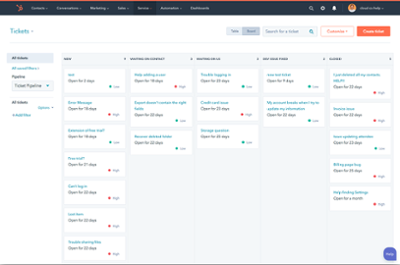
These are the basic capabilities. The number of tools grows with the edition a company chooses and with what the team needs to make the customer experience the best it can be. Higher editions add ticket routing, video management, NPS and customized surveys, customer experience and satisfaction surveys, contact qualification, team structuring, custom objects, conversation analysis and goal setting. Product packaging changes over time, so confirm which edition includes each feature on HubSpot's current pricing and product pages before deciding. The more consequential question is which of these capabilities your service model actually requires, and that is a design question before it is a purchasing one.
The first gain is retention. When customers receive quality service they are satisfied with the company and with what they receive from it, so the next time they need a product or service they think of that company first. The second is satisfaction that works as commercial currency, because a satisfied customer is the best ally a company can have. Beyond staying loyal, that customer shares the experience with prospects and helps convince them that the company's service is the best. The third is faster growth. Good service and support always speak well of the company, and that matters because people look for that added value both before buying and after buying, when they decide whether to continue.
The deeper benefit appears when service is combined with marketing and sales and customer data is integrated across the modules. Each department sees a complete record of a lead's or customer's interactions with the company and can collaborate to solve problems faster. A salesperson preparing a renewal sees the open tickets before calling. A marketer planning a campaign excludes the customers with unresolved complaints instead of sending them a promotion. A service agent knows what was promised in the sale and does not contradict it. None of this requires heroic coordination. It requires a single record and a process that uses it.
Before comparing features, leadership should be clear on the service model the software must support. A company that wants to resolve issues faster will care about ticket pipelines, routing, service levels and task queues, and will track time to first response and time to resolution. A company that wants to reduce cost to serve will invest in the knowledge base, the customer portal and automation for routine requests, and will watch the share of requests solved through self-service. One that is focused on retention will look to feedback surveys, health scores and the shared CRM record, and will judge the investment by renewal rates, repeat purchases and churn. Those that want to grow existing accounts will lean on the customer success workspace and its integration with sales, measured in expansion revenue. Quality, finally, shows up in dashboards, conversation analysis and satisfaction indicators such as CSAT, NPS and the rate of repeat contacts.
Seen this way, the evaluation stops being a feature checklist and becomes a conversation about outcomes. It also exposes the most common trap. Companies buy the full feature set and then use only the shared inbox, so the investment never reaches the indicators that justified it. Value comes from designing the process, the rules and the responsibilities first, and configuring the tools that support them afterwards.
Most disappointing implementations fail for organizational reasons, not technical ones, and the same patterns repeat. The first is copying the old inbox into a new tool. If tickets are created without categories, priorities or owners, the company simply moves its disorder to a more expensive place. Ticket design should reflect the real reasons customers contact the company, and our guide to service tickets in HubSpot Service Hub explains how to structure them.
The second pattern is keeping service apart from sales. When service runs on a separate system, sellers renew accounts without knowing about open problems and agents promise things sales cannot deliver, so the value of a unified CRM disappears. The third is launching a knowledge base without owners. Self-service only reduces contacts if the articles are accurate and current, and a knowledge base that nobody maintains generates more tickets, not fewer. The fourth is automating before standardizing. Chatbots and AI agents amplify whatever process sits behind them, so if answers vary from agent to agent, automation spreads the inconsistency at machine speed. Standardize the responses first and automate them afterwards, as described in our article on how to automatically answer tickets with chatbots in HubSpot. The fifth is surveying without acting. Collecting NPS or CSAT scores without a routine to call back detractors and fix root causes teaches customers that their feedback is ignored.
All five share one remedy. Define the service model, the rules and the responsibilities first and let the software follow. That sequence also makes the business case easier to defend before a finance director, because every configuration choice is tied to an indicator that leadership already tracks.
The same platform produces different value depending on the business. Imagine a regional bank whose customers contact the call center about a blocked card. If the service record is shared with the relationship managers, the manager who calls that client the following week already knows about the incident and can address it, which turns a complaint into evidence of attentiveness. In a manufacturer of industrial equipment, tickets about spare parts reveal which machines are approaching the end of their useful life, a signal that the aftersales team can pass to sales as an early replacement opportunity. In a software company, health scores built from usage and ticket history let the customer success team prioritize its day around the accounts that are drifting. In hospitality or retail, satisfaction surveys sent at the right moment feed loyalty programs with real information instead of assumptions.
The common thread is that the service record stops being an archive and becomes an input to commercial decisions. That is the shift that separates companies that merely answer customers from companies that learn from them.
For the chief executive and the chief commercial officer, the first decision is to bring service data into the retention review. Open tickets, survey scores and repeat contacts are early warnings of churn, and they arrive months before the revenue numbers confirm the damage. A committee that reviews renewals without looking at service history is reading the last page of a story it has not read. Retention improves when someone is accountable for acting on those signals, and that accountability belongs on the leadership agenda rather than in the support team's weekly report.
For the leaders responsible for loyalty and service, the opportunity is to use satisfaction and NPS surveys to identify promoters and give sales and marketing a structured way to turn them into references and expansion conversations. Service levels should also be defined by customer segment, so that high-value accounts receive the response time their contract and their importance justify, while other segments are served efficiently through self-service. Finally, for the executives accountable for efficiency, the discipline is to measure which share of requests could be solved through self-service or automation and to invest there first, while keeping a clear path to a human agent for the moments that matter.
A seasoned service leader would begin with listening rather than configuring. Spend the first week mapping the main reasons customers contact the company and how each one is resolved today, because that map is the raw material of every later decision. Use the second week to define ticket categories, priorities and service levels on paper, with the commercial leadership in the room, before anyone opens a pipeline in the software. Then decide which questions belong in a knowledge base, assign a named owner to keep each article current, and connect service to the same CRM record that marketing and sales already use.
Choose two or three survey moments instead of surveying constantly, for example after a ticket is closed and at renewal, and agree on a small set of service indicators that will be reviewed every month with the commercial team. Five is enough. The discipline of reviewing them together is what turns a service tool into a management system.

To connect service to every stage of the relationship, use the ICX Customer Journey toolkit, which helps teams identify where service interactions shape loyalty and repeat purchases.
ICX Consulting designs service models before configuring software. Through our customer support consulting, service automation and SLA-based customer segmentation services, we define ticket processes, service levels, self-service content and the indicators leadership should review. We then implement the design in HubSpot Service Hub through our HubSpot implementation services, connected to marketing and sales. Want to know whether your service operation is protecting or eroding retention? Request a diagnostic with an ICX consultant.
No. Small teams often benefit most, because a shared inbox, a ticket pipeline and a knowledge base replace scattered email threads and spreadsheets. The editions scale with the operation, so a company can start with core ticketing and add routing, health scores or AI agents when volume and complexity justify them.
A focused implementation with clear categories, service levels and a first set of knowledge articles can go live in a few weeks. The longer part is usually agreeing on the process and migrating historical data. Rushing configuration before the service model is defined is the main cause of rework.
AI works well for routine requests such as order status, password resets or policy questions, and it frees agents for complex cases. It should not be a mandatory gate for every issue. Design a clear escalation path, measure resolution quality, and expand automation only where customers are actually satisfied with the result.
Customer service reacts to requests and problems as they arrive, through tickets, chat or calls. Customer success works proactively with a portfolio of accounts, monitoring health, adoption and renewal risk before the customer asks for help. Many companies need both, with clear handoffs, and Service Hub supports each through separate workspaces on the same customer record.
Track time to first response, time to resolution, self-service resolution rate, satisfaction scores and repeat contacts, and connect them to retention or renewal. If service metrics improve but churn does not, the problem may sit in the product or the sales promise, which the shared CRM record helps reveal.
Customer service is often the last department to be redesigned and the first one customers judge. If you want every support interaction to strengthen the relationship and the revenue behind it, ICX can help you design the service model and the HubSpot setup that make that possible.


A service ticket in HubSpot Service Hub is a record of a customer request, from the moment it arrives until it is resolved. It stores the contact's...

HubSpot Service Hub is the customer service module of the HubSpot CRM. It gathers tickets, a shared help desk, feedback surveys, a knowledge base and...

To create business rules for sales and service teams with HubSpot, first define each rule in business terms, such as who owns a lead, what a deal...

