








How to create a business model canvas: the ultimate guide
A business model canvas, or BMC, is a one-page visual tool that shows how an organization creates, delivers and captures value. It arranges the...

By Role
By Industry
By Target Customer
What We Offer
ICX helps companies grow revenue and profitability by connecting customer experience, sales, pricing, CRM and automation into one commercial system.
Customer Experience
We design memorable, customer-centered experiences that drive loyalty, enhance support, and optimize every stage of the journey. From maturity frameworks and experience maps to loyalty programs, service design, and feedback analysis, we help brands deeply connect with users and grow sustainably.
Marketing & Sales
We drive marketing and sales strategies that combine technology, creativity, and analytics to accelerate growth. From value proposition design and AI-driven automation to inbound, ABM, and sales enablement strategies, we help businesses attract, convert, and retain customers effectively and profitably.
Pricing & Revenue
We optimize pricing and revenue through data-driven strategies and integrated planning. From profitability modeling and margin analysis to demand management and sales forecasting, we help maximize financial performance and business competitiveness.
Digital Transformation
We accelerate digital transformation by aligning strategy, processes and technology. From operating model definition and intelligent automation to CRM implementation, artificial intelligence and digital channels, we help organizations adapt, scale and lead in changing and competitive environments.
Operational Efficiency
We enhance operational efficiency through process optimization, intelligent automation, and cost control. From cost reduction strategies and process redesign to RPA and value analysis, we help businesses boost productivity, agility, and sustainable profitability.
Customer Experience
Marketing & Sales
Pricing & Revenue
Digital Transformation
Operational Efficiency
Creating a Business Model Canvas (BMC) means describing on a single page how an organization creates, delivers and captures value, by completing nine blocks in a logical order that runs from customer segments and the value proposition through channels, relationships, revenue, resources, activities, partners and costs. It is the most widely used tool for turning a business idea into a model that can be discussed.
The executive committee of a food distributor is listening to the commercial director's proposal. He wants to sell directly to restaurants, bypassing the wholesalers the company has worked with for twenty years. The enthusiasm is genuine and the market figures are attractive. Then the chief financial officer asks a simple question: how will this business make money, with whom and at what cost? An uncomfortable silence follows. Each person in the room imagines a different answer. Marketing thinks of an ordering app, operations of additional trucks and sales of a visiting team. Nobody has put on one sheet of paper what is being promised, to whom, through which channel and with what resources. The conversation becomes a sum of intuitions.
The Business Model Canvas was created to solve exactly that situation. Strategyzer, the company founded by its creators, describes it as the tool that shows how a business "creates, delivers and captures value on one page," designed for a single business model at a time, which can be questioned, redesigned and compared with alternatives. You can review their approach in the Strategyzer Business Model Canvas guide. This article explains what the BMC is, how to build it step by step and how to use it in real leadership decisions. To place the concept in a broader picture, you may first want to read Types of business models in less than 800 characters.
BMC stands for Business Model Canvas. It is a tool that shows how an organization captures, delivers, organizes and creates value, and it is essential for creating and reviewing business models. It helps describe the main aspects of the business idea that must work for the project to thrive. Its origin is the book Business Model Generation, by Alexander Osterwalder and Yves Pigneur, published by Wiley in 2010.
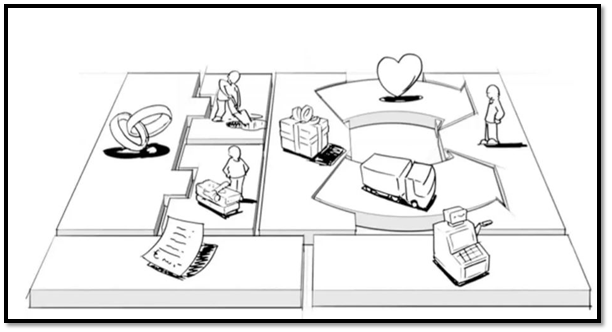
The canvas can be designed with many aesthetic variations, but it must contain certain components so that the model is created satisfactorily and it is clear what the business idea is and what the value proposition for the customer is. There are three main components: the cost center, the value proposition and the profit center. In the classic representation, the value proposition sits in the middle, symbolized by a gift. Everything to its right belongs to the profit center, the market, and everything to its left belongs to the cost center, what is needed to serve that market.

Each block is organized around a question, and the value of the exercise lies in answering them honestly. The value proposition answers which customer problem is being solved and how. In the cost center, key partners answer whom the company must ally with to deliver and create a solution, key activities which actions must be taken, key resources what is needed to produce and deliver, and the cost structure which components are involved in the model and the cost associated with each one.
In the profit center, customer relationships answer how new customers are acquired and what relationships they want; customer segments, which groups of people the solutions are meant for; channels, how the solution is delivered and where customers can find it; and revenue streams, how money is generated. When a question has no answer, it is not an annoyance of the format; it is the most valuable finding, because it points to the part of the model that is still an assumption.

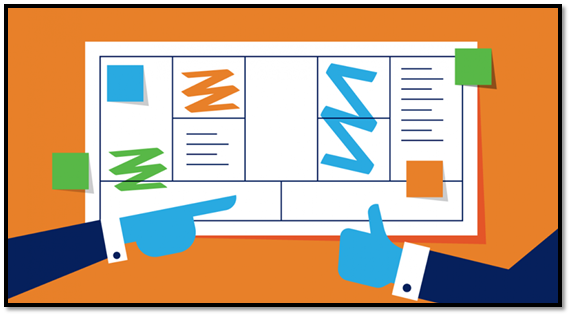
The use of the canvas does not follow a rigid structure. It allows, for example, a preliminary brainstorm to better design the business model. You can even start by answering the questions on which the organization has the clearest view of its model and, as confidence in contributing ideas grows, move on to those that require more detailed analysis. Even so, for the first BMC it is best to follow an order that runs from the customer toward the operation, because value is defined from the outside in.
A useful segmentation strategy is to group customers according to their needs, the channels through which they can be reached and the different types of offer or relationship. This also generates ideas for the other sections and gives you an orderly way to understand the customer. In the case of the distributor, an independent restaurant that buys twice a week is not the same as a fast-food chain with annual contracts and traceability requirements: they are different segments and require different propositions.

For each segment you must specify which features and benefits are created. It is recommended to justify the proposition with five criteria: newness, meaning how novel the products and services are; performance, the quality and speed that increase value; customization, how adaptable the products and services are; design, how design differentiates from the competition; and price, which can be high or low depending on the chosen model. For the independent restaurant, the proposition may be punctual delivery with last-minute orders; for the chain, traceability and stable prices under contract.

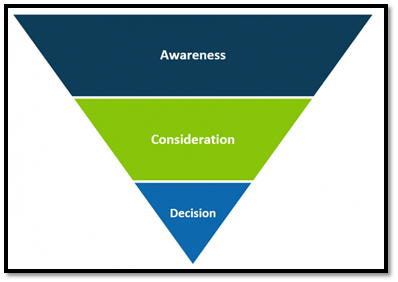
Channels can be varied: owned or partner, and direct or indirect. They exist at the different stages of the customer journey. In the Buyer Journey, those stages are awareness, consideration and decision. A channel is not only where the solution is delivered, but where the customer discovers, evaluates and buys, and each stage may require a different channel.

Customer relationships are of the utmost importance for delivering, reaching and communicating the value proposition. This block determines how new customers are won and which relationships fit the solution the company wants to deliver, from personal assistance to self-service.

This block answers how the company generates revenue from each customer and whether it is recurring or one-time. The clearest examples are sale, where the customer pays once for a product or service; subscription, a recurring payment for a specific service; and pay per use, also recurring but with a cost that varies according to the customer's consumption. A seemingly minor decision, such as moving from sale to subscription, changes cash flow, the acceptable acquisition cost and the relationship with the customer.

Key resources are everything needed to carry out the model and are divided into physical, intellectual, human and financial. Key activities are the tasks the business must execute to give the target customer a solution to their problem. And key partners include stakeholders, the network of suppliers and the partners needed; the factors that make a model require a partner are the optimization of economies of scale, the reduction of risks and the acquisition of resources or activities, especially from companies dedicated to outsourcing. In the distributor, the cold chain, the network of carriers and the consumption data by restaurant are resources and activities that determine whether the direct model is viable.


Finally, for the model to be successful, its financial viability must be ensured. To do so, operating costs are divided into fixed and variable, and economies of scale, cost minimization and premium value propositions that generate the maximum possible value are considered. It is the block that closes the circle: if the revenue that is promised does not cover the costs that are needed, the model needs redesign, not more enthusiasm.
For the chief executive, the canvas is an instrument of strategic clarity. It forces the committee to talk about the same model, makes it possible to compare alternatives on one page and leaves visible where untested assumptions remain. A good practice is to require a canvas for every new line of business before approving budget, and to review it every quarter to record what was learned.
For the commercial and marketing directors, the blocks of segments, value proposition, channels and relationships are the core of attraction and conversion. They force a decision about whom not to serve, something that in commercial practice is as important as whom to serve. For the head of customer experience, the relationships block and the journey through the channels connect the model with loyalty and service. And for finance and operations, the blocks of revenue, resources, activities, partners and costs show whether the model holds up in numbers and in capacity, and which alliances make it more efficient.
The value of the canvas for an executive team can be seen in a case that Strategyzer documents. In a Latin American conglomerate, a workshop of about twenty people helped a CEO who had been in the role for two days understand the company's inner workings, because the canvas showed the strengths and weaknesses of each business model in a short time. In another case, a new chief financial officer for Latin America and Europe used it to understand his business and proposed that the entire regional senior management team complete the same exercise, which produced a unified perspective of the model. You can read both accounts in how to onboard executives with the Business Model Canvas.
The practical lesson is that the canvas is not only for entrepreneurs. A committee with history, with inherited decisions and with areas that view the business from different angles gets from a single page something hard to achieve in a fifty-slide presentation: a common language. When commercial, finance and operations look at the same sheet of paper, the discussion shifts from defending positions to examining assumptions.
The first is filling in the canvas for the whole company. Strategyzer insists on completing it once for each business model, because mixing the subscription line with the direct sales line produces contradictory answers in the same block. If the company operates three models, three canvases are needed, along with a conversation about how they relate.
The second is describing what the company would like to be instead of what it is. The canvas of an existing business must reflect how it operates today, with its real costs and its real customers. Only afterward is the future version drawn, and the distance between the two is the transformation agenda. The third is treating the blocks as independent boxes. Strategyzer warns that they depend on one another: changing a customer segment drags along the channels, the activities and the costs. That is why every adjustment requires going through the entire canvas again.
The fourth mistake is confusing the cost structure and revenue with a financial projection. Those two blocks are only reliable if the blocks that precede them are correct; if the segment is poorly defined or the value proposition does not convince, the figures entered below are an orderly illusion. And the fifth is keeping the canvas in a drawer. A business model that is never looked at again stops being a management tool and becomes an ornament of the annual planning cycle.
Gather in a room, for two hours, one person from each function that would take part in the business: commercial, finance, operations, technology and service. Put the large canvas on the wall and hand out sticky notes. Start with the customer segment and do not move on to the next block until the group agrees on the answer. When there is disagreement, write it down instead of resolving it through hierarchy: disagreements are hypotheses to validate.
At the close of the session, mark in red the notes that are assumptions without evidence, normally those for the segment, the value proposition and revenue. Assign each one a person and a concrete test, for example five interviews with potential customers or a pilot offer to ten accounts. Within two weeks, come back with the results and update the canvas, saving the previous version. Over time, that collection of versions is a record of how the business learns. To go deeper, we recommend Business Model Canvas: Osterwalder-Pigneur and alternatives and Build a Business Model Canvas step by step.
ICX Consulting supports executive teams in designing and reviewing business models. Our business model service facilitates canvas-building sessions and hypothesis testing, our value proposition work sharpens the offer for each segment, and the alignment of the operating and business model ensures that the organization can execute it. If a new line of business is under discussion in your committee, request a diagnostic with an ICX consultant.
To start with a working template, use our business model canvas toolkit.
There is no rigid order, but for the first canvas it is best to move from the customer toward the operation: segments, value proposition, channels, relationships, revenue, resources, activities, partners and costs. That way value is defined from the outside in and the operation is sized afterward.
One for each distinct value proposition or business model. A company can operate several models at once and each requires its own canvas, which can then be compared as a portfolio.
The canvas fits on one page and is used to discuss and challenge assumptions. The business plan is an extensive document that details execution, and it is usually written once the model has already been agreed. Strategyzer proposes treating the canvas as a statement that is dated, versioned and redrawn as evidence arrives.
At least every quarter, or whenever information appears that contradicts an assumption, such as a price change, a channel that does not perform or a new competitor.
A business idea is only a good business when someone can explain, on one page, how it makes money. If your company is currently discussing a new line, a new channel or a price change, talk to an ICX consultant before the next investment is approved without anyone having drawn the complete model.
A business model canvas, or BMC, is a one-page visual tool that shows how an organization creates, delivers and captures value. It arranges the...
The Business Model Canvas is a one-page map of how a company creates, delivers and captures value. Its nine blocks, from customer segments and value...
The Business Model Canvas is a one-page strategic tool that describes how a company creates, delivers and captures value through nine connected...