





Skip to the main content.

What We Offer

ICX helps companies grow revenue and profitability by connecting customer experience, sales, pricing, CRM and automation into one commercial system.

Customer Experience

We design memorable, customer-centered experiences that drive loyalty, enhance support, and optimize every stage of the journey. From maturity frameworks and experience maps to loyalty programs, service design, and feedback analysis, we help brands deeply connect with users and grow sustainably.

Marketing & Sales

We drive marketing and sales strategies that combine technology, creativity, and analytics to accelerate growth. From value proposition design and AI-driven automation to inbound, ABM, and sales enablement strategies, we help businesses attract, convert, and retain customers effectively and profitably.

Pricing & Revenue

We optimize pricing and revenue through data-driven strategies and integrated planning. From profitability modeling and margin analysis to demand management and sales forecasting, we help maximize financial performance and business competitiveness.

Digital Transformation

We accelerate digital transformation by aligning strategy, processes and technology. From operating model definition and intelligent automation to CRM implementation, artificial intelligence and digital channels, we help organizations adapt, scale and lead in changing and competitive environments.


Operational Efficiency  

We enhance operational efficiency through process optimization, intelligent automation, and cost control. From cost reduction strategies and process redesign to RPA and value analysis, we help businesses boost productivity, agility, and sustainable profitability.

Customer Experience

chevron-right-1

Marketing & Sales

chevron-right-1

Pricing & Revenue

chevron-right-1

Digital Transformation

chevron-right-1

Operational Efficiency 

chevron-right-1

8 min read

What are HubSpot playbooks, and what are their methods of use?

8 min read

What are HubSpot playbooks, and what are their methods of use?

What are HubSpot playbooks, and what are their methods of use?
7:11

HubSpot playbooks are interactive guides that appear inside contact, company, deal and ticket records, so reps follow a proven script, ask the right questions and log standardized notes during each conversation. They turn the way your best salespeople sell into a repeatable method the whole team can use, measured in the CRM.

For a sales leader, the question is not whether the team has knowledge, but whether that knowledge reaches every conversation. New reps take months to absorb how the company sells, experienced reps each sell their own way, and managers coach from memory. The result is uneven conversion and a customer experience that depends on who picks up the phone. This article explains what HubSpot playbooks are, which licenses include them, what a good playbook must contain, and the main methods of use across the sales cycle.

Some context on the platform helps. HubSpot is a CRM built for omnichannel customer management that covers the commercial areas of an organization, with hubs for marketing, sales and customer service, and it stands out for its high level of automation in those departments. Playbooks belong to the sales side of that ecosystem. Every company is in a different growth context, but in almost all of them the sales force is constantly changing. New account executives come on board, and more experienced members have to advise and coach them. Playbooks simplify that process, adapt to the department's business rules and carry an essential part of the coaching, from basic information to complex guides, depending on the company's business model.

What are HubSpot playbooks?

According to HubSpot's documentation on how to use playbooks, playbooks are interactive cards that reps open from the right panel of a CRM record, including contacts, companies, deals, tickets and custom objects. Each playbook combines guidance, such as context, talking points and objection handling, with questions the rep answers during or after the call. When the rep logs the engagement, the answers are saved as a note on the record.

In other words, playbooks or sales guides compile the templates, documents, tactics and sales strategies that support the sales team, and they can be opened from any of the records in the CRM. That last point is what separates a playbook from a sales manual in a shared drive. A manual tells reps what to do. A playbook sits inside the workflow, guides the conversation in real time and leaves structured evidence of what the customer said. Over time, that evidence shows management which questions advance deals and which objections stall them.

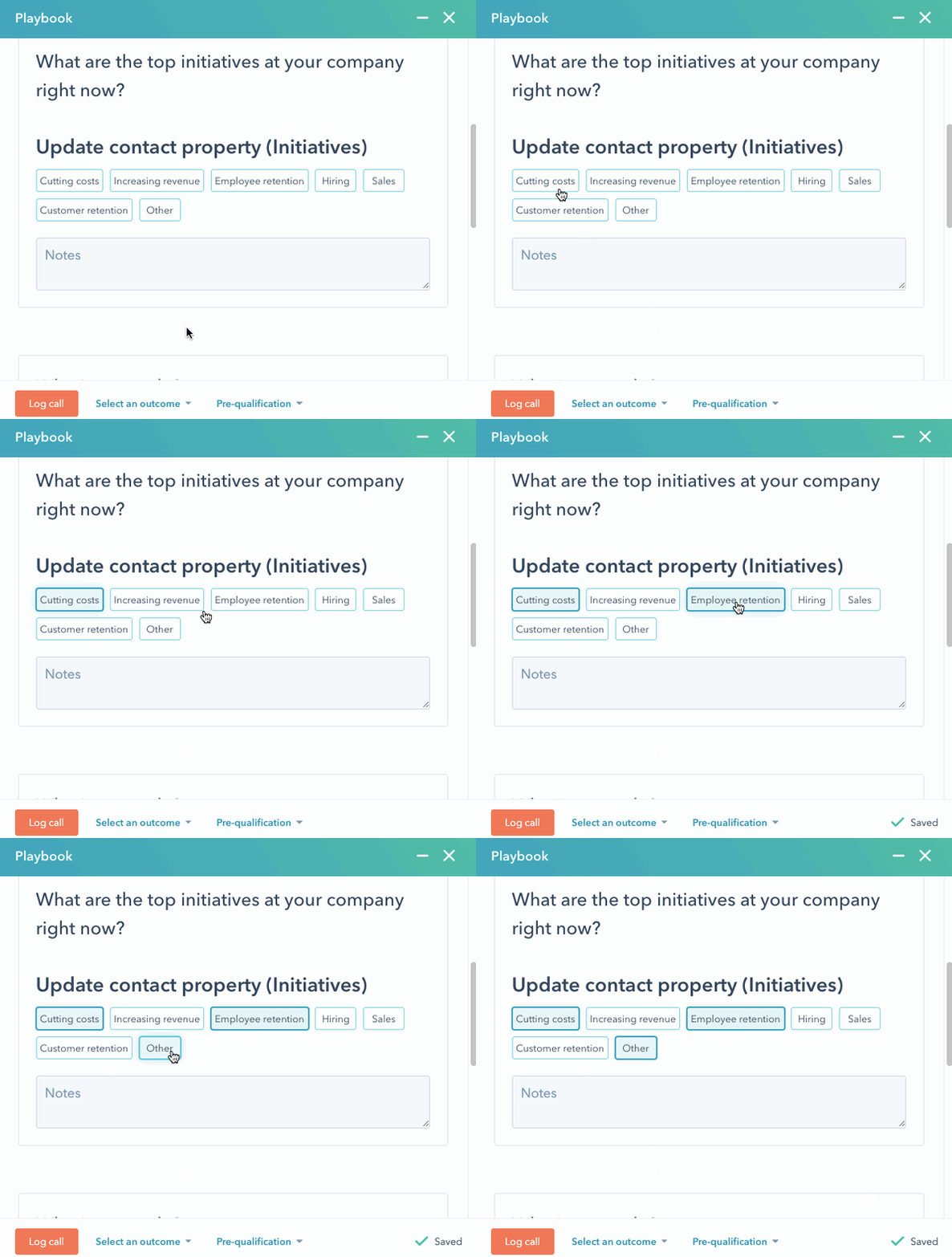
HubSpot playbook open in the side panel of a CRM record guiding a sales conversation

Which HubSpot licenses include playbooks?

Playbooks were once limited to Enterprise editions. Today, HubSpot lists them in Sales Hub Professional or Enterprise and Service Hub Professional or Enterprise. Users need an assigned Sales or Service seat to create, edit and view playbooks, and creating them requires the playbooks edit and publish permission. To learn how to standardize your team's approach, HubSpot Academy offers the free lesson Standardizing Your Approach With Playbooks.

Some capabilities still depend on the edition:

CapabilityProfessionalEnterprise
Create and use playbooks on CRM recordsYesYes
Open text questions logged as notesYesYes
Questions with predefined answer optionsNoYes, in Sales Hub Enterprise
Answers that update record properties automaticallyNoYes, in Sales Hub or Service Hub Enterprise

The Enterprise features matter more than they appear. When a discovery answer, such as budget range or decision timeline, writes directly to a deal property, that information becomes reportable. Management can then segment the pipeline by what customers actually said, not by what reps remembered to type.

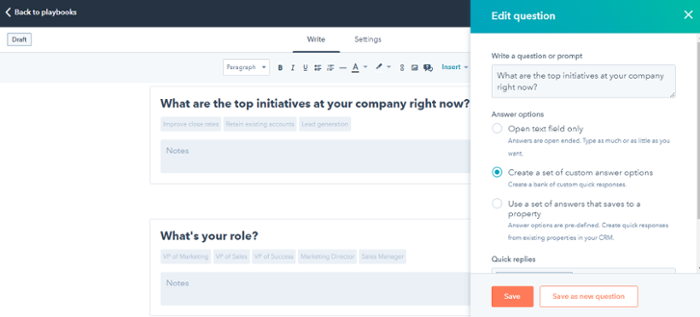
HubSpot playbook editor where managers configure content and discovery questions

Why do sales playbooks matter to revenue?

Buyers have changed faster than most sales teams. A Gartner survey of 646 B2B buyers, published in March 2026, found that 67% of them prefer a rep-free experience. The implication is direct. When a buyer does agree to talk with a seller, that conversation has to add real value, and it has to be consistent across the team.

Playbooks address that problem in four ways:

  • Consistency. Every rep qualifies, presents and handles objections with the same standard, so conversion depends less on individual talent.
  • Faster ramp-up. New reps learn the company's sales method inside the records they work on, instead of in a separate training that fades in weeks.
  • Better data. Structured answers turn conversations into information the company can analyze, from common objections to real buying criteria.
  • Coaching based on evidence. Managers review what was asked and answered in each deal, and coach on facts rather than impressions.

What should a HubSpot playbook contain?

A playbook is only as good as the sales method behind it. Different guidelines are needed depending on whether the customer is B2B or B2C and on the industry of each buyer persona, and no generic methodology fits a company's buyer personas and sales process exactly. The work therefore starts with adapting the sales methodologies your team uses and unifying them into one that fits your business model and your teams. Good documentation is what teaches each rep that method. The objective is simple: guides that show reps the best way to execute the company's sales process at each stage of the negotiation and across the buyer persona's inbound stages of awareness, discovery and decision. A useful playbook answers four questions for the rep.

1. What the rep needs to know

The context of the situation. Which buyer persona is involved, what problem they typically face, which products or services fit, how your company sells and where this conversation sits in the sales stages. Keep it short. Reps read playbooks during live work, not as homework.

2. What the rep needs to ask

The discovery questions that qualify the opportunity and uncover the customer's priorities. These are the questions that should be logged, ideally with answer options or property updates, so the answers can be reported later.

3. What the rep needs to say

The core message and the arguments that connect your offer to the buyer's problem, plus the most frequent objections with tested responses. Write them as guidance, not as a script to read verbatim. Buyers notice the difference.

4. What the rep needs to show

The proof that supports the conversation, such as relevant use cases, product material, comparison sheets or pricing guidance. Link to the approved version so reps stop sending outdated files.

Each playbook should also state its objective in one line, the stage where it applies and the next step the rep must secure before the call ends. A playbook without a defined next step is a conversation guide. A playbook with one becomes a conversion tool.

Three mistakes undermine most playbook programs. The first is writing playbooks from the product outward, listing features instead of the buyer's problems and decision criteria. The second is turning them into long documents that nobody opens in the middle of a call. The third is publishing them once and never revisiting them, so the questions and arguments drift away from what customers are actually saying. Each of these is avoidable with a clear owner, a short format and a regular review of the answers reps log.

What are the methods of use of HubSpot playbooks?

In the sales module, playbooks come into play once the team has qualified a lead and created a deal to track the revenue opportunity through the negotiation stages of the pipeline. Because the deal is associated with its contacts and companies, the rep sees the context of all relevant records in one place while using the playbook. Playbooks are most effective when each one is tied to a specific moment in the sales cycle. These are the most common methods of use.

Prospecting and discovery call playbooks

Prepare the rep before the first meaningful conversation and guide it while it happens. The playbook covers the agenda, the company's likely priorities and business model, the decision makers involved, and the questions that establish need, budget, timing and process. The answers become the qualification record of the deal.

Sales rep using a HubSpot discovery call playbook and logging answers on a deal record

Proposal and presentation playbooks

Support reps when they present a proposal or a demo. The playbook reminds them which value points to connect to the discovery answers, which signals to watch for in the room and which commitments to request at the end, such as a decision date or a meeting with the economic buyer.

Competitive and value positioning playbooks

Help reps identify the star products or services of your company, their strengths and weaknesses, and explain where your offer is strongest, where it is not the best fit, and how it compares with the alternatives the customer is considering. The aim is a fair, credible comparison that builds trust, not a list of claims about other providers.

Objection handling and negotiation playbooks

Capture the objections that appear most often, such as price, timing or internal priorities, with the questions and responses that have worked. Logging which objection came up in each deal shows management where the offer or the pricing needs attention.

Service and account management playbooks

Because playbooks also work on tickets and in Service Hub, they can guide onboarding calls, renewal conversations and escalations. That extends the same discipline from the sale to retention and expansion.

How to create a playbook in HubSpot

HubSpot periodically updates its interface, so confirm the latest steps in its knowledge base. As of this writing, the process is the following.

  1. Go to CRM > Playbooks and click Create playbook.
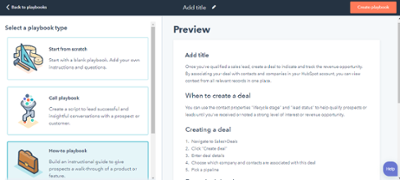
  2. Start from scratch or choose one of HubSpot's Sales or Service templates, then give the playbook a clear title that states its moment of use, for example "Discovery call, mid-market".
  3. Write the guidance in the Write tab, add questions and choose the answer type. Where your edition allows it, link answers to record properties.
  4. In Settings, define the options that control how the playbook is used and logged.
  5. Publish it and, if needed, add a recommended enablement card to the record layout so the right playbook appears at the top of the record.

If your team uses Slack with the HubSpot integration installed, reps can also search playbooks from Slack. The important decision, however, is not technical. It is choosing the five to ten moments in your sales cycle where a better conversation would change results the most, and building playbooks for those first.

What this means for the C-level

Playbooks are an enablement investment, and their value shows in several parts of the commercial engine:

  • Convert. Standardize discovery and proposal conversations around the questions that predict a win. Conversion rises when every rep qualifies the same way.
  • Serve. Use service playbooks for onboarding and escalations so customers receive the same quality of attention regardless of who handles the case.
  • Retain. Build renewal and account review playbooks that surface risks and expansion opportunities before the renewal date.
  • Efficiency. Shorten ramp-up for new reps and reduce the time managers spend repeating the same coaching in every one-to-one.

The executive test is simple. If your best rep left tomorrow, how much of the way they sell would remain inside the company? A good playbook program makes that answer "most of it".

A practical checklist to launch playbooks next week

  • Choose one sales stage with the largest drop in conversion and start there.
  • Interview your two or three best reps on how they handle that stage, and write down their questions and arguments.
  • Define the objective of the playbook and the next step the rep must secure.
  • Turn qualification questions into logged answers, linked to deal properties where your edition allows it.
  • Pilot the playbook with a small group for a few weeks and review the logged answers with them.
  • Measure conversion at that stage before and after, and refine the playbook before rolling it out.
  • Assign an owner who updates the playbook when the offer, pricing or market changes.

Playbooks work best when they are built around a clear picture of the buyer. Use the Persona Playbook toolkit to define who you are selling to, what they care about and how each persona buys, before you write the first playbook.

How ICX helps

ICX Consulting designs the sales method first and then makes it usable in the CRM. Our sales enablement consulting builds the playbooks, content and coaching routines your reps need, aligned with ICX's PROACTIVE sales methodology and your buyer personas. Through our sales strategy consulting, we define the stages, qualification criteria and value messages the playbooks rely on. We then implement them in HubSpot and measure adoption and conversion, so enablement becomes a revenue lever rather than a library of documents. To see how stages and playbooks connect, read our article on the HubSpot deal pipeline and how it organizes your sales team.

Frequently asked questions

Are HubSpot playbooks available in Sales Hub Professional?

Yes. HubSpot currently lists playbooks in Sales Hub Professional and Enterprise and in Service Hub Professional and Enterprise. Professional covers creating playbooks and logging open text answers. Predefined answer options require Sales Hub Enterprise, and answers that update record properties require Sales Hub or Service Hub Enterprise.

What is the difference between a sales playbook and a sales script?

A script prescribes the words to say. A playbook guides the conversation with context, key questions, value arguments and objection handling, and leaves the rep room to adapt. In HubSpot, a playbook also records the customer's answers on the record, which a script cannot do.

How many playbooks should a sales team have?

Start with a few, tied to the moments that most affect conversion, such as discovery, proposal and negotiation. Add more only when the first ones are used consistently. A small set that reps actually open is worth more than a large library nobody reads.

How do you measure whether playbooks work?

Track how often each playbook is used on the deals where it applies, and compare conversion at that stage for deals with and without it. Review the logged answers regularly to spot recurring objections and update the playbook when the market or the offer changes.

If your sales results depend on a few talented reps instead of a shared method, playbooks are a practical place to start. Our team can help you design them around how your customers buy and put them to work inside HubSpot. Is your sales method living in people's heads instead of your CRM? Request a diagnostic with an ICX consultant and let us look at your sales process together.

DOWNLOAD GUIDE EVALUATING MY CRM

Content added to ICX Folder
Default Save Save Article Quit Article

Save for later

Print-Icon Default Print-Icon Hover

Print

Subscribe-Icon Default Subscribe-Icon Hover

Subscribe

Start-Icon Default Start-Icon Hover

Start here

Suggested Insights For You

HubSpot target accounts: What are they and what are they for?

HubSpot target accounts: What are they and what are they for?

HubSpot target accounts are the companies your marketing and sales teams have flagged as high priority because they closely match your ideal customer...


What is HubSpot Service Hub and, what are its tools?

What is HubSpot Service Hub and, what are its tools?

HubSpot Service Hub is the customer service module of the HubSpot CRM. It gathers tickets, a shared help desk, feedback surveys, a knowledge base and...

What are HubSpot workflows and how can they automate processes?

What are HubSpot workflows and how can they automate processes?

HubSpot workflows are rule-based automations inside the CRM. They enroll a contact, company, deal, ticket or other record when a trigger is met, then...

What's next?

ARE YOU READY?

ICX SUBSCRIPTION
Stay ahead with exclusive insights from our senior consultants. Subscribe for the latest thinking on CX, growth, and digital transformation.