




Skip to the main content.

What We Offer

ICX helps companies grow revenue and profitability by connecting customer experience, sales, pricing, CRM and automation into one commercial system.

Customer Experience

We design memorable, customer-centered experiences that drive loyalty, enhance support, and optimize every stage of the journey. From maturity frameworks and experience maps to loyalty programs, service design, and feedback analysis, we help brands deeply connect with users and grow sustainably.

Marketing & Sales

We drive marketing and sales strategies that combine technology, creativity, and analytics to accelerate growth. From value proposition design and AI-driven automation to inbound, ABM, and sales enablement strategies, we help businesses attract, convert, and retain customers effectively and profitably.

Pricing & Revenue

We optimize pricing and revenue through data-driven strategies and integrated planning. From profitability modeling and margin analysis to demand management and sales forecasting, we help maximize financial performance and business competitiveness.

Digital Transformation

We accelerate digital transformation by aligning strategy, processes and technology. From operating model definition and intelligent automation to CRM implementation, artificial intelligence and digital channels, we help organizations adapt, scale and lead in changing and competitive environments.


Operational Efficiency  

We enhance operational efficiency through process optimization, intelligent automation, and cost control. From cost reduction strategies and process redesign to RPA and value analysis, we help businesses boost productivity, agility, and sustainable profitability.

Customer Experience

chevron-right-1

Marketing & Sales

chevron-right-1

Pricing & Revenue

chevron-right-1

Digital Transformation

chevron-right-1

Operational Efficiency 

chevron-right-1

9 min read

Business Model Fundamentals: What do you need to know?

9 min read

Business Model Fundamentals: What do you need to know?

A business model describes the logic by which an organization creates, delivers and captures value. Put simply, it explains how a company makes money: for whom it creates value, how it reaches them, what they pay for and what the company must have and do to keep the system running. Alex Osterwalder and Yves Pigneur organize that logic into nine building blocks.

Picture a board meeting at a distribution company whose largest customers have begun to buy from a competitor that offers its service on a subscription basis. The chief executive asks whether the company should respond with a lower price. The chief financial officer asks what would happen to margin. The commercial director wonders whether the competitor's offer is even the same product. No one is wrong, but the discussion is stuck because the room argues about prices when the real question is about the model: who the customer is, what they are really buying, and how value is captured. A company that cannot describe its own model with precision cannot judge whether a competitor's move is a threat, an opportunity or a distraction.

This article offers the fundamentals every executive should hold in mind before such a discussion: what a business model is, which recurring patterns explain how companies earn money, what the tool is used for in practice, and where its limits lie. It complements ICX's step-by-step guide to building a Business Model Canvas, which deals with the mechanics of the exercise, by concentrating on the concepts and the strategic choices behind it.

What is a business model?

The most quoted definition comes from Osterwalder: a business model describes the logic of how an organization creates, delivers and captures value. Most people who study the subject end up agreeing on a simpler formulation, that it is a tool for describing how a business makes money. That is a superficial definition, but it is a useful starting point, and the book that popularized the concept, Business Model Generation, published by John Wiley & Sons and written by Osterwalder and Pigneur, develops it in considerable depth.

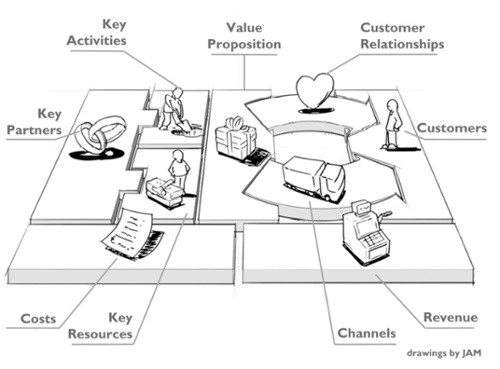
The authors describe a model made up of nine blocks. Customer segments are the groups of people or organizations the business plans to reach. The value proposition is the product or service that generates value for each segment and, after all, the reason why customers look for the company. Channels are the means through which the business communicates with segments and delivers the proposition. Customer relationships describe the kind of link the company has with its customers, which may be personal assistance, automated contact or self-service, as when a person searches for something on Google. Revenue streams are the ways in which the business earns money from each segment, whether from sales of products or services, subscriptions, loans, licenses to use intellectual property or advertising placements.

The remaining four blocks describe what lies behind the scenes. Key resources are the physical, financial, intellectual and human assets needed to deliver the proposition, reach the segment and make money. Key activities are the most important things the business must do. Key partnerships are the strategic alliances with suppliers, non-competing companies or even direct competitors, which can improve procurement, achieve economies of scale or reduce risk and uncertainty. The cost structure gathers all the costs the business must cover in order to operate. Osterwalder also created the Business Model Canvas, a one-page format that makes the nine blocks visible, and a related article explains why to use the canvas template and how. For a short companion on the concept itself, see What is a Business Model? Business Models Explained.

Can one company have several business models?

It can, and in many cases it does. Each value proposition needs its own business model, because different offers usually involve different segments, channels and revenue streams. A company may earn money in more than one way, and the way to find out is to complete the exercise for each value proposition separately. A bank that sells mortgages, runs a payments network and offers wealth management is operating three models whose economics have little in common, even if they share a logo and a balance sheet.

This observation changes how leaders read their own numbers. An average margin for the whole company can hide a profitable model that subsidizes an unprofitable one, or an emerging model that deserves investment but is judged by the standards of the mature one. Separating the models is the first step towards managing them differently. The shorter reference on types of business models published by ICX offers a quick orientation before exploring the patterns below.

What types of business models exist?

Osterwalder and Pigneur speak of patterns, which are recurring behaviors found in many business models. Learning them helps executives understand how a business works and how they might develop their own. What follows is a summary of five patterns, organized around examples, and the book remains the recommended source for those who want to go deeper.

Disaggregation of business models

In this pattern, three different types of business activity coexist in the same company and compete for management attention: customer relationship, product innovation and infrastructure. The authors use private banking as an example. One part of the organization focuses on client communication, such as a personalized wealth management service. Another focuses on innovation through financial products and services. A third provides infrastructure, such as managing transactions at scale. Each has different economics, cultures and talent needs. Separating them, sometimes into distinct units, allows each to be managed against the right goals, since a relationship business rewards depth and trust, while an infrastructure business rewards scale and efficiency.

Long tail models

The long tail, sometimes described in logistics as high mix, low volume, responds to a customer demand for personalization. Instead of selling large volumes of a few items, the company offers a very wide variety and sells few units of each. The book illustrates this with Lego, which traditionally sold packs of pieces for pirate ships or spaceships, often tied to blockbuster films, in large volumes. The company then opened its design process to customers so that their creations could be made available for sale, which increased the number of designs and gave buyers more options, with few units sold of each. The company's fan-design programs have since evolved into LEGO Ideas, launched in 2014 as the successor to the CUUSOO pilot. The strategic point is that the pattern only works when the cost of adding one more variety is low, which makes it attractive for digital catalogs and difficult for physical inventory.

Multi-sided platforms

Platforms generate value by facilitating interaction between distinct customer segments, and their value rises as more users participate. Google connects people seeking information with information providers and earns money through advertising. Visa links merchants with banks. Apple, through the iPhone and the App Store, connects developers of applications, music and books with their customers. Amazon, eBay and Microsoft also operate in this way in parts of their business. The managerial challenge is that the platform must attract several sides at once, and each side needs the other to be present before it joins, which explains why platforms often subsidize one side to win the other.

Free as a business model

Here one segment enjoys a product at no cost because another segment pays for something extra. Spotify is the clearest example: anyone can listen to music for free, and the service is sustained by people who pay for the benefits of membership. Free mobile games follow the same logic, offering to remove advertising or speed up progress in return for payment. A close relative is the bait and hook model, in which a product is sold at a very low price or almost given away, while a complementary product or service needed to use it is sold separately. Mobile phones offered at a minimal price in exchange for monthly service fees and razors with replaceable heads are the classic illustrations. The discipline required is to understand clearly what the free side costs and what conversion rate to the paid side makes the model profitable.

Open business models

Open models depend on collaboration with external partners, in one of two directions. Outside-in, a company designs a process or service and someone else automates it or contributes capabilities it lacks. Inside-out, a company develops intellectual property and monetizes it through patents or licenses. The pattern suits organizations whose innovation outpaces their ability to commercialize it, or whose competence in one area is complemented by partners in another. Its risks are loss of control and the need for clear rules on who owns what is created.

What is a business model for?

The first benefit of documenting the model is knowledge. It is often said that you can only improve what you measure, and you can only measure what you know. A written, visual description of the model shows which parts of the business deserve attention. Strategyzer, the firm associated with the canvas, recommends several uses, and its article on 14 ways to apply the Business Model Canvas goes further than the five summarized here.

The first use is strategic planning or development. The canvas offers a base for organizing strategies, and because it allows leaders to observe in general terms what the different units of a company are doing, planning becomes simpler and the dissemination of projects smoother. The second is retrospective analysis. If the model is documented and updated over time, the company can compare how it did things before with the results obtained later, identify which changes helped and which hurt, and plan from a better perspective.

The third use is managing a portfolio of models. A portfolio shows which models make money today and which could tomorrow, and it reveals synergies between them. The example offered by Strategyzer is a technology that Nestlé used for one product and then developed into different value propositions in coffee, tea and baby formula. The fourth is as a cross-functional language. The canvas integrates marketing, technology, engineering, operations and finance, which counters the weakness of vertical hierarchies where each department knows only one facet of the customer. The fifth is investment decisions. Visualizing the model reveals strengths and weaknesses, and therefore where to concentrate effort and resources, keeping mature models alive while leveraging new ones.

What are its advantages and disadvantages?

The advantages follow from those uses. The canvas helps focus strategy on solving problems, defines the core function of the company, its parts and how they relate, and makes the business logic understandable to everyone. It opens a discussion across departments, which tends to produce stronger insights, it is easy to understand and use, and it reduces the risk of failure by exposing weak assumptions early. These benefits explain why the tool has become a standard in strategy workshops from start-ups to large corporations.

A serious executive should also keep its limits in view. It is not a methodology or a strategy; it is a tool that must be learned and used well. It omits the study of the competition, so competitive analysis is extra work, although a canvas can be drawn for each rival to compare. It does not address current concerns such as sustainability, social responsibility and environmental factors, whose importance is growing because of their impact. It does not consider stakeholders beyond customers. And it is often filled with assumptions rather than data, which gives the appearance of rigor to what may be speculation. The remedy for the last weakness is discipline: label each statement as fact or hypothesis, and test the hypotheses against customers and numbers.

It is worth stressing that a company can survive without a canvas, but it may do so without noticing that its money is made in a different place than it assumes. A team may discover that the product is not what generates the profit, but the way it is delivered to the segment, or that the secret to lower costs lies in strengthening strategic alliances, or that the model itself can change to a more profitable one.

What does this mean for the C-level?

For the chief executive, the discipline of describing the model is a defense against strategic drift. Companies seldom fail because they ignored the market; more often they keep optimizing a model whose logic has changed. Asking, at least once a year, which patterns describe the company and which describe its most dangerous competitors forces a conversation about where value is created and captured, and that conversation is more productive than a debate about the next quarter's price list.

For those responsible for growth and customer experience, the nine blocks translate into decisions about whom to attract, which channels to convert them through, what kind of relationship will keep them and how to build loyalty. For finance and operations, the revenue streams, resources, activities and cost structure show where efficiency is available and what it would cost to support a new offer. A company that wants to turn the model into measurable goals can continue with ICX's guidance on how to define the best business indicators.

How to start on Monday morning

A seasoned consultant would ask three questions in the first meeting. Which of our value propositions earns the most, and which earns the least once all costs are assigned to it? Which pattern from this article best describes each one, and does the way we manage it fit that pattern? And what would a competitor that attacked each model look like, and which block would it attack first?

With answers in hand, draw one canvas per value proposition on a large sheet, label every box as fact or assumption, and invite colleagues from other functions to challenge it. Select the two assumptions that, if wrong, would hurt the most, and design a modest test for each, such as interviews with five customers or an analysis of margin by segment. Review the results in thirty days. The exercise costs little, and it tends to uncover opportunities and risks that periodic financial reports do not show.

How ICX helps

ICX Consulting helps leadership teams describe, test and redesign their business models so that strategy and operations stay aligned. Its business model consulting works with the segments, value propositions and revenue logic of each unit, and its value proposition development service sharpens what the company offers and to whom. The diagnosis is organized with ICX Compass, which sets priorities and sequence, and the model is then connected to pricing, customer experience and processes so that it can be executed.

To begin with a concrete tool, use the ICX business model canvas toolkit in your next leadership session. Would you like an outside view of whether your business model still fits your market? Request a diagnostic with an ICX consultant.

Frequently asked questions

What is the difference between a business model and a strategy?

A business model describes how a company creates, delivers and captures value at a given moment. A strategy describes the choices a company makes to win over time, including which model to run, how to change it and how to respond to competitors. The model is a structural description, while strategy is the direction and the trade-offs that shape it.

How many business models can a company have?

As many as it has distinct value propositions. Each proposition may involve different segments, channels, revenue streams and cost structures, and therefore needs its own model. Mapping them separately reveals which ones generate profit, which require investment and where they share resources or customers.

Is the Business Model Canvas enough to define a strategy?

No. It is a tool to describe and discuss the model, not a methodology. It does not study competitors, ignores stakeholders beyond customers and often relies on assumptions. It works best as the starting point of a broader process that includes market analysis, financial planning and testing with real customers.

When should a company change its business model?

When evidence shows that value is being captured differently by customers or competitors, when a segment grows faster than the core, or when costs and prices no longer support the margin the company needs. Regular reviews, at least annually, allow leaders to change the model deliberately rather than under pressure.

A company that can explain how it makes money, and why, is better placed to defend its margin and to find its next source of growth. If your leadership team is questioning whether its model still fits the market, talk to an ICX consultant and start with the facts about how your business really earns its money.

Business Model Canvas showing the nine building blocks of a business model

Business model patterns illustrated with examples of companies

DOWNLOAD CHECKLIST BUSINESS MODEL

Content added to ICX Folder
Default Save Save Article Quit Article

Save for later

Print-Icon Default Print-Icon Hover

Print

Subscribe-Icon Default Subscribe-Icon Hover

Subscribe

Start-Icon Default Start-Icon Hover

Start here

Suggested Insights For You

Business Model Canvas: A New Way to Understand Your Customers

Business Model Canvas: A New Way to Understand Your Customers

The Business Model Canvas is a one-page strategic tool that describes how a company creates, delivers and captures value through nine connected...

We Love the Business Model Canvas (and so should you!)

We Love the Business Model Canvas (and so should you!)

The Business Model Canvas is a one-page map of how a company creates, delivers and captures value. Its nine blocks, from customer segments and value...

How to create a business model canvas: the ultimate guide

How to create a business model canvas: the ultimate guide

A business model canvas, or BMC, is a one-page visual tool that shows how an organization creates, delivers and captures value. It arranges the...

What's next?

ARE YOU READY?

ICX SUBSCRIPTION
Stay ahead with exclusive insights from our senior consultants. Subscribe for the latest thinking on CX, growth, and digital transformation.