





8 recommendations before starting your eCommerce project
Before starting an eCommerce project, a company should settle eight things in this order: the processes the store will automate, the platform that...

By Role
By Industry
By Target Customer
What We Offer
ICX helps companies grow revenue and profitability by connecting customer experience, sales, pricing, CRM and automation into one commercial system.
Customer Experience
We design memorable, customer-centered experiences that drive loyalty, enhance support, and optimize every stage of the journey. From maturity frameworks and experience maps to loyalty programs, service design, and feedback analysis, we help brands deeply connect with users and grow sustainably.
Marketing & Sales
We drive marketing and sales strategies that combine technology, creativity, and analytics to accelerate growth. From value proposition design and AI-driven automation to inbound, ABM, and sales enablement strategies, we help businesses attract, convert, and retain customers effectively and profitably.
Pricing & Revenue
We optimize pricing and revenue through data-driven strategies and integrated planning. From profitability modeling and margin analysis to demand management and sales forecasting, we help maximize financial performance and business competitiveness.
Digital Transformation
We accelerate digital transformation by aligning strategy, processes and technology. From operating model definition and intelligent automation to CRM implementation, artificial intelligence and digital channels, we help organizations adapt, scale and lead in changing and competitive environments.
Operational Efficiency
We enhance operational efficiency through process optimization, intelligent automation, and cost control. From cost reduction strategies and process redesign to RPA and value analysis, we help businesses boost productivity, agility, and sustainable profitability.
Customer Experience
Marketing & Sales
Pricing & Revenue
Digital Transformation
Operational Efficiency
9 min read
Esteban Cordero | May 29, 2025
9 min read
Esteban Cordero | May 29, 2025
At ICX Consulting, where we design commercial and digital commerce strategies for companies in the United States and Latin America, we see that better sales conversion in an ecommerce depends on four factors in checkout. A well-analyzed process, visible trust, speed in every step and clearly communicated value turn more carts into paid orders.
One of the most immediate, high-impact eCommerce strategies to increase online sales is to optimize the payment process. This is achieved by understanding the process to be automated, choosing the right payment platform and building the integrations the process needs, such as billing, inventory and shipping.
For executives, checkout is where marketing investment either becomes revenue or evaporates. Every visitor who reaches the payment step has already cost the company money in media, content and catalog work. Losing them at the last step is the most expensive leak in the funnel, and fixing it raises revenue without buying a single additional visit. That makes checkout optimization one of the few initiatives that improves growth and acquisition efficiency at the same time.
Picture the weekly trading meeting of a mid-sized online retailer. The marketing director reports a strong month of traffic, and the CEO asks why revenue did not follow. The head of ecommerce explains that nearly everyone who reached the payment page left without paying. The CFO points out that the company paid for every one of those visits. The operations lead adds that the checkout asks for a postal code twice because the address system was added later and nobody touched the form. Each person describes a different symptom of the same problem, and none of them owns the last three clicks of the customer's journey. The meeting changes when the CEO asks for one number, checkout completion by step, and one owner to answer for it.
Traffic is the most visible ecommerce metric, but conversion is the one that multiplies everything else. If a store doubles its conversion rate, it doubles revenue from the same traffic and halves the effective cost of each order. Speed alone shows how sensitive this is. A study commissioned by Google and conducted by 55 and Deloitte across 37 brand sites and more than 30 million sessions found that a 0.1-second improvement in mobile site speed increased retail conversion rates by 8.4% and lifted retail spending by 9.2%.
The following are the 4 key factors to achieve better purchase conversion in your eCommerce. Process, trust, speed and value.
| Factor | Question to answer | Typical quick win |
|---|---|---|
| Process | Do we know exactly how our customers buy and pay today? | As-Is / To-Be map of the checkout |
| Trust | Does the customer feel safe entering their data? | Visible security, policies and reviews at checkout |
| Speed | How long does it take to load pages and complete payment? | Fewer fields, autofill and inline validation |
| Value | Does the customer see why this purchase is worth it now? | Value proposition and savings shown in checkout |
Companies must know their clients' purchasing process. We recommend a methodology such as As-Is / To-Be analysis. It maps the current purchase and payment process of your customers (As-Is) and defines the new, optimized process (To-Be). It is also useful to work with a Customer Journey Map or a SIPOC diagram, which identifies the suppliers, inputs, process, outputs and customers involved in each step.
In practice, the As-Is map often reveals steps no one designed on purpose, such as a manual credit check, a duplicate address form or a payment confirmation that depends on someone in finance. Each of those steps adds delay and abandonment. The To-Be design removes or automates them and defines which systems, such as the payment gateway, ERP, inventory and shipping, must be integrated so the customer never waits for an internal process.
Let us go back to a traditional shopping example. Imagine you are buying from a merchant at an open-air market downtown. Do you feel completely safe handing over your credit card to this merchant? What if they cannot provide a receipt, or there are no signs indicating which cards they accept or their policies? Worse, what if several people have told you this merchant is unreliable? Most people would hesitate to complete the purchase, no matter how easy it is.
Trust is even lower online, because the process is not as transparent as an in-person transaction. Once shoppers enter their personal and confidential information, they wonder where it is going and who has access to it.
Fortunately for online stores, calming these worries is achievable. First, customers will be on high alert if the site looks out of date, with an unfriendly interface and unprofessional design. If this is your case, consider investing in design to refresh the look and, above all, to improve usability.
Strengthen consumer trust with visible security certificates and trust seals. Popular options have included Verisign, BuySafe, GeoTrust and McAfee, and they show visitors that your site is a safe place to do business. Several of these brands have changed ownership over the years, so confirm that the seal you display is current. Provide clear links to your privacy policy, shipping policy and frequently asked questions (FAQs) within the checkout screen.
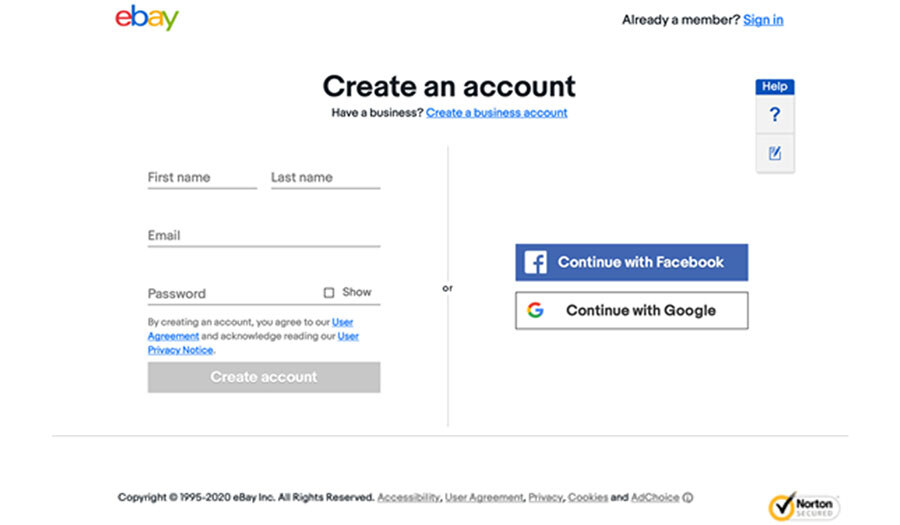
Optimizing the language in calls to action within checkout also goes a long way toward increasing trust. See below how eBay increases trust with its security and registration options.

eBay increases consumer confidence by offering additional registration options. In addition to the standard account creation, customers can register with their Google account or create a business account.
Registration itself is a trust and friction decision. Forcing an account before payment is one of the most common reasons shoppers abandon. Baymard Institute reports that 18% of shoppers who abandoned a purchase did so because the site wanted them to create an account. Platforms such as Adobe Commerce, the evolution of Magento within Adobe's portfolio, allow guest checkout by default and let shoppers register after the purchase, which keeps the option without blocking the sale.
According to a HubSpot study, 78% of internet users research products online before buying. Customers like to check what their peers, social groups and past buyers say before making a decision.
Build trust and give peace of mind to even the most critical customers by enabling a product review and testimonial system on your website. Invite customers to share not only product reviews but also testimonials about their experience with your company.
There are two ways to think about speed in the payment process. One is the overall speed of the site and its page load times. We have seen conversion rates increase with every second removed from page load. The other is the speed at which a customer can complete the payment.
Speed affects your eCommerce site whether you realize it or not. Conversion rates, SEO, customer experience and sales are directly affected by site speed and page load times. Figures widely cited by HubSpot include the following.
Site speed and page load times are a crucial component of any eCommerce strategy and also benefit your SEO. Slow pages drive customers away from browsing and even more from paying.
The last thing you want is for customers to browse your site, reach checkout and then find that the process takes too long. To avoid losing customers this way, optimize speed and load times for both desktop and mobile devices.
Online shoppers are impatient. Once they have chosen their products, they do not want to waste time on long registrations or unnecessary fields.
Think of a mall. You choose a product, try it and weigh price against value before deciding. Even after all that, if you reach the cashier and the line is enormous, you may leave without buying simply because you have no time to lose.
Online, the equivalent is taking a customer to checkout and then hitting them with too many steps, a mandatory account and requests for too much information. Many sites do not use technology to autofill fields the customer has already completed or to infer data already provided.
Did the customer already provide a postal code? Focus on processing the payment first and confirm address details in the shipping step. If customers abandon at the payment step, that is a clear signal to streamline your eCommerce checkout.
There is no magic number of steps for checkout. It varies by industry and type of product. What matters is that your design comes from a process that has been analyzed and is tested with customers on a regular basis.
Help customers through checkout with autofill and inline validation. With inline validation, customers do not reach the end of the form before learning they entered too few digits in their card number. A notification appears as soon as they complete the field.
A progress bar helps customers see the light at the end of the tunnel and predict how much longer payment will take, which makes the process feel structured and less uncertain. Avoid asking commercial or segmentation questions during payment. Request only the information you need.
Your company has probably done a great job with catalogs and product photos, and your eCommerce may already highlight the most popular and best-reviewed products. These features increase customers' desire for what you sell.
Customers will tolerate a less than perfect shopping experience if they perceive what they are buying as valuable. That is why the value we communicate becomes one of the most important elements of the payment process.
Achieve higher conversion by showing your Unique Value Proposition (UVP) clearly during checkout. Suppose your UVP is free shipping. If you cannot offer it on every order, remind customers in checkout how much more they need to spend to qualify.
Show value through discounts and promotions. Integrating them into checkout is where customers really see the benefit.
Offer promotional codes or coupons in the checkout process. Once a code is applied, show a message with how much the customer has saved.
Display the time period or expiration date of the offer. When customers feel they will miss a deal by waiting, they are more likely to complete the payment instead of leaving to compare prices elsewhere.
From a pricing perspective, use promotions with discipline. Discounts shown at checkout should be designed with a clear margin limit and a specific goal, such as raising average order value or clearing inventory, so conversion gains do not come at the cost of profitability.
Overall, the payment process has changed relatively little over time. The information an ecommerce needs to complete a digital transaction remains the same, so most payment forms request similar data. The difference between stores lies in how well they execute.
Reduce cart abandonment and raise conversion on your checkout page by improving speed, increasing trust and promoting value. Build a strategy for your online business around these emotional triggers, supported by a well-designed process.
A few execution habits help you move quickly.
Start by reviewing the purchasing processes of other companies, which helps you see trends in the information they request and make quick adjustments to your site. Use the standard checkout functionality of Magento Commerce, now Adobe Commerce, or other proven platforms, which ensures your forms follow industry standards.
Measure abandonment at each checkout step separately, so you know whether the problem is shipping cost, registration, payment errors or page speed. Then test one change at a time and keep the winning version only after it has run long enough to compare results reliably.
For a deeper look at the platform side, see the 5 essential steps to optimise checkout in Magento, and if conversion is fine but traffic is not, start with our 3 reasons why sales do not grow in an e-commerce.

The weight of each factor depends on what the company sells. In fashion and consumer goods, speed and mobile experience dominate because shoppers buy on impulse and abandon at the first friction. In electronics and home improvement, trust and value matter more, since the ticket is higher and shoppers compare prices and read reviews before paying. In B2B distribution and manufacturing, process leads, because orders involve approved price lists, credit terms and purchase orders that a consumer checkout was never built to handle. In travel, services and subscriptions, clarity about what is being charged and when is part of trust, and surprises at the final step are among the quickest ways to lose the sale.
Checkout work can only recover the demand that has already arrived. If the wrong visitors reach the store, or the product page fails to make the offer clear, a perfect payment flow will not rescue the result. It is also easy to overfit. A change that wins on desktop may hurt on mobile, and a change that lifts conversion this month may attract buyers who return the product, so the executive team should read conversion alongside margin, returns and repeat purchase rate.
There is also a security and compliance boundary. Reducing friction does not mean removing the checks that protect the customer and the company, such as payment authentication and fraud screening. The goal is to place those checks where they are least intrusive and to explain them in plain language. Return to the trading meeting. After a quarter of focused work, the retailer maps its real checkout process, removes the duplicate address field, adds guest checkout and shows shipping costs earlier. The CEO now reviews a single step-by-step abandonment chart each Monday, and the conversation moves from blaming traffic to deciding which fix to test next.
To convert, make checkout conversion a monthly executive indicator with an owner, and measure abandonment step by step. To retain, remember that a smooth, trustworthy first payment experience is the foundation for repeat purchases and positive reviews. To serve, clear policies, order confirmation and tracking reduce calls and emails to customer service.
And for efficiency, integrating payments, billing, inventory and shipping removes manual work and errors that raise the cost of every order.
ICX Consulting improves ecommerce conversion by starting with the customer's purchase process, not with the software. We map the As-Is and To-Be checkout, design the customer journey and define the integrations it needs through our B2C and B2B digital commerce consulting. When the platform is part of the solution, we implement on Adobe Commerce and connect it with your CRM and ERP.
To document your current checkout and the optimized version, download our Define Activities and Processes toolkit and run the exercise with your ecommerce, finance and operations teams.
It is the share of shoppers who start checkout and complete a paid order. It differs from the overall store conversion rate, which compares orders with all visits. Tracking both separately tells you whether the problem is attracting buyers to the cart or closing the sale once they are there, which call for very different fixes.
Not always. A single page works well for simple purchases with few fields, while complex orders with shipping options, invoicing data or installments may convert better in clear, short steps with a progress bar. The right answer comes from testing with your own customers rather than copying another store's design.
Offer the methods your customers already use in each market. In many Latin American countries that means local cards, bank transfers and installment options in addition to international cards and digital wallets. Review payment-step abandonment by method and by country, and add options where data shows customers leave because their preferred method is missing.
If your store attracts shoppers who fill their carts but do not pay, the opportunity is already inside your funnel. Talk to an ICX consultant and find out which checkout changes will turn more of those carts into revenue.
Before starting an eCommerce project, a company should settle eight things in this order: the processes the store will automate, the platform that...
Magento, today marketed by Adobe as Adobe Commerce, is a strong option for creating an online store because it combines search visibility,...
The four benefits of eCommerce wish lists are higher customer engagement, more sales, new customers acquired through sharing, and a stream of data...