











Customer Experience Design and how does it benefit your business?
ICX Consulting, a commercial strategy and customer experience firm, helps companies use customer experience design to grow revenue and protect...
9 min read
9 min read
Companies should define the processes that affect the customer experience because a good experience that depends on who happens to serve the customer is not a strategy. Documented marketing, sales and service processes, aligned with the customer journey, make the experience consistent, measurable and efficient, and they let the company improve it on purpose.
According to Gartner, when deciding where to shop, 64% of people consider the quality of the customer experience more important than price. Whatever the exact figure in each market, the direction is clear. Customers reward companies that make buying and owning easy, and they punish those that make it hard.
But how do you make sure your company gives customers a good experience every time? Is it always the same experience, or does it change? Does it depend on the person in charge that day? For executives, these questions are about more than service quality. An experience that varies by employee or branch is hard to scale, hard to measure and expensive to fix, while a defined process turns good intentions into a repeatable result. This article explains what customer experience covers, how marketing, sales and service processes shape it and why defining those processes pays off.
A telecommunications company receives a complaint from a business customer whose connection has failed twice in one week. The customer calls the sales representative who closed the contract, who forwards the message by email to technical support. Support opens a ticket, asks for the same details and promises a visit, but the field team never receives the order because the ticket was classified under the wrong category. Three days later the customer calls the call center, where an agent with no history asks the customer to explain everything again. At the next executive review, the director of operations presents a satisfaction score that is acceptable on average and cannot explain why this customer is now evaluating a competitor.
The explanation is not that anyone failed individually. Every person in the chain did what they considered reasonable, and no process defined who owns the customer between departments, what information travels with the case or how long each step may take. This is the situation in which executives conclude that they have a service problem, when in fact they have a process problem. The remedy begins with defining the work that sits between the departments, since that is where customers experience the company as it really is.
Customer experience (CX) includes every experience a customer has with a company or brand, across the points of contact that exist before, during and after the purchase. These experiences can be positive or negative depending on factors such as the product, the service and the technology, but the simplicity, effectiveness and efficiency of the process deserve special attention. Customers often forgive a product limitation more easily than a process that wastes their time.
To read more about CX, you can visit the blog Importance of customer experience design (CX).

Many companies measure satisfaction interaction by interaction and conclude that the experience is good. The customer, however, judges the whole journey. A McKinsey study of about 27,000 American consumers found that satisfaction measured across customer journeys predicts overall satisfaction 30% better than measuring each interaction separately, and that maximizing journey satisfaction can lift revenue by up to 15% while cutting the cost of serving customers by as much as 20%. The same research illustrates the trap with a pay-TV example. Six interactions with a 95% satisfaction rate each can still leave up to one in four customers with a poor onboarding experience.
Consistency does not come from talent alone. It comes from processes that define what happens at each step, who does it, with what information and within what time. That is why defining processes is not a bureaucratic exercise. It is the mechanism that makes the experience the same on a busy Monday and on a quiet Friday, with the best salesperson or with a new hire.
When talking about customer experience, it is essential to consider the Customer Journey. This tool portrays the buying process of each Buyer Persona (ideal customer), including their initial need, objectives, motivations and frustrations, and the step-by-step process they follow until they buy a product or service that solves the initial problem. Visualized in a Customer Journey Map, this process allows marketing, sales and customer service teams to identify the moments in which the customer interacts with each department and the efforts needed to create positive experiences.
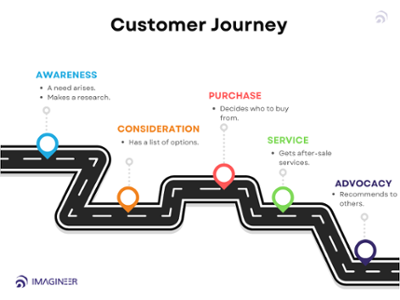
The customer does not see the buying process as three different processes (marketing, sales and service) but as one. Therefore, it is crucial to synchronize the efforts of the three departments and define their processes correctly.
When customers discover that they have a problem or need, they start searching online to learn about the issue and possible solutions, and they find websites, blogs and social media posts that offer knowledge and options. At that moment, the company is executing its marketing process with advertising campaigns, content creation and strategies aimed at its Buyer Personas. A defined marketing process makes sure the content answers the questions customers really ask and that every lead reaches the right person with its context intact.
>> Strategic use of buyer persona in HubSpot CRM <<
When the customer finds several options and starts asking questions through website chat, WhatsApp, social networks, a call or email, a sales executive responds and starts the corresponding process. It may involve exchanging information, negotiating, sending a quotation and any other action needed for the customer to decide. A defined sales process sets response times, qualification criteria, proposal standards and approval rules, so the buyer receives the same quality of attention regardless of the executive. For a closer look at how each of these touchpoints creates or destroys value, read valuing each interaction in sales departments.
>> The definitive guide to creating a sales process <<
After buying the product or service that solves the need, customers expect to be able to contact the company if problems or new questions arise. For the company, that means having processes for claims, warranties and customer service. A defined service process establishes channels, response times, escalation rules and the information the agent needs, and it closes the loop by feeding what customers report back to marketing and sales.

Both B2B and B2C customers are looking for a comprehensive, fast and personalized buying process with positive experiences. That requires synchronization between customer-facing and internal processes, starting with an analysis of the customer journey and the definition of the activities carried out by marketing, sales and customer service, so that the buying process is effective and efficient.
Efficiency is also a key pillar for the success of any process. Markets are highly competitive, so companies need to eliminate or reduce activities that do not add value, both for the customer and for the business.
>> DMAIC: Make continuous improvement of your processes a reality <<
Defining processes delivers concrete benefits for the leadership team:
To achieve this, it is necessary to review and correctly define two levels of process.
Defining the Customer Journey is vital to analyze and plan the internal strategy. With this map, the company can identify the buyer persona's needs, motivations, frustrations and other relevant factors, and align customer expectations with what the company actually delivers.
Once the customer process is understood, it is time to define the company's processes. With a diagram such as the service blueprint, the flow of activities described in the Customer Journey becomes the basis for the actions the company must carry out at each stage, at the operational level and in the systems and technology required. As the Nielsen Norman Group explains, a service blueprint links customer actions with frontstage actions the customer sees, backstage actions they do not see and the support processes behind them, separated by a line of visibility.
It is also ideal to diagram the marketing, sales and customer service processes using a SIPOC or a flowchart. Document not only how the work is done today (As-Is) but also the improved version (To-Be), without unproductive tasks, with defined checkpoints, alerts and indicators, with established business rules and, ideally, with automation.

| Tool | What it shows | When to use it |
|---|---|---|
| Customer journey map | The customer's steps, needs, emotions and touchpoints | To understand the experience from the customer's point of view |
| Service blueprint | Frontstage and backstage actions and support processes behind each touchpoint | To connect the journey with internal operations and systems |
| SIPOC | Suppliers, inputs, process, outputs and customers of a process | To scope a process quickly before detailing it |
| Flowchart (As-Is and To-Be) | Detailed activities, decisions, rules and handoffs | To redesign, standardize and prepare for automation |
This process definition ensures alignment between the Customer Journey and internal activities, and the standardization that gives the customer a quality experience every time. Of course, the people in charge must follow the processes. Otherwise, the experience will change depending on who executes the actions.
The need appears in every sector, though it takes different forms. A retail bank must define the process by which a customer disputes a card transaction, including who reviews it, how long the customer waits and what the customer is told along the way, because in that moment trust is either reinforced or lost. A manufacturer that sells through distributors needs a defined process for warranty claims that crosses sales, quality and logistics, so the distributor does not have to chase three people for one answer. A hotel group or a private clinic network needs a defined process for the first contact after a booking, since a confused arrival is difficult to repair later.
In each of these cases the process is not documentation for its own sake. It is a promise made explicit, with owners, times and rules that any employee can follow and any manager can audit. These are illustrative scenarios, but they show a recurring condition. The processes that matter most to customers are usually the ones that cross departmental boundaries, which are also the ones that nobody owns until leadership decides that someone should.
A process on paper is not a process in practice. Many companies have thick manuals that employees have never read and systems that allow shortcuts everyone takes. The first cause is that the process was designed by a central team without the participation of those who execute it, so it ignores the exceptions that frontline employees handle every day. The second is that nobody measures compliance, which tells employees that the process is optional. The third is that the systems do not reflect the process, so the CRM or the ticketing tool allows a case to move forward without the information the next step needs.
The corrective approach is to treat process definition as a joint exercise between the customer perspective and the operational reality. The journey shows what the customer expects, the blueprint shows what the company does, and a few indicators confirm whether the two coincide. When compliance falls, leadership should ask first whether the process is workable and only then whether employees are following it. That order of questions preserves trust and tends to produce better processes.
For the executive committee, defined processes are the means by which strategy reaches the customer. In converting prospects, a sales process with clear response times and proposal standards removes the variability that loses deals between the first inquiry and the quotation. In retaining customers, defined service and warranty processes protect the relationship at the moments when people are most likely to leave, which are the moments when something has gone wrong.
Serving well requires seeing the work the customer never observes. A service blueprint makes visible the backstage activities such as approvals, inventory and billing that customers always feel even when they cannot see them. Efficiency follows from the same exercise, because eliminating activities that add no value lowers the cost to serve, and only a defined process can be automated without multiplying errors. The executive who sponsors this work is investing in both the customer and the margin at once.
ICX Consulting helps leadership teams connect the customer journey with the processes that deliver it. Our customer process and customer rules and service blueprint services translate the journey into frontstage and backstage activities, and our process mapping and analysis practice documents and redesigns the As-Is and To-Be flows. The ICX Process Matrix then prioritizes what to improve and automate first.
To start documenting your own processes, use the ICX toolkit to define activities and processes and map who does what at each stage of the customer journey.
Bring this topic to your company
An ICX Consulting advisor will assess where your organization stands today and which decisions can move your commercial and customer experience results.
A customer journey map describes the experience from the customer's perspective, including steps, needs and emotions. A service blueprint goes one level deeper and shows what the company does to deliver each step, including frontstage interactions, backstage work, support processes and systems. Companies usually build the journey map first and the blueprint second.
Not if it is done well. A good process defines outcomes, rules and minimum standards, and leaves room for employees to adapt to each customer within those limits. Rigidity usually comes from processes designed around internal convenience. Processes designed from the customer journey tend to give frontline teams more clarity and more freedom, not less.
Each priority journey should have an executive owner with authority across marketing, sales and service, supported by process owners in each department. Without a single accountable leader, handoffs between teams remain nobody's responsibility, and those handoffs are where most customer frustration appears.
Review indicators monthly and the full process at least once a year, or whenever a new channel, product or system is introduced. Complaints, repeat contacts and abandoned purchases are early signals that a process no longer fits how customers behave, and they should trigger a review before the annual cycle.
A quality experience does not happen by magic. It must be analyzed, planned and designed, and it is essential to define business and customer processes correctly so that they are executed accurately and give customers a consistent experience. If you want to know where your processes are making the experience depend on luck, request a diagnostic with an ICX consultant and build an experience your customers can count on.

ICX Consulting, a commercial strategy and customer experience firm, helps companies use customer experience design to grow revenue and protect...

 Aileen Pierce : May 29, 2025
To build the best customer experience with the customer journey, a company maps how its buyer personas move from need to purchase and beyond, then...

Aileen Pierce : May 29, 2025
A service blueprint is a visual tool that maps a customer's experience with a service, showing the steps and touchpoints the customer goes through...

