




/ICX_Insights%20content/Folder%20icon%20for%20insights.svg)
/ICX_Insights%20content/Folder%20celeste.svg)
Save for later
/ICX_Insights%20content/Print%20gris.svg)
/ICX_Insights%20content/Print%20celeste.svg)
/ICX_Insights%20content/Share%20icon.svg)
/ICX_Insights%20content/Share%20celeste.svg)
/ICX_Insights%20content/Subscribe%20icon.svg)
/ICX_Insights%20content/Subscribe%20celeste.svg)
Subscribe
/ICX_Insights%20content/Start%20Here%20icon.svg)
/ICX_Insights%20content/Start%20here%20celeste.svg)
Start here
9 min read
9 min read
Choosing pricing software seems, at first glance, a technological decision. In fact, it often reveals something much more uncomfortable: how mature the company is at deciding prices, how much it still depends on Excel, and how much margin it is letting slip through processes that no one has questioned in years.
The common mistake is to start with the functionalities. Dashboards, algorithms, artificial intelligence, automations and integrations are compared, but rarely do we start with the really important question: which pricing decisions do we want to improve and which do we want to stop making manually? Without that clarity, even a good platform ends up becoming another system that the team consults, but that doesn't change the way prices are set.
Omnia Retail argues that a modern dynamic pricing tool should combine competitive information, pricing rules, automation, scalability, and the ability to explain why a price changes. It's an especially useful approach for retailers and brands that handle large catalogs and markets where competitor moves are frequent.
But when the conversation expands to B2B, distribution, manufacturing, customer segmentation, or strategies where elasticity, margin, and competition matter, additional requirements appear. Platforms such as SYMSON are particularly interesting because they allow pricing to be treated as a broader decision system and not just as a repricing mechanism.
A pricing platform should be able to understand that a company can use several pricing logics at the same time. A distributor may need to maintain aggressive pricing on highly comparable products, protect margin on specialized SKUs, and apply different conditions depending on region, channel, or customer segment.
When all these decisions are tried to be resolved using a single formula, the result is usually predictable. Exceptions, parallel files and improvised discounts appear. The calculated price may be mathematically correct, but commercially make little sense because it ignores the role that each product or customer plays within the business.
SYMSON addresses this problem through its Pricing Strategy Builder, which allows you to build and combine different strategies and business rules. The platform can work with variables related to costs, competition, segments, regions, inventory, elasticity, and other factors that directly intervene in the price decision.
That's a lot more useful than simply getting a recommendation that says the optimal price is $127. The inevitable question would be: optimal for what? It can be optimal for protecting margin, increasing volume, improving competitive positioning or accelerating inventory output.
Good software should allow you to define that goal, apply different rules depending on the context, and modify the logic when conditions change. Otherwise, the organization ends up subordinating its business strategy to the way the tool works, when the exact opposite should happen.
Appian updates its platform with artificial intelligence
There is something curious about the current race to incorporate artificial intelligence into pricing. Some solutions seem to put more effort into proving that they use AI than explaining how they arrived at a recommendation. For a CFO or a Commercial Director, that difference should matter a lot.
If tomorrow the system recommends increasing the price of a family of products, someone will have to defend that decision. Maybe in front of the CEO, in front of the sales team or when sales react differently than expected. "It was decided by the algorithm" will hardly be a sufficient explanation.
The ability to interpret the results, understand what information was used, and review the variables that led to a recommendation should be part of the selection process. Mathematical sophistication has value, but it loses much of that value when no one within the organization can understand or question it.
SYMSON approaches its model from an explainable artificial intelligence approach, avoiding treating the algorithm as a black box. This allows for the review of data, scenarios, and variables used, making it easier for recommendations to be discussed from a commercial and financial perspective, not exclusively from a technical one.
Omnia follows a similar logic at this point. Its rules structure allows you to understand how certain decisions are constructed and its approach incorporates tools that help to consult competitive movements, price positioning and margin opportunities.
Technology can be complex internally. The final decision should not be mysterious.
If the user can't understand why the system recommends a price, the tool starts to lose credibility just when it should gain the most.
Copying competitive prices is relatively easy. Understanding how much a price can increase before it affects demand too much is already much more difficult. That difference is important because many companies still manage adjustments using overall percentages for entire categories.
Let's assume a company with several thousand references. The sales team knows perfectly well which ones are very sensitive to price and which ones are more tolerant of an increase. That knowledge may work as long as the operation is manageable, but it loses accuracy when regions, channels, customers, and products multiply.
That's when intuition stops climbing. An overall increase of 4% may be too aggressive for certain products and too conservative for others. The average simplifies the decision, but it also hides opportunities and risks that can have a direct effect on margin and volume.
SYMSON uses machine learning models to estimate price elasticity and sensitivity, build scenarios, and recommend prices based on targets such as margin or revenue. It can also consider seasonality and other factors that affect demand response.
This allows you to change the question. Instead of discussing how much all prices should rise, the company can look at where there is real capacity to raise them, where it should be held, and where a rise could have an unnecessarily negative business effect.
That difference may seem small, but it completely changes the pricing discipline. The conversation shifts from general percentages to the relationship between price, customer behavior, and profitability.
Monitoring competitors' prices is a relevant capability, especially in retail, ecommerce, and highly comparable categories. However, there is a considerable difference between using competitive information and allowing competitors to end up defining our pricing policy.
SYMSON can incorporate competitive information into pricing strategies and use it in conjunction with pre-established rules. The platform can work with market sources, marketplaces, and external tools to integrate that data into the decision.
Omnia has a particularly clear strength in this area. Its proposal is closely linked to competitive monitoring and dynamic pricing for retail, where the ability to observe large quantities of SKUs and react quickly can be critical.
The problem arises when the reaction becomes automatic without sufficient judgment. Consider a retailer that sets a simple rule: always stay 1% below your main competitor. That rule seems reasonable until the competitor decides to liquidate inventory.
Our system lowers the price. The competitor reduces it again. The algorithm responds again. In a few hours a perfectly automated price war can be built, even if neither company has consciously decided to enter it.
That is why good software must allow you to define margin limits, exceptions, products that should follow the market and products where that comparison has little relevance. Competitive data is useful; Blindly obeying it can be quite expensive.
In B2B business, another difficulty appears. Two customers may buy exactly the same product and represent completely different business situations. You buy large volumes and pay punctually; another buys sporadically and negotiates each order as if it were an exception.
A third customer may operate in an industry where the product has a critical function and show less price sensitivity. Applying a single logic to everyone simplifies administration, but usually forces the seller to correct that simplification through discounts.
That's when the exceptions begin to multiply. Some are registered in the CRM, others in the ERP and many survive only in emails or in the memory of the person who manages the account. Over time, no one is clear why two similar customers pay such different prices.
SYMSON allows you to work with segments considering variables such as region, channel, behavior or commercial characteristics. It can also analyze price sensitivity and support the construction of differentiated strategies for different customer groups.
This does not mean that an algorithm should autonomously decide how much to charge each customer. It means that the organization can turn its business segmentation into a consistent pricing discipline, reducing arbitrary decisions and hard-to-justify exceptions.
For a Chief Commercial Officer, that ability can alleviate one of the most repetitive frictions of the business: determining how much discount to authorize, who to grant it to, and when a commercial concession actually makes sense.
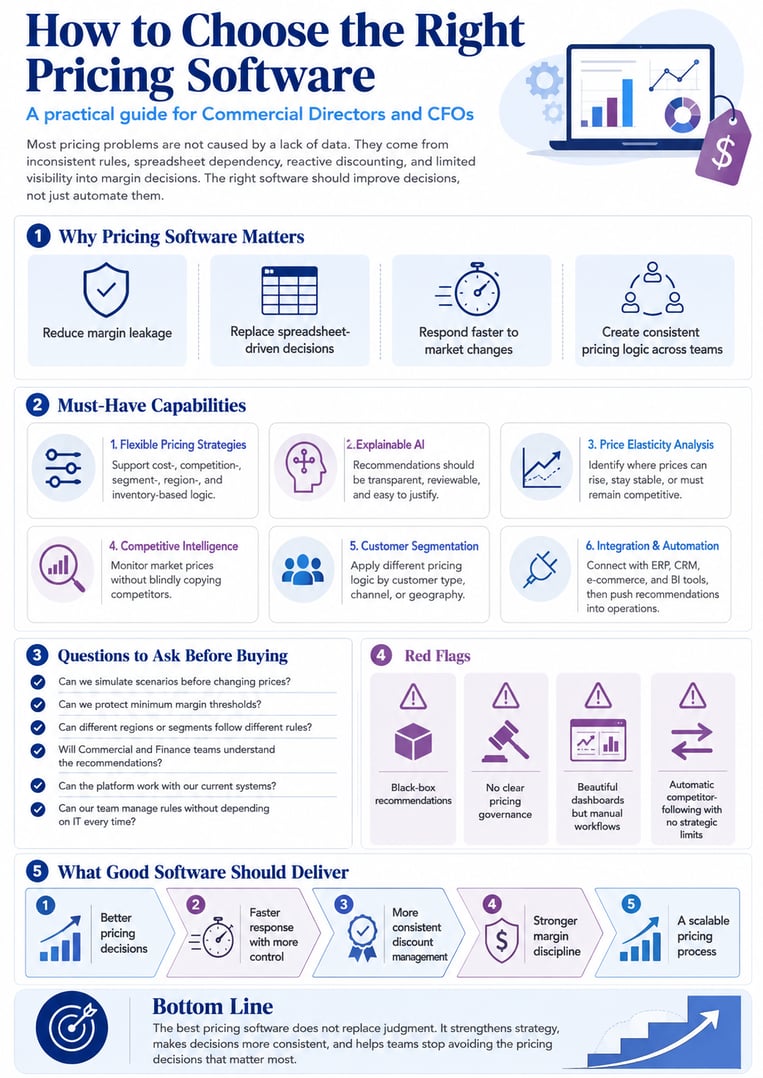
It is also advisable to be wary of overly beautiful demonstrations. A dashboard can look flawless and still leave a deeply manual operation behind. That happens when data needs to be extracted, transformed, loaded, and re-exported each time a recommendation is updated.
If every Monday someone downloads information from the ERP, arranges it in Excel, uploads it to the tool and then exports prices again to publish them in another system, automation is quite relative. There is software, yes, but the process still depends on people moving files.
The right software must coexist with the existing technological ecosystem. It must be able to receive information from ERP, CRM, ecommerce or Business Intelligence tools and return recommendations to the place where business decisions are actually executed.
SYMSON is designed to integrate with different sources of information and export recommendations using APIs or files. This allows you to connect the pricing engine with the systems where customers, products, orders or price lists are managed.
The point is not to have an integration for technical reasons. It is to prevent the recommendation from being trapped in a dashboard that no one uses during the operation. The price needs to reach the channel where it will be applied, and then the result must return to the system to feed the next analysis.
Without that cycle, a company may end up with an interesting analytical tool, good graphics, and little influence over actual decisions. And that happens more often than is usually admitted during a trading demo.
Software demos are usually set up to make everything work well. I would do exactly the opposite. Instead of asking for a list of functionalities, I would pose situations that force the vendor to demonstrate how the tool responds when the business becomes less orderly.
For example, what happens if a competitor drastically reduces its price? What if the cost of purchase increases while there is still inventory purchased at a previous cost? Can the system protect a minimum margin without completely blocking the trading reaction?
I would also ask if certain products can be kept unchanged, use different strategies by region, differentiate customer segments, and simulate decisions before publishing them. The test should look more like a business discussion than a tour of menus.
Another important question would be whether the system can explain why it recommended a certain change. If a price variation cannot be understood by Finance or Commercial, it will be difficult to build enough trust to allow automation to gain space.
Then comes a less sophisticated, but probably more relevant, question:
Can the business team use the platform without permanently relying on IT, external consultants, or data scientists to modify each rule?
An overly technical solution can hand the pricing back to a small group of specialists. That doesn't solve the problem either. The company needs analytical sophistication, but also enough autonomy to adjust rules when a business condition changes.
SYMSON seeks that balance by allowing strategies, rules, and scenarios to be configured within the platform, combining them with analytical models and machine learning. That kind of flexibility often adds more value than a long list of features that no one changes after implementation.
This is the least engaging part of the conversation. Buying technology is relatively simple. Deciding who can change prices, who approves exceptions, which targets take precedence, and how discounts are managed can be much more awkward.
No software will resolve that discussion. If Commercial chases volume, Finance protects margin, and Marketing launches promotions without shared logic, the tool will receive conflicting instructions. The problem will not be in the algorithm, but in the organization.
Omnia indirectly acknowledges this reality when it states that more sophisticated dynamic pricing processes work best when there is sufficient maturity and governance. It makes sense because a platform can automate rules, but someone needs to decide what those rules are.
Technology amplifies the discipline it finds. If there is a clear strategy, you can make it scalable. If you find a company where each salesperson negotiates according to their criteria and the exceptions are corrected afterwards, it will probably make the mess more visible, but it will not necessarily solve it.
That is why implementation should be accompanied by decisions about roles, limits and responsibilities. Who defines the strategy, who can intervene a price, what exceptions require approval and how to evaluate whether a recommendation worked should be sufficiently clear.
I would narrow the evaluation down to capabilities that really change the way you manage pricing: integration with internal data, competitive insights where relevant, multiple strategies, configurable rules, elasticity analysis, scenario simulation, segmentation, and automation.
I would add another condition that is often underestimated: explainability. A recommendation that no one can defend has little chance of surviving in the face of the first trade disagreement. The system must help make more sophisticated decisions without making them incomprehensible.
It would also assess how much effort it takes to maintain the tool six months after implementing it. There are platforms that work very well during the initial project because they have specialists around, but they become rigid when the internal team starts using them on their own.
Because of the combination of these capabilities, SYMSON deserves to be high on a list of solutions to evaluate, especially when the organization needs something broader than competitive monitoring or repricing. Its approach combines business rules, segmentation, elasticity, scenarios, machine learning, and integration within a single environment.
For companies with a strong retail and ecommerce orientation, Omnia also deserves consideration, especially when competitive tracking, SKU volume, and speed of reaction to market are core components of the strategy.
But buying software should be almost the end of the conversation and not the beginning. First we have to decide which decisions we want to stop making by intuition, which can be automated and which will continue to require human judgment even if there is an algorithm capable of recommending something else.
The right software doesn't replace that discussion. What it does is make it more concrete, measurable and difficult to postpone. And that's probably one of the clearest signs that the chosen tool is really helping to improve pricing.


