



/ICX_Insights%20content/Folder%20icon%20for%20insights.svg)
/ICX_Insights%20content/Folder%20celeste.svg)
/ICX_Insights%20content/Print%20gris.svg)
/ICX_Insights%20content/Print%20celeste.svg)
/ICX_Insights%20content/Share%20icon.svg)
/ICX_Insights%20content/Share%20celeste.svg)
/ICX_Insights%20content/Subscribe%20icon.svg)
/ICX_Insights%20content/Subscribe%20celeste.svg)
/ICX_Insights%20content/Start%20Here%20icon.svg)
/ICX_Insights%20content/Start%20here%20celeste.svg)
How to measure success in CRM implementation
 Susana Matamoros : May 29, 2025
You've made the strategic decision to acquire a new CRM system, and now you're facing the exciting challenge of getting it up and running.
10 min read
10 min read
A company may have a CRM to manage customer relationships, an ERP to oversee operations, and several applications developed to address specific business needs. Each system serves its purpose. The problem arises when employees still need to transfer information between platforms, manually verify records, or repeat tasks that should already be connected to complete a process.
Low-code platforms have made enterprise application development more accessible through visual tools, reusable components, and automation capabilities. Organizations can address specific needs without building every solution from scratch. However, this accessibility introduces a challenge: developing applications faster does not necessarily create a more integrated operation.
Consider an application designed to manage customer requests. It may offer an intuitive interface, capture information, and send notifications. Yet if employees must access the CRM to retrieve customer details and then manually enter the request into the ERP, a significant part of the process remains fragmented.
This is where integration becomes essential. A low-code application can use existing systems to retrieve information, execute actions, and participate in processes involving multiple departments.
Achieving this requires decisions about architecture, integration, data ownership, and technology governance. These decisions determine whether each new application strengthens the organization's existing capabilities or becomes another standalone solution that must be maintained independently.
Low-code development offers an important advantage: it allows organizations to create solutions for needs that might not justify a large-scale, traditional software development project.
An operations department may need an application to record inspections. Human Resources may require a tool to manage internal requests. A sales team may need a simpler way to access customer information during client visits.
These are all legitimate needs, and each can be addressed by an application that performs well on its own.
The challenge emerges when these solutions become part of broader business processes.
An inspection application, for example, may generate information needed by the maintenance department. Maintenance may require inventory data stored in the ERP. If an inspection results in a billable service, the financial system may also become involved.
When these relationships are overlooked during design, employees end up relying on emails, spreadsheets, and duplicate records to keep operations moving.
This challenge is common among organizations that have adopted multiple technologies without considering how they should work together. As we discuss at ICX, accumulating more software can make business processes harder to evolve when applications lack a shared architecture that supports changing business needs.

A connected enterprise architecture allows each system to retain the responsibilities it was designed to handle.
A CRM can continue managing customer relationships and sales information. An ERP can retain control over inventory, orders, and financial operations. A low-code platform can provide a dedicated interface that allows employees to complete tasks without navigating multiple systems.
The key is defining how these platforms work together.
For example, a low-code service request application could retrieve customer information from the CRM, create a work order in the appropriate system, and display the request's progress to the user.
The application focuses on simplifying the interaction, while the existing systems continue performing their core functions.
This approach helps organizations make better use of previous technology investments and avoids unnecessarily rebuilding capabilities that already exist elsewhere.
CRM and ERP integration illustrates how commercial, financial, and operational information can be connected so that different departments participate in the same workflow without duplicating effort.
Before selecting connectors, APIs, or automation platforms, organizations should examine what they actually need to accomplish.
Suppose a company wants to reduce the time required to process purchase requests. Today, an employee submits a form, their manager approves it by email, and someone in the administrative department checks the available budget before entering the request into the ERP.
A low-code application could replace the form and centralize approvals. However, if someone still needs to copy the information into the ERP afterward, only part of the process has been digitized.
To connect the entire process, we first need to understand how the request moves through the organization and which systems are involved.
The analysis should address five questions:
These answers help define what the application needs to do and which responsibilities belong to the systems it will interact with.
In the previous example, the application could manage the request and display its status, while an automated workflow checks budget information, routes approvals, and records the transaction in the ERP when appropriate.
Users benefit from a simpler experience without the company having to recreate its financial capabilities inside the application.
It is equally important to question whether every activity in the current process is still necessary.
A duplicate approval, a validation nobody uses, or a manual transfer introduced because of an earlier technical limitation should not automatically become part of the new solution.
Developing an application around a poorly designed process can simply make its inefficiencies run faster.
Business process automation should be accompanied by a review of the activities, decisions, and responsibilities that shape the operation. Otherwise, existing problems may simply be transferred to a new platform.
As explored in our article on the cost of poorly designed process automation, executing an activity automatically does not guarantee better business outcomes.
For this reason, low-code solution design should begin with the business process. Technology comes next, once it is clear which activities add value, which can be simplified, and where integration is required.
Once the process has been defined, the next step is determining how platforms will exchange information and capabilities.
Not all integrations work the same way. Some need to retrieve information immediately when a user performs an action. Others must execute background tasks, periodically synchronize records, or coordinate activities across multiple systems.
Choosing the right approach helps prevent integrations that are difficult to maintain and operations that depend unnecessarily on one another.
Although these approaches can be combined, each addresses a different need.
|
Integration type |
Purpose |
Example |
|---|---|---|
|
Data integration |
Share, transform, or synchronize information across systems. |
Periodically update inventory data used by a sales application. |
|
Application integration |
Allow one application to access functions or information exposed by another. |
Retrieve an order's status from the ERP through an API. |
|
Process integration |
Coordinate activities involving multiple systems and people. |
Manage a request from submission through approval and financial updates. |
These approaches are not mutually exclusive. A single business process may involve data exchange, API calls, and automated workflows that coordinate different stages.
Digital process integration provides a broader perspective on these relationships, examining how activities and systems should be connected to support coordinated operations.
APIs allow a system to expose functions or information through defined interfaces. An application can use them to retrieve a record, create a request, or execute an authorized operation without directly accessing the internal workings of another system.
Connectors make these interactions more accessible within low-code platforms.
For example, Microsoft Power Platform offers connectors that allow applications and automated workflows to interact with external services. When a suitable connector is unavailable, custom connectors can be developed to integrate specific APIs, subject to technical and security requirements.
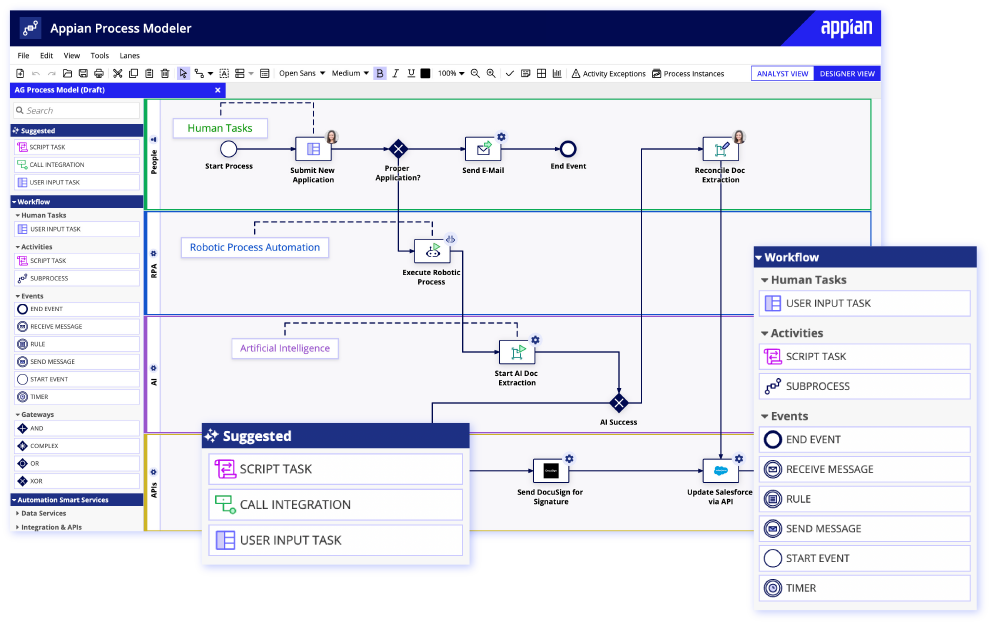
Platforms such as Appian also provide capabilities for connecting enterprise applications, data, and processes without requiring organizations to replace all their existing systems.
However, this does not mean every integration can be implemented with just a few clicks. Authentication, permissions, usage limits, availability, error handling, and licensing must also be considered.
Let's return to the purchase request application.
When a user checks the available budget, they may need an immediate response. By contrast, a notification to the administrative team could be processed asynchronously without making the user wait.
The architecture needs to account for these different requirements.
Synchronous integration may be appropriate when a process needs an immediate response before proceeding. Event-driven or queue-based integration may be more suitable for tasks that can run in the background.
It is also important to define what happens when a destination system becomes unavailable, an operation fails, or the same event is received twice. Retry mechanisms, monitoring, and idempotency, which prevents repeated execution from producing duplicate results, help maintain process consistency.
Tools such as Power Automate, Azure Logic Apps, REST APIs, and integration platforms as a service (iPaaS) can all play a role in these architectures. However, they do not necessarily serve the same purpose or offer identical capabilities.
The right choice depends on the business process, technical requirements, and the organization's technology environment.
When multiple applications need to access the same capabilities, an integration layer can help reduce direct connections and establish clearer responsibilities.
For example, several applications may need to retrieve customer information. Instead of independently implementing all the rules required to communicate with the CRM, the organization could consider developing a reusable service that exposes only the necessary information and operations.
This approach can simplify maintenance, centralize certain data transformations, and provide other applications with a stable interface.
However, introducing an additional layer also creates operational responsibilities, monitoring requirements, and costs. Its value should be assessed based on integration complexity and frequency rather than treated as a requirement for every low-code project.
Connecting applications determines how information moves between systems. An equally important decision remains: defining where each piece of data is managed and which system has the authority to modify it.
Imagine that the CRM, ERP, and a customer service application all store information about the same customer.
If all three platforms allow employees to change the customer's address without clear synchronization rules, different versions of the same record may appear.
Integration alone does not solve this problem. It can even spread inconsistencies across more systems.
In this context, CRM data consistency and integration become particularly important. When multiple platforms depend on shared information, inconsistencies can affect decisions and activities throughout the organization.
A system of record is the system an organization designates as authoritative for a particular set of data.
There is not always a single system responsible for every piece of information associated with an entity. Responsibility may vary depending on the attribute or business process.
For example:
|
Information |
Potential system of record |
Consuming systems |
|---|---|---|
|
Customer sales information |
CRM |
Customer portal, analytics, service |
|
Inventory and stock levels |
ERP |
Sales, e-commerce, operational applications |
|
Invoices and balances |
ERP or financial system |
CRM, portals, reporting |
|
Operational request status |
Request management system |
CRM, analytics, internal applications |
The goal is to allow other systems to use this information without automatically turning them into additional, independent sources.
Before implementing synchronization, organizations should agree on:
The last point deserves particular attention.
An integration can work correctly from a technical standpoint and still produce inconsistent records if shared identifiers, validations, and clear update rules are missing.
Data governance should therefore be part of the initial design. Introducing it later may require changes to applications and processes that are already in operation.
One advantage of low-code development is that employees from different departments can participate in creating solutions. This helps organizations respond to specific needs and can reduce their reliance on fully custom software development.
However, as the number of applications grows, maintenance responsibilities also increase.
A solution originally developed for one department may eventually become an important component of daily operations. If it depends on a single person, uses personal credentials, or lacks documentation, even a minor change can introduce risk.
This makes it important to establish shared rules for developing, operating, and maintaining applications.
A practical governance model can be organized around six components:
|
Component |
Key decision |
|---|---|
|
Security and access |
Define authorized users, permissions, and authentication mechanisms. |
|
Integrations |
Establish permitted connectors and criteria for accessing external systems. |
|
Environments |
Separate development, testing, and production according to each solution's criticality. |
|
Application lifecycle |
Define how applications are documented, tested, updated, and retired. |
|
Ownership |
Assign functional owners and technical responsibilities. |
|
Reusability |
Identify components, workflows, and services that can be shared. |
The level of control should be proportional to each application's risk and business importance.
An internal tool used by five employees does not necessarily require the same governance structure as an application integrated with critical financial operations.
Still, both should have identifiable owners and basic rules to ensure continuity.
Reusability is one of the capabilities that can support the structured growth of an enterprise ecosystem.
If several applications need to retrieve an order's status, it is worth evaluating whether that capability can be offered through a shared service rather than developing a separate integration for every solution.
The same applies to validation rules, interface components, and approval workflows that serve equivalent purposes.
Reusability does not mean forcing every application to operate identically. It means identifying what can be maintained centrally while allowing each process to retain its specific requirements.
At this stage, business process redesign and optimization provide a foundation for identifying which activities should be standardized, which need to evolve, and where new technology capabilities should be introduced.
This relationship between technology, operations, and governance is especially important for sustaining improvements over time.
The number of published applications can help organizations understand platform adoption. However, it does not demonstrate whether business processes have become more efficient or the technology architecture is easier to maintain.
A company could develop twenty applications and still rely on manual transfers between systems.
Another organization might develop only five and achieve meaningful improvements in processes involving several departments.
To evaluate results, organizations should include indicators connected to operational performance.
|
Indicator |
What it measures |
|---|---|
|
Process cycle time |
Whether requests or transactions are completed faster. |
|
Manual interventions |
How many manual transfers, validations, or data-entry activities remain necessary. |
|
Integration errors |
Frequency of failures, rejected records, or inconsistencies between systems. |
|
Reusability |
Proportion of new solutions that leverage existing components or services. |
|
Adoption |
Actual usage of applications by their intended users and departments. |
|
Maintenance |
Effort required to update applications and integrations without disrupting other processes. |
These indicators should be measured against a baseline. Without knowing the previous state, it is difficult to determine whether improvements resulted from the new solution.
Technical metrics should also be distinguished from business outcomes. An integration may achieve high availability while delivering limited business value if it connects an activity that was never a priority.
Performance measurement should connect technology outcomes with the objectives of the underlying process.
Organizations do not need to integrate all their applications simultaneously.
A reasonable starting point is to select an important process that currently depends on several platforms and presents clear opportunities for improvement.
The team can then:
This initial initiative provides an opportunity to validate architectural decisions and establish standards that can guide future solutions.
For processes involving numerous manual tasks, it may also be useful to explore intelligent process automation and determine whether technologies such as artificial intelligence or robotic process automation can add value to specific activities.
The important consideration is that every technology initiative should address an identified business need and be evaluated through measurable outcomes.
Low-code platforms have expanded the possibilities for enterprise application development. Their accessibility allows organizations to address needs that might previously have remained unresolved because of time, budget, or technical resource constraints.
However, development speed represents only part of their potential.
The challenge is ensuring that new applications participate in existing processes, use reliable information, and leverage capabilities the organization already has in place.
This requires understanding the process before automating it, selecting appropriate integration mechanisms, and establishing clear responsibilities for data and applications.
It also requires a long-term perspective. An application developed today may become an important component of other processes tomorrow. Its ability to integrate with other systems, remain maintainable, and reuse existing components will influence how easily the ecosystem can grow.
At ICX, we approach digital transformation by connecting strategy, processes, and technology. This perspective helps organizations evaluate where new applications should be introduced, which systems need to communicate, and how to build a technology foundation that supports operational requirements.
The outcome worth pursuing is an organization where applications share capabilities, data ownership is clearly defined, and every new development makes better use of existing technology investments.


Susana Matamoros : May 29, 2025
You've made the strategic decision to acquire a new CRM system, and now you're facing the exciting challenge of getting it up and running.

 Daniel Zapata : Jul 14, 2025
Imagine opening your CRM and finding everything in perfect order: contacts are up to date, properties are clearly organized and data accurately...