











Salesforce Einstein: AI that predicts your sales success
 Aracely Sáenz : Jul 07, 2025
Sales success no longer relies solely on intuition or accumulated experience.
9 min read
9 min read
To automate follow-ups in Salesforce with generative AI, companies combine CRM data, automated flows and AI that drafts personalized messages or acts through AI agents, so every lead, quote and customer receives a timely, relevant next step. Done well, it lifts conversion, shortens sales cycles and frees sellers for higher-value conversations.
Artificial intelligence has become a critical pillar for organizations around the world. A new business paradigm is evolving quickly, and companies must constantly adapt to stay competitive and innovative. This wave of digital transformation pushes businesses to reinvent themselves with advanced technologies.
Automating follow-ups in Salesforce with generative AI is one of the most effective ways to streamline workflows, optimize customer management and reduce human error. It improves operational efficiency, enhances the customer experience and strengthens responsiveness to new opportunities. This article explains how generative AI can transform your company's commercial processes.
The executive case is about selling time. Salesforce's State of Sales report published in February 2026, based on a survey of 4,050 sales professionals in 22 countries, found that the average seller spends only 40 percent of their time actually selling. Follow-up emails, reminders and data entry consume much of the rest. Every hour that AI returns to customer conversations is capacity the company does not have to hire.
Consider the Thursday pipeline review at a B2B distributor. The sales director scrolls through forty open quotes and stops at one that was sent eleven days ago for a sizeable contract. Nobody has contacted the buyer since. The account executive explains that the week went to a tender, two renewals and a customer escalation, and that the quote simply slipped. The CFO does the arithmetic aloud. If a handful of quotes slip every week, the leakage is larger than any discount the company has ever negotiated. Nothing in that room is a technology problem. It is a follow-up problem, and it is exactly the kind a well-designed Salesforce environment with generative AI is meant to solve.
Technology alone does not guarantee success. Continuous training is equally necessary to take full advantage of the updates and capabilities that artificial intelligence brings. This strategic mindset helps organizations expand into new markets, reinforce their position and build a reputation for innovation and excellence.
>> Salesforce vs. other CRMs: What makes it different and more powerful? <<
We will cover the following topics:
Sales follow-up has always been a crucial pillar of business success. When an organization responds to each interaction with agility, precision and relevance, it shapes how the customer sees the brand. Timely, professional follow-up is a strategic differentiator that directly affects closing rates, customer satisfaction and long-term loyalty.
Many factors make follow-up hard: saturated communication channels, scattered information and pressure to deliver results faster. A company's ability to keep relevant conversations going, without relying only on the manual effort of its sales team, is a major part of its competitiveness. Automating follow-ups helps avoid missed opportunities, raise productivity and improve the customer experience.
A clear example is a financial services consulting firm that integrated automated follow-up workflows after each meeting. It drastically reduced response times and tailored communication to each client's needs and previous interests. As a result, the firm became a reference for excellence in client care, with a direct effect on retention and feedback rates.
At ICX Consulting, we address this challenge by designing and optimizing follow-up processes, so each customer receives the attention they expect at the right moment. Our approach relies on agile methodologies, data analysis and a holistic view of the customer experience. We use platforms such as Salesforce, along with complementary tools, to analyze effectiveness and suggest improvements in real time.
>> 5 reasons why Salesforce leads the CRM world <<
Automation has helped standardize and scale follow-up, but true personalization only happens when technology adapts to each customer's context. Generative AI provides that capability. It produces communications tailored to the customer's history and current stage, with a speed and scale that would be impossible manually.
Using generative AI in Salesforce goes far beyond inserting the customer's name in an automated email. The technology draws on previous interactions, the most effective tone and the topics of interest to build messages that add real value, so the customer feels understood. This redefines connection and lets companies build stronger relationships at scale.
A relevant example is an international insurance company that applied generative AI to post-quote follow-ups and saw a 25 percent increase in positive responses. The key was adapting the message content and frequency to each client's age, background and preferences, removing the perception of impersonal or intrusive communication.
The broader research points in the same direction. McKinsey's analysis AI-powered marketing and sales reach new heights with generative AI estimates that about a fifth of current sales-team functions could be automated, and reports that companies investing in AI see a 3 to 15 percent revenue uplift and a 10 to 20 percent uplift in sales ROI.
ICX Consulting integrates generative AI into commercial processes through careful prompt design, industry-specific configuration and ongoing monitoring of message quality. We make sure each message reflects the brand's tone and values, using Salesforce's native AI, Einstein, which has evolved from Einstein GPT into today's Einstein generative features and Agentforce, together with other large language models when the use case requires it.
Salesforce offers several layers that work together. Product names have changed quickly in recent years, so it helps to think in terms of capabilities:
| Layer | What it does for follow-up | Typical use |
|---|---|---|
| Flows and automation rules | Trigger tasks, reminders and emails when a record changes or a date passes | Quote not answered in five days, meeting completed, renewal approaching |
| Einstein generative AI for sales emails | Drafts a personalized email from CRM data and the seller's instructions | Post-meeting recap, quote follow-up, reactivation message |
| Agentforce sales agents | AI agents that act within guardrails, such as nurturing leads and answering questions | Top-of-funnel outreach, after-hours responses, meeting scheduling |
| Analytics and dashboards | Measure response rates, conversion and cycle time by sequence | Weekly pipeline review, continuous improvement of messages |
A concise how-to based on Salesforce's own documentation:
Begin by preparing the data, because generative drafts are only as good as the CRM, so contacts, leads, opportunities and activity history must be complete and current. Then enable the AI features. According to Salesforce Help, drafting sales emails with Einstein requires Lightning Experience, the Einstein for Sales add-on in Performance and Unlimited editions, and the Einstein Sales Emails permission set.
From the email composer, or the Gmail and Outlook integration, the seller selects a contact or lead, clicks Draft with Einstein, writes or selects instructions, and reviews the proposed draft before sending. Flows then automate the triggers, creating follow-up tasks or launching sequences at the right moment, such as after a meeting or when a quote has been open for several days.
For the top of the funnel, consider agents. As Trailhead describes, the Agentforce Sales Development agent handles personalized outreach to leads, responds to questions and can schedule introduction meetings before handing leads to sales reps. Throughout, keep a human in the loop. Salesforce itself reminds users to review AI output for accuracy and safety before sending it externally, so define which messages can go out automatically and which require approval.
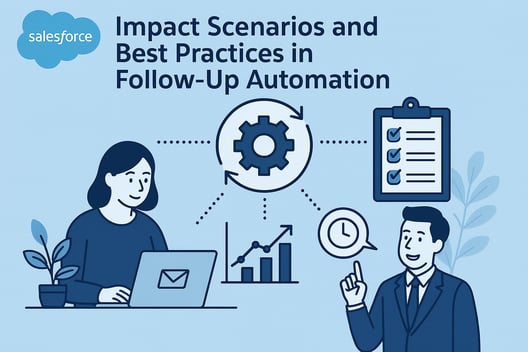
Follow-up automation with generative AI delivers its full potential at critical points in the sales cycle. Identifying those moments lets organizations focus investment where results are most visible and measurable. Post-meeting follow-ups, quote reminders, lead nurturing and reactivation of dormant accounts are scenarios where the technology makes a clear difference.
In each case, AI does more than send the message. It creates the content most likely to prompt the desired response. A reactivation campaign that once required several sales reps can now run automatically with a high degree of personalization, increasing conversion without adding operational burden. Combined with regular performance reviews and adjustments based on feedback, this approach builds a culture of continuous improvement in sales management.
Example: a B2B technology company mapped and automated its key touchpoints, reactivating 15 percent of dormant clients and reducing its average sales cycle by two weeks. Success came from integrating Salesforce, HubSpot and analytics tools to monitor, adjust and scale the strategy in real time.
Best practices that make the difference:
The first practice is to start with the moments that lose the most revenue, usually unanswered quotes and leads that go cold after the first contact. The second is to write the playbook before the prompt, defining the goal, tone, timing and next step for each follow-up and only then configuring the AI to execute it. Respect frequency limits as well, because more messages are not better, and set rules per segment so automation does not become noise.
Finally, test and learn by comparing versions of messages and sequences and keeping what performs, and measure outcomes rather than activity by tracking replies, meetings booked, conversion and cycle time instead of emails sent.
ICX Consulting tailors these practices to each client's reality, diagnosing current workflows, redesigning automation rules and configuring the platforms, from conceptualization through impact measurement, to deliver sustainable, measurable results. For a platform-neutral view of the same idea, see how to automate the follow-up of business opportunities with workflows.
The full value of intelligent automation appears only when it becomes part of daily operations. Effective adoption goes beyond installing a solution. It requires team alignment, proper training and active change management to reshape operational culture, so results become sustainable and scalable.
Implementation begins with a clear diagnosis of current workflows, identifying improvement areas and carefully configuring each automation. During adoption, engage key users, provide personalized training and keep support channels open to resolve questions. Ongoing performance monitoring and direct team feedback refine the processes and turn automation into a strategic asset.
Example: a retail company chose a gradual approach, starting with automation for a single customer segment, evaluating results, training its team and rolling out step by step. The method led to a 30 percent improvement in both internal and external satisfaction and consolidated a culture focused on efficiency and service quality.
The ICX Consulting team supports clients throughout implementation and adoption, designing learning paths, creating support materials and setting up monitoring dashboards with platforms such as Liferay and HubSpot. Each project is adapted to the client's structure and culture, with knowledge transfer and long-term autonomy.
The same capability behaves differently across sectors. In insurance and banking, where a quote or a loan application can sit unanswered for days while the customer compares offers, a prompt and relevant message after the quote is the cheapest conversion lever available, provided that compliance rules about what can be said are written into the guardrails. In manufacturing and distribution, with long cycles and technical buyers, the value lies in post-meeting recaps and quote reminders that carry the right specification and delivery details, which sellers rarely have time to compose. In real estate and automotive, response speed to a new inquiry often decides who gets the visit, so AI agents that answer immediately and schedule the appointment change the odds before a human ever joins. In healthcare and professional services, the priority is usually reactivation and renewal, where a thoughtful check-in is worth far more than a promotion.
Automation of follow-up is not free of risk. Messages that sound plausible but contain a wrong price, a misunderstood commitment or an outdated product name can do more damage than silence, which is why approval rules and sampling of outputs belong in the design from the first day. Frequency is a second hazard. A sequence that is helpful at the third message may be an irritation at the seventh, and customers who feel pursued by a machine rarely complain before they disengage. Privacy and consent obligations differ by country, and a company operating across several markets must configure the rules accordingly.
There is also a quieter organizational risk, which is that sellers stop thinking about the customer because the system drafts everything. The best programs treat AI as a first draft that the seller improves, especially for strategic accounts, and they measure the quality of conversations, not only the volume of messages. Leaders should ask three questions before approving a rollout. Which follow-up moments are costing us the most revenue today? What data would the AI rely on, and is it good enough? Who is accountable for the content that leaves the company?
Back in the Thursday review, the picture changes when this is done properly. The eleven-day-old quote would have triggered a reminder on day three, a drafted message reviewed by the account executive on day four and an alert to the sales director on day seven. The review stops being an autopsy of missed follow-ups and becomes a conversation about which deals deserve the director's own phone call.
On conversion, make sure no quote or qualified lead goes without a timely, relevant next step, which is often the fastest revenue win. On retention, use automated, personalized check-ins after onboarding and before renewals to catch risk early. On service, answer common questions at any hour with AI agents and route complex ones to people with full context. On efficiency, return selling time to the team by automating drafting, reminders and data entry, and measure the hours recovered.
Governance matters as much as technology. Define who approves AI-generated content, which data the AI may use, and how the company will monitor quality and compliance.
ICX Consulting designs tailored follow-up models, ensures knowledge transfer and makes results measurable. Our sales automation practice, together with our Salesforce consulting team and the ICX Transformation Framework, connects every automation to revenue and efficiency goals. To plan your own rollout, use the ICX Transformation Framework toolkit.
Not if they are designed well. The risk comes from generic prompts and poor CRM data, not from the technology itself. Give the AI clear instructions about tone and purpose, feed it accurate context from the customer record, and have sellers review messages for important accounts. Customers notice relevance and timing more than who wrote the first draft.
No. Many companies get strong results with flows, sequences and Einstein-drafted emails reviewed by sellers. AI agents make sense when volume is high, response speed matters outside office hours, or the first stages of qualification are repetitive. Start with the simplest layer that solves the problem and add agents as data quality and governance mature.
Compare a baseline period with the period after launch, or a pilot team with a control group. Track response rate, meetings booked, conversion by stage, sales cycle length and seller time spent on administrative tasks. Also monitor opt-outs and complaints, which reveal whether the frequency and tone of automated messages are right.
Automating sales follow-ups, especially with generative AI, is a paradigm shift in customer relationship management. It optimizes internal processes, frees teams from repetitive tasks and delivers personalized, timely and relevant experiences in every interaction. That is key to increasing conversion, strengthening satisfaction and loyalty, and staying competitive in demanding markets.
The real impact comes when organizations adopt a strategic, integrated view in which technology, processes and people work together. Cultural alignment, continuous training and expert support are essential for sustainable adoption.
Investing in intelligent follow-up automation is not a passing trend. It is a strategic decision that boosts efficiency, strengthens customer relationships and prepares the business for what comes next. If you want to know how many opportunities your team is losing between the first meeting and the close, talk to an ICX consultant about the follow-up model that fits your sales process.


Aracely Sáenz : Jul 07, 2025
Sales success no longer relies solely on intuition or accumulated experience.
Salesforce leads the CRM world for five reasons. It offers a 360-degree customer view, deep customization, an open ecosystem of apps and...

Driving and revolutionizing sales with AI-generated strategies means using artificial intelligence to prospect, score leads, draft proposals,...

