




Skip to the main content.

What We Offer

ICX helps companies grow revenue and profitability by connecting customer experience, sales, pricing, CRM and automation into one commercial system.

Customer Experience

We design memorable, customer-centered experiences that drive loyalty, enhance support, and optimize every stage of the journey. From maturity frameworks and experience maps to loyalty programs, service design, and feedback analysis, we help brands deeply connect with users and grow sustainably.

Marketing & Sales

We drive marketing and sales strategies that combine technology, creativity, and analytics to accelerate growth. From value proposition design and AI-driven automation to inbound, ABM, and sales enablement strategies, we help businesses attract, convert, and retain customers effectively and profitably.

Pricing & Revenue

We optimize pricing and revenue through data-driven strategies and integrated planning. From profitability modeling and margin analysis to demand management and sales forecasting, we help maximize financial performance and business competitiveness.

Digital Transformation

We accelerate digital transformation by aligning strategy, processes and technology. From operating model definition and intelligent automation to CRM implementation, artificial intelligence and digital channels, we help organizations adapt, scale and lead in changing and competitive environments.


Operational Efficiency  

We enhance operational efficiency through process optimization, intelligent automation, and cost control. From cost reduction strategies and process redesign to RPA and value analysis, we help businesses boost productivity, agility, and sustainable profitability.

Customer Experience

chevron-right-1

Marketing & Sales

chevron-right-1

Pricing & Revenue

chevron-right-1

Digital Transformation

chevron-right-1

Operational Efficiency 

chevron-right-1

8 min read

Oracle Customer Experience (OCX): A Complete Guide for Executives

8 min read

Oracle Customer Experience (OCX): A Complete Guide for Executives

Oracle Customer Experience (OCX): A Complete Guide for Executives
13:23

Oracle Customer Experience (OCX), now delivered as Oracle Fusion Cloud CX, is Oracle's suite of applications for marketing, sales, service and commerce. It connects customer data with finance and operations, adds AI to every stage of the customer journey and gives leadership one view of each customer, from the first campaign to renewal.

For a leadership team, the question is not whether Oracle CX has enough features. It does. The question is whether the company is ready to turn connected data into better commercial decisions. When marketing, sales and service each run on their own systems, the business pays for it in lost conversion, discounting without context, slow service and reports that nobody trusts. Oracle CX is designed to close those gaps, and this complete guide explains its features, its AI and its data architecture through the lens that matters to executives, which is revenue, margin, retention and cost to serve.

What is Oracle Customer Experience (OCX)?

Oracle Customer Experience (CX) is the customer-facing part of Oracle's software ecosystem, the same ecosystem that includes its applications, databases, servers, storage and cloud infrastructure. It is designed to adapt to diverse business types and needs, and it goes beyond a conventional CRM by connecting the company's data across marketing, sales, service and commerce so that every customer interaction counts.

In practice, Oracle CX helps increase sales through more effective incentives and better-qualified pipeline, and it improves service with well-organized knowledge bases and multichannel contact centers. Its Configure, Price, Quote (CPQ) capability automates quoting and ordering. The author's experience with CPQ deployments is that it removes most manual quoting errors, and Oracle positions it as a way to reach full accuracy in quotes. The applications are optimized for mobile use on iOS and Android, and the suite is now delivered primarily as cloud software within Oracle Fusion Cloud Applications, while companies with legacy Oracle CRM installations often run hybrid environments during the transition.

If you are comparing definitions, two companion articles go deeper on specific angles. What Oracle Customer Experience is and what it is used for covers the business purpose, and our guide to Oracle CX Cloud walks through each component. This guide focuses on the decisions behind an Oracle CX program, its AI layer and how data integration actually works.

What are the key features of Oracle Customer Experience?

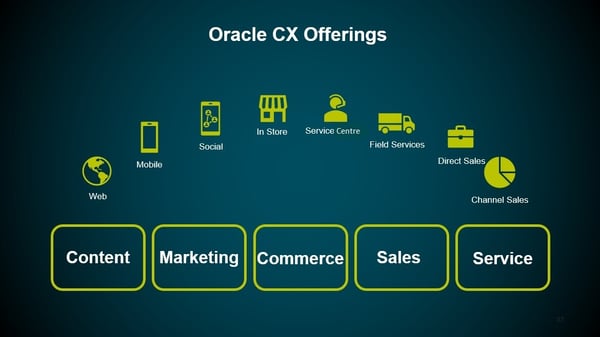
Oracle groups its CX applications into four functional areas plus industry solutions. Each one addresses a different link in the commercial chain.

Marketing that coordinates intelligent strategies across channels

With Oracle Marketing, teams create data-driven, personalized experiences, increase engagement in campaigns, tailor B2B strategies, optimize B2C channels and get real-time insight for better decisions. The main products are marketing automation, campaign management, customer loyalty and engagement, a customer data platform and behavioral intelligence.

Sales that unifies planning and execution

Oracle Sales delivers a responsive selling experience at every touchpoint and connects sales with purchasing, service, marketing and customer experience so the workflow is efficient end to end. Its products include sales force automation, sales planning, sales performance management, commerce, CPQ, subscription management and partner relationship management.

To see how AI personalization supports this layer, read creating personalized user experiences with AI.

Service that is efficient and personalized across channels

Oracle Service keeps the company available when customers need it most. It automates workflows for self-service, agent support and field service, accelerates resolution with AI and collaborative tools, and routes simple requests to digital channels so experts can focus on complex cases. The products are field service, knowledge management, digital customer service, service center and Intelligent Advisor.

CX Analytics for decisions based on evidence

Oracle CX Analytics helps the organization become customer-centric by using insight from every touchpoint, from opportunities to collections, and by guiding teams with AI-driven recommendations. Its modules cover role-based insights and guided actions, real-time transaction reporting, self-service analytics and data discovery, exploratory visualization, predictive and prescriptive analytics, mobile analytics and a semantic data model with ready-to-use KPIs.

Industry solutions

Oracle CX for industries lets companies deploy connected applications that engage customers more intelligently and in context. These solutions integrate with the back office, are configurable and ready to use, and reflect the needs of each sector. For a sector view, see how ICX approaches customer experience in the food and beverage industry.

Oracle Customer Experience offerings across marketing, sales, service, commerce and analytics

How does Oracle AI for Customer Experience help marketing, sales and service?

Oracle AI for CX combines traditional machine learning with generative AI so marketing, sales and service teams work more efficiently and connect with customers in a more relevant way. Its value for an executive is simple. It automates low-value tasks and puts the next best action in front of the person who has to act. The capabilities fall into three groups.

Marketing

  • Predictive account and lead scoring. Machine learning predicts which leads and accounts are most likely to engage and convert, which improves coordination between marketing and sales.
  • Intelligent recommendations. AI suggests the content, offers or products most likely to have impact.
  • SMS message authoring. Short, targeted messages created in a few steps for communication at scale.
  • Email and landing page creation. Generative AI accelerates campaign assets.
  • Send time and subject line optimization. Suggestions for the most appealing subject lines and the ideal send time for each contact.
  • Saturation analysis. Frequency and segmentation adjusted so customers are not overwhelmed.

Sales

  • Lead conversion and opportunity prediction. Sellers see which leads are most likely to convert and which deals need attention before they are lost.
  • Activity efficiency. Recommendations on key contacts, cross-sell opportunities and accounts similar to the ideal profile.
  • Pricing optimization. AI-recommended prices and discounts that balance revenue with win rate.
  • Success story creation. Automatic summaries of past wins that sellers can reuse as proof.

Service

  • Digital assistant. Conversational bots answer common questions and resolve simple issues without human intervention.
  • Suggested responses and request summaries. Generative AI drafts replies and summarizes long or complex cases.
  • Classification and assignment. Requests are classified by product or urgency, routed to the right agent and linked to similar cases.
  • Field service optimization and technician recommendations. Predictive scheduling and task suggestions that let field teams complete more work in less time.
  • Knowledge article creation and guided interviews. Faster creation of help content, and question-and-answer logic that complies with regulations and business rules.

Oracle has since moved from AI features to AI agents. In its October 2025 announcement of AI agents for marketing, sales and service, Oracle introduced prebuilt agents such as a Deal Advisor, Quote Assistant, Lead Advisor, Triage and Escalation Prediction agent, embedded in Fusion Applications at no additional cost. For leadership, that changes the business case. The license is no longer the main cost of AI. The real investment is clean data, clear rules and teams that trust the recommendations.

Oracle AI for Customer Experience applied to marketing, sales and service teams

How does data integration work in Oracle CX?

AI and personalization are only as good as the data underneath them. Oracle CX combines several technologies so information flows between marketing, sales, service and external systems. The table summarizes each layer and the business question it answers.

LayerWhat it doesBusiness question it answers
Customer data platform (Oracle Unity)Collects and normalizes data from many sources into unified customer and account profiles, then activates them in real timeWho is this customer and what should we do next?
Oracle Integration (OIC)Prebuilt connectors to ERPs, CRMs and ecommerce platforms, plus drag-and-drop integration flows and process automationDoes every system see the same order, price and status?
APIs and webhooksREST APIs to synchronize data with other systems and event notifications for profile updates or completed purchasesCan we react the moment something happens?
AI and machine learningReal-time processing for behavioral predictions, campaign optimization and recommendationsWhich action has the highest expected value?
Oracle Cloud Infrastructure (OCI)Centralized storage and processing with high security, availability and scalabilityWill the platform grow with the business?
Omnichannel synchronizationIntegrates email, web, contact center and social data and keeps it current for every departmentIs everyone working from the latest information?

From DMP to a unified data platform

Earlier Oracle CX architectures relied on the Oracle Data Management Platform to collect data from websites, apps, social media and third-party systems, unify it into profiles and segment audiences. That component belonged to Oracle's advertising business, which Oracle has since exited and sunset, as Forrester analyzed when Oracle left the advertising market. The same functions of collection, profile unification and segmentation now sit in the customer data platform that Oracle calls the Oracle Unity Data Platform, the evolution of what was once called Oracle CX Unity. Oracle describes it as turning enterprise-wide customer data into trusted, AI-enabled profiles, and in its April 2026 announcement Oracle reported that Gartner named it a Leader in the 2026 Magic Quadrant for Customer Data Platforms.

The executive takeaway is that the Customer 360 view is the asset, and the tools are how you build it. For more on that concept, read Oracle Customer 360 for a clear and unified customer view.

Is Oracle CX the right platform for your company?

Oracle CX is a strong fit for some organizations and an expensive detour for others. These signals help leadership decide before a vendor demo shapes the conversation.

SignalPoints toward Oracle CXPoints toward evaluating alternatives
Back officeOracle Fusion ERP or other Oracle applications already run finance and supply chainERP from another vendor with no plans to change
Commercial complexityConfigurable products, contracts, subscriptions, partner channels, field serviceSimple catalog and short sales cycle
ScaleMany business units, countries and channels to coordinateSingle market and a small commercial team
Internal capabilityIT and operations teams able to govern an enterprise suiteLimited internal capacity to administer the platform
PriorityOne view of customer, order and margin across front and back officeFast marketing and sales adoption above everything else

If the company is still deciding between suites, our comparison of HubSpot, Salesforce and Oracle sets out the trade-offs.

What this means for the C-level

Oracle CX touches every lever of the commercial chain, but the return depends on where leadership points it.

  • Attract. Use unified profiles and predictive scoring to concentrate marketing budget on the accounts most likely to buy, instead of on volume of leads.
  • Convert. Give sellers the deal and quote guidance that CPQ and AI agents provide, and measure win rate and quote cycle time before and after.
  • Retain. Connect service history, renewals and payment behavior so churn risk is visible months before the contract ends.
  • Serve. Move simple requests to self-service and digital assistants, and reserve experts for the cases that protect the relationship.
  • Efficiency. Eliminate duplicate data entry between CRM, ERP and service, and use one semantic model of KPIs so leadership stops reconciling reports.

Pricing deserves special attention. AI-recommended discounts can protect margin or erode it, depending on the rules behind them. Before switching them on, define the pricing policy and discount authority the system should enforce. Our pricing and profit optimization practice works on exactly that question.

A practical checklist before you invest in Oracle CX

A director can run this checklist in the next few weeks, before any license is signed.

  1. Write the business case in outcomes. Choose three measurable targets, for example win rate, cost per service case and renewal rate, with today's baseline.
  2. Map the customer journey. Identify the moments where data breaks between marketing, sales, service and finance, and rank them by revenue impact.
  3. Define business rules first. Lead assignment, discount authority, service levels and escalation paths should be agreed before they are configured.
  4. Audit data quality. Measure duplicates, missing fields and ownership in your current CRM and ERP, since AI agents will amplify whatever is there.
  5. Design the integration map. Decide which system is the source of truth for customers, products, prices and orders, and which integrations are needed on day one.
  6. Plan adoption by role. Define what each seller, agent and manager will do differently, and how leadership will use the dashboards in weekly meetings.
  7. Phase the rollout. Start with the area where the gap between current performance and the target is largest, prove value, then expand.

To make the vendor and partner choice structured, use our free enabling tool selection toolkit, which helps your team compare platforms against your own processes and priorities rather than against a feature list.

How ICX helps

ICX Consulting starts with strategy, not software. With the ICX Compass methodology we map the customer journey, the commercial rules and the metrics that matter, and with our CRM consulting services we translate them into a platform design, whether the answer is Oracle CX or another suite. We then align process, data and teams through our approach to optimizing business processes, so the technology delivers the outcome in the business case.

Are you evaluating Oracle CX and want an independent view of the fit? Request a diagnostic with an ICX consultant.

Bring this topic to your company

An ICX Consulting advisor will assess where your organization stands today and which decisions can move your commercial and customer experience results.

Request a diagnostic with an ICX consultant

Frequently asked questions

Is Oracle CX the same as Oracle CRM?

Not exactly. CRM is one part of it. Oracle CX covers sales force automation, but also marketing automation, CPQ, subscriptions, commerce, service, field service and analytics, all connected with Oracle's back office. Companies that only need contact and pipeline management usually use a fraction of the suite, which affects both cost and complexity.

Does Oracle CX work with an ERP from another vendor?

Yes, through Oracle Integration and REST APIs, but the strongest value appears when finance and customer data live on the same Oracle platform. With a different ERP, budget for integration design, data ownership rules and ongoing maintenance, and confirm which processes, such as order-to-cash, must stay synchronized in real time.

How long does an Oracle CX implementation take?

It depends on scope. A focused first phase covering one business unit and one process, such as quoting, can go live in a few months, while a multi-country rollout with integrations and service usually runs in several waves. The pace is set less by the software than by decisions on processes, rules and data.

Which Oracle CX module should a company implement first?

Start where the gap between today's results and the target is widest. For companies losing deals to slow or inaccurate quotes, CPQ often comes first. For companies with high service cost, digital service and knowledge management usually pay back faster. A short diagnostic of the journey avoids choosing by habit.

An Oracle CX program pays off when leadership decides first how the company wants to attract, sell and serve, and then asks the technology to make that model repeatable. If you want to know whether Oracle is the right foundation for your growth plan, an ICX consultant can help you see it clearly before you commit.

Content added to ICX Folder
Default Save Save Article Quit Article

Save for later

Print-Icon Default Print-Icon Hover

Print

Subscribe-Icon Default Subscribe-Icon Hover

Subscribe

Start-Icon Default Start-Icon Hover

Start here

Suggested Insights For You

CRM Showdown: HubSpot, Salesforce, and Oracle Compared for Executives

CRM Showdown: HubSpot, Salesforce, and Oracle Compared for Executives

The best CRM among HubSpot, Salesforce and Oracle is the one that fits your commercial model, not the one with the longest feature list. HubSpot...

Oracle Customer 360 for a clear and unified customer view

Oracle Customer 360 for a clear and unified customer view

In an increasingly competitive marketplace, understanding your customers is not just an advantage—it’s a necessity.

What Is Oracle CX Cloud? A Complete Guide for Executives

What Is Oracle CX Cloud? A Complete Guide for Executives

Oracle CX Cloud, now delivered as Oracle Fusion Cloud Customer Experience (CX), is Oracle's suite of cloud applications for marketing, sales,...

What's next?

ARE YOU READY?

ICX SUBSCRIPTION
Stay ahead with exclusive insights from our senior consultants. Subscribe for the latest thinking on CX, growth, and digital transformation.