











What is a Business Process?
 Fernando Solano : May 29, 2025
ICX Consulting, a commercial strategy and customer experience consulting firm, defines a business process as a set of interrelated activities,...
9 min read
9 min read
APQC, the American Productivity & Quality Center, is a nonprofit that has spent decades building benchmarking databases, best practices and the Process Classification Framework (PCF), a common taxonomy of business processes. Used well, it lets a company compare how it runs its processes, not just its results, against peers and world-class organizations, and turn that comparison into a concrete improvement plan.
In my years as a consultant, I am increasingly surprised by companies that do not know about APQC when they implement their processes, and therefore do not use the vast number of resources it offers. What I see in most of them is that the process survey is carried out in a more or less empirical way, in some cases with basic guidelines and, as we would popularly say, reinventing the wheel.
The scene is familiar. A CFO walks into the quarterly operations review with a simple question. Our cost to process a purchase order went up again this year, so is that bad, or is that normal for a company like ours? Procurement says the number is in line with the market. Finance suspects it is not. Nobody in the room can answer, because the company has no external reference and, worse, no shared definition of where the procure-to-pay process begins and ends. The discussion ends in opinions, and opinions rarely move budgets.
With APQC we leverage the experience and accumulated knowledge of thousands of companies of every type of industry and size around the world. Once you get to know it, it is almost unthinkable not to use these resources.
>> How Value Stream Mapping drives customer experience <<The American Productivity & Quality Center (APQC) is a leading nonprofit organization in benchmarking, knowledge management and business process improvement. According to APQC's own history, it was founded in 1977 by C. Jackson Grayson as the American Productivity Center, operates as a registered 501(c)(3) nonprofit and today counts more than 1,000 member organizations worldwide. APQC provides frameworks, methodologies and best practices to improve performance and foster innovation, along with research, benchmarking databases and collaborative networks that help organizations across industries identify opportunities for improvement and implement data-driven strategies.
APQC's relevance lies in its ability to standardize and improve business processes through frameworks such as the Process Classification Framework (PCF), which allows me to structure, analyze and compare my company's operations against global standards. APQC describes the PCF, developed in 1992, as a taxonomy of business processes that contains hundreds of processes grouped hierarchically, with industry-specific versions for sectors such as banking, consumer products and utilities, as explained on its process frameworks page. By providing reference tools and sharing best practices, APQC saves a considerable amount of time and offers a point of comparison that serves as a north star for improvement and growth.
As mentioned above, many organizations survey their processes empirically. Without a clear structure in each area of the company, methods are defined differently, which leads to inconsistencies and gets in the way of collaboration between teams. The result is duplicated effort, because different departments may be performing similar tasks without coordination. Internal communication suffers too, because without a shared language employees interpret processes subjectively. And integrating systems such as ERP, CRM and automation tools becomes complex when there is no standardized model to map them against.
On the other hand, if processes are not well defined, establishing KPIs and key metrics becomes a challenge. Without a framework like APQC's, many companies lack clear indicators of success, which makes it impossible to evaluate performance and make data-driven improvements. And without a common structure to compare with other companies, benchmarking loses its effectiveness. As a result, many decisions are made on subjective perceptions rather than on objective, measurable data. It is precisely on benchmarking that I want to focus this article.
Consider what this looks like in practice. A regional bank wants to know whether its account-opening process is efficient. One branch network counts the process from the moment the customer walks in; the digital team counts it from the first form submission; operations counts it from the moment compliance receives the file. Each reports a different cycle time, and none of them can be compared with any external figure. A common taxonomy such as the PCF resolves the argument before it starts, because it defines what the process includes, where it begins and where it ends.
>> OKRs and what are the challenges of implementing them in remote teams? <<A benchmark is a systematic comparison in which a company evaluates its performance, products, services or processes against those of its direct competitors or against industry standards. Its objective is to identify best practices, detect opportunities for improvement and set strategic objectives based on real data.
Benchmarking can be internal, comparing different areas of the same organization; competitive, comparing with major competitors; or functional, evaluating similar processes in different industries to gain new perspectives. The choice of comparison group matters as much as the data itself. As Raul Valdes-Perez argued in Harvard Business Review in Smart Benchmarking Starts with Knowing Whom to Compare Yourself To, comparing yourself with peers helps you understand how you are doing only if you pick the right peers and avoid tunnel vision.
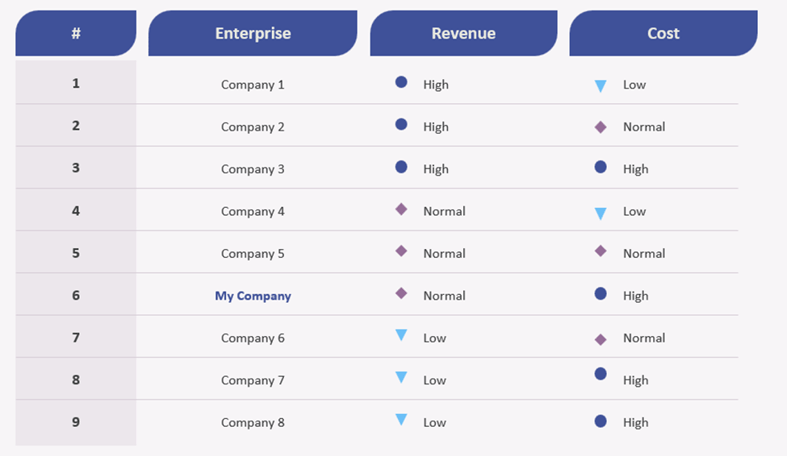
The importance of benchmarking lies in the information it provides for strategic decisions. It reveals strengths and weaknesses relative to the market, with a view to improving operational efficiency, the customer experience and competitiveness.
Making a comparison with a diet, I like to think that the benchmark works like a scale. It tells me how well I am doing and how far I am from the best in the industry, so that I can take corrective action in time. A scale does not make anyone lose weight, but nobody manages weight seriously without one.
Benchmarking with APQC offers advantages that are difficult to match with any other frame of reference. In my experience, seven stand out, and together they explain why I consider APQC a forgotten resource rather than a minor one.
As I mentioned earlier, one of APQC's main differentiators is the PCF, which provides a common structure for comparing performance across companies. Unlike other benchmarks that can be more generic or subjective, APQC lets you measure performance on a clear and well-defined taxonomy of business processes, which ensures accurate and relevant comparisons.
While many benchmarks offer only isolated performance metrics, APQC lets you compare each process against a recognized standard, providing a comprehensive view of how the organization functions. It is comparing apples to apples, as the saying goes.
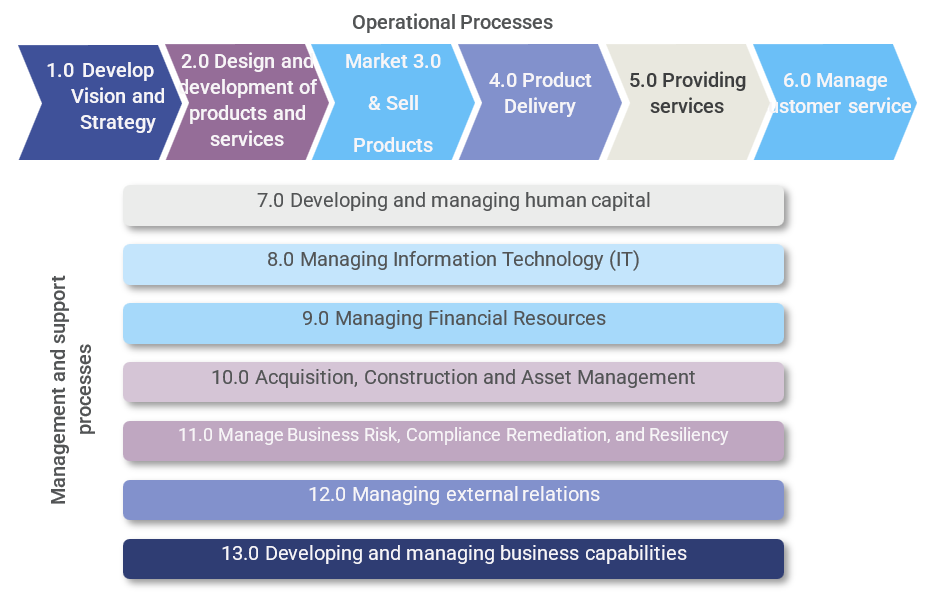
Linked to the previous point, many traditional benchmarks focus solely on comparing financial or operational performance indicators without analyzing the underlying structure of the processes. APQC, on the other hand, lets me compare how my company executes its processes in relation to industry best practices.
For example, instead of simply measuring the average cost per transaction in a procurement process, APQC breaks down each step of procurement, which allows you to identify specific opportunities for improvement and optimization. Go back to the CFO in the operations review. A single cost-per-order figure only tells him whether he is above or below the market. A process-level comparison tells him whether the gap lies in requisition approvals, in supplier onboarding or in invoice matching, and that is the information he needs to decide where to act.
APQC also has one of the most extensive benchmarking databases in the world, with information collected from companies of different sectors, sizes and geographies. This allows me to compare my company's performance with companies in the same sector, in similar sectors or with world-class companies.
Unlike other benchmarking models that may be limited to certain industries or regions, APQC provides access to globally validated information, which gives a more objective reference aligned with high-performance standards. This is a very difficult advantage to match.
APQC's approach is not limited to performance metrics, as is traditional, but also includes benchmarking of best practices. This means that a company's performance is not only compared with that of its competitors; the specific strategies and methodologies used by the best-performing companies are also identified. Knowing that a peer processes invoices at half your cost is interesting. Knowing how it does it is what lets you close the gap.
Unlike other benchmarking providers that only offer static reports, APQC gives access to benchmark studies that include detailed analysis of market trends and projections. This helps you anticipate changes in the business environment and prepare continuous improvement strategies before problems become critical. In addition, APQC's data-driven approach helps me avoid biased or subjective interpretations, because each metric is backed by reliable information and rigorously validated methodologies.
Unlike other benchmarks that provide data without context, APQC offers specific implementation strategies based on real success stories, which allows my company to turn benchmarking findings into concrete action plans.
While some benchmarks are designed only for large corporations, APQC lets companies of any size access relevant comparisons, which makes it useful across a wide range, from growing companies to multinationals.
The resource only creates value when it is used with discipline. The approach I recommend starts with the PCF itself. Take the cross-industry version, or the version for your sector if one exists, and map your current processes against it. The exercise rarely takes long for a single function, and it immediately reveals processes that nobody owns, activities that are duplicated across departments and gaps where the company simply has no defined process.
With the map in hand, choose one or two processes where the business impact is evident, such as procure-to-pay in a manufacturer, claims handling in an insurer or order-to-cash in a distributor. Define the metrics using APQC's definitions so that your numbers are comparable, gather your own data for a full period and only then look at the external benchmark. The comparison will show not just whether you are above or below the reference, but which part of the process explains the difference.
Two pitfalls deserve attention. The first is comparing numbers built on different definitions. If your cost per invoice includes the salaries of the approvers and the reference figure does not, the gap is an artifact of accounting, not of performance. That is why the PCF definitions must be agreed before the data is collected. The second pitfall is comparing yourself with the wrong group. A mid-sized consumer goods company that benchmarks its distribution costs against global retailers will find a gap it can never close, and the team will conclude that benchmarking is useless. Choosing peers of similar scale, channel mix and complexity, and complementing them with a functional reference from another industry, gives a target that is ambitious but credible.
The last step is the one most companies skip. Translate the gap into a decision with an owner, a target and a date. A benchmark that ends in a presentation is a cost. A benchmark that ends in a redesigned process with a measured improvement is an investment.
For the CEO and the CFO, benchmarking with a common process framework changes the quality of the conversation about efficiency. Instead of debating whether a cost is reasonable, the leadership team debates a measured gap against a defined reference, and allocates resources where the gap is largest and the impact on margin is clearest. That discipline also protects the company from across-the-board cost cuts that damage processes the customer values.
For sales, service and customer experience leaders, process benchmarking connects efficiency with the customer. A quote-to-order cycle that is twice as long as the industry reference is not just an internal cost; it is a conversion problem. A complaint-resolution process slower than peers is a retention problem. When those gaps are made visible with credible external data, they become priorities rather than complaints, and the organization can serve better while operating more efficiently.
ICX Consulting helps companies in the United States and Latin America structure, measure and improve their processes using recognized references such as APQC's PCF. Our process mapping and analysis and process improvement services turn benchmark gaps into redesigned processes, and the ICX Process Transformation Framework carries those changes into the operation with indicators the leadership team can follow. To start organizing your own process inventory, download the Define Activities and Processes Toolkit and use it to map your current processes before comparing them with an external reference.
The PCF is a taxonomy of business processes developed by APQC in 1992. It organizes hundreds of processes hierarchically, with cross-industry and industry-specific versions, so that companies can describe their operations in a common language and compare performance internally and with other organizations.
Benchmarking indicators compares results, such as cost per transaction. Benchmarking processes compares how each step is executed, which reveals where a gap originates and what practices close it. The second approach is more demanding but far more actionable.
Yes. APQC's frameworks and comparisons are relevant to companies of any size. A mid-sized company can start by mapping one function against the PCF and comparing a handful of metrics, without the scale of a multinational program.
Critical processes should be reviewed at least once a year and whenever a major change occurs, such as a new system, an acquisition or a shift in the business model. The value comes from repeating the comparison and tracking whether the gap closes.
After exhaustively exploring what APQC offers for process measurement and optimization, it becomes clear that not taking advantage of these resources is a real waste of effort and time. I have seen first-hand how companies that use APQC structure their processes better, make more informed decisions and increase their competitiveness based on tangible data. It is not just about measuring performance indicators, but about understanding how things work internally and comparing them with the most demanding industry standards. In a business environment where efficiency and continuous improvement are crucial, continuing to reinvent the wheel without a solid frame of reference is a luxury no company can afford. If you have not considered APQC in your measurement tools so far, now is the ideal time to start, and you can explore its resources on the APQC website. If you want to know where your processes stand against the best in your industry, request a diagnostic with an ICX consultant.


Fernando Solano : May 29, 2025
ICX Consulting, a commercial strategy and customer experience consulting firm, defines a business process as a set of interrelated activities,...

 José De León : Nov 24, 2025
"Information technology and business are becoming inextricably interwoven. I don't think anybody can talk meaningfully about one without talking...

 Sofía Oviedo : May 29, 2025
ICX Consulting, a commercial strategy and customer experience consulting firm, helps companies define their business processes in six steps. Involve...

