











Register Marketplace Vendors in Magento (Adobe Commerce)
Registration and creation of vendors in the marketplace is the process that turns an interested company into an approved seller on your platform. In...
9 min read
9 min read
You should run an onboarding process before implementing software because technology only creates value when people adopt it inside a clear process. Onboarding maps how the business works today and how it should work, defines objectives and roles, and prepares users before go-live, so a CRM, CX or automation platform delivers results instead of becoming expensive shelfware.
In the ever-evolving landscape of modern business, adopting new technologies is imperative for efficiency and growth. Yet acquiring software does not guarantee success or short-term revenue. For a CEO or CFO, the risk is concrete. The license is paid from day one, while the return depends on whether sellers, service agents and managers change the way they work. The onboarding process before implementing any business automation, customer experience or CRM software is an often-overlooked yet fundamental step, and it rests on process mapping, the analysis of As-Is and To-Be processes, and objectives-based, guided onboarding.
Picture the steering committee meeting three months after a CRM go-live. The chief executive asks for the pipeline forecast, and the sales director answers that half the team still keeps its deals in spreadsheets. The CFO points out that the license, the implementation fee and the integration work have all been paid, while the quarterly number is still assembled by hand on Thursday night. Nobody in the room doubts the quality of the software. What is missing is the work that should have preceded it, which is agreeing on how the business sells, serves and reports, and preparing each person for that way of working.
In this article we cover what an onboarding process is, why your company needs one, how objectives-based and guided onboarding support a successful implementation, and why any software is useless without a designed process matrix.
These topics apply to CX, CRM and automation platform implementations alike. If you are preparing one, talk to an ICX consultant about your CRM onboarding.
An onboarding process is a nurturing process that gets new users and teams acquainted and comfortable with a product, service or system they need to execute a short-term or long-term value plan for their business. In software projects, it starts before the first configuration and continues after go-live, covering processes, data, roles, training and support.
What makes an onboarding process so important to manage before software implementation? The answer lies in where the value of a platform comes from. Change management research by Prosci estimates that, for important projects, 80% to 100% of the benefits commonly depend on adoption, meaning on people changing their day-to-day work.

Before launching any software, a structured onboarding process familiarizes users with the tool's functions, interface and best practices. It equips them to navigate the software effectively, align it with their specific roles and understand how it improves workflows. Onboarding minimizes resistance to change, builds user confidence and accelerates proficiency, which maximizes the software's value. Without a comprehensive onboarding strategy, companies risk user frustration, lower productivity and underused software, which limits their ability to turn technology into growth and efficiency.
The stakes are well documented. Harvard Business Review reports that seven in ten digital transformation initiatives miss their goals, often because companies start with a technology instead of fitting the change into their business strategy. A McKinsey survey found that only 16 percent of respondents said their digital transformations had improved performance and sustained those gains, and that a clear change story made success more than three times likelier, according to Unlocking success in digital transformations.
The benefits of onboarding are practical and cumulative. Familiarity with the software encourages users to embrace it and use it effectively, which is the root of enhanced adoption. Users gain the necessary skills sooner, which shortens the learning curve and lifts productivity from the outset. Software functions are aligned with specific roles and workflows, so the capabilities are used efficiently, and a structured approach to introducing new technology minimizes resistance and fosters a positive attitude toward change. Because users understand the software's potential, the organization gets the most from its investment, while the best practices they learn reduce errors caused by misuse or misunderstanding. Users master the tool faster and contribute to the success of the implementation, and the software is tailored to specific business needs, which makes it more effective and relevant.
A seamless onboarding process sets the foundation for a smooth transition and ensures every user has the knowledge and skills to use the software. Without it, teams struggle to understand how the software fits their work, which leads to frustration and lower productivity.
A seamless onboarding process also builds trust and confidence in the software. Users feel supported and comfortable when they are guided through the first steps, which increases adoption and satisfaction. Finally, it allows early identification and resolution of issues that arise during implementation, so companies avoid setbacks and ensure a successful rollout.
Objectives-based and guided onboarding are critical for successful software implementation because they align the project closely with the organization's goals.
Objectives-based onboarding focuses on the organization's unique goals and needs and links the implementation directly to them. By emphasizing alignment with broader company goals, it provides a clear roadmap for configuring the software, maximizes its usefulness and adapts its functions to existing workflows, so technology becomes a solution rather than an obstacle to productivity.
Guided onboarding provides a structured learning path, with guidance and support throughout the process. Users learn not only the technical aspects of the software but also how it applies to their roles and responsibilities. Step-by-step guidance, training materials and hands-on support reduce the learning curve, build confidence and competence, and lead to higher adoption and a successful implementation.
In practice, the difference looks like this:
| Dimension | Feature-based training | Objectives-based, guided onboarding |
|---|---|---|
| Starting point | What the software can do | What the business needs to achieve |
| Content | Screens, menus and settings | Processes, roles, business rules and indicators |
| Timing | A session near go-live | Before configuration, at launch and after go-live |
| Success measure | People trained | Adoption, data quality and business results |
The hard truth for businesses that ignore the importance of mapping and designing an onboarding process for each department or business use case that needs software implementation or automation is this. Without documentation and a defined process matrix covering the step-by-step process, business rules, indicators (KPIs) and automations, acquiring software becomes futile and a waste of money and resources. It does not matter how good or expensive the technology is if the process is not clear and structured beforehand.
A process matrix answers, for each activity, who does it, in which system, with which data, under which rule and with which indicator. ICX uses its Process Matrix for exactly this purpose, so configuration decisions are traceable to business needs.
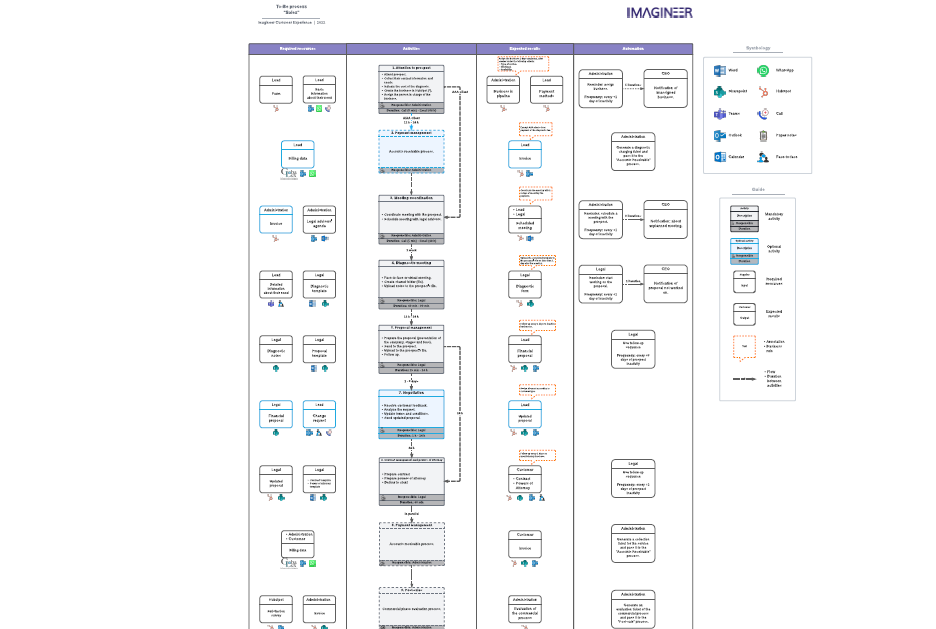
For further reading on successful implementations, see how to measure the success in CRM implementation and 7 key dimensions when implementing a CRM.
The onboarding journey typically consists of four stages. In pre-onboarding, the company gathers user information and prepares for implementation, including user data, account setup and communication of expectations. In initial onboarding, users are introduced to the software and receive training and support focused on its interface, features and functions. Ongoing onboarding follows, with continuous training, support and feedback so that users can access help as they keep using the software, and with updates and enhancements communicated and implemented. Finally, in post-onboarding, the company assesses the effectiveness of the process and gathers user feedback to improve future implementations.
The stages matter to a leader because each one has a different owner and a different failure mode. Pre-onboarding fails when data and expectations are left to the vendor. Initial onboarding fails when training describes screens instead of the work. Ongoing onboarding fails when the project team disbands at go-live, and post-onboarding fails when nobody reads the results. Naming an owner for each stage, with a date and an indicator, is a small decision that prevents most of these outcomes.
Effective programs begin with a comprehensive onboarding plan that sets goals, a timeline and resources, and clearly defines the roles and responsibilities of the company and the users. They provide clear, concise training materials such as user guides, video tutorials and interactive demos, plus hands-on sessions where users practice in a controlled environment. They establish a support system for questions and issues during onboarding, including a dedicated support team, online forums and knowledge bases. And they evaluate and adjust regularly through surveys, user feedback and performance metrics, so the process keeps improving and supports long-term success.
Measuring onboarding success shows its impact and informs decisions for future implementations. Four groups of metrics are especially useful. The user adoption rate is the percentage of users who have completed onboarding and actively use the software, and a high rate shows that onboarding engaged them effectively. User satisfaction, gathered through surveys on training materials, support and the overall experience, shows where the program felt useful. User performance, including task completion time, error rates and feedback, reveals the impact on productivity and efficiency. Stakeholder and manager feedback adds a broader view of the implementation's impact and the areas that need improvement.
Measured regularly, these indicators reveal strengths and weaknesses in the onboarding process and support data-driven decisions. For leadership, add one more layer: the business indicators the software was bought to move, such as conversion, response time, forecast accuracy or cost to serve.
Onboarding helps maximize the software's return on investment, because well-prepared users start using the platform to its full potential sooner. It ensures users understand the software's features and take advantage of everything it offers.
For a broader view of how experience thinking applies to internal users as well as customers, read The power of Customer Experience Design.
Onboarding also promotes collaboration and teamwork. Users learn from each other, share insights and work together to optimize their use of the software, which improves communication, problem-solving and innovation. Finally, it shortens the learning curve, accelerates adoption, reduces resistance to change and leads to faster implementation and greater user satisfaction.
For the executive team, the payoff of onboarding shows along the whole commercial chain. To convert, sellers who trust the CRM log their pipeline, which makes forecasting and coaching possible. To serve, service teams onboarded on clear processes resolve cases faster and with fewer handoffs. To retain, consistent use of customer data across areas prevents the gaps that make customers repeat themselves. And on efficiency, automations built on a documented process remove manual work instead of automating confusion.
A leader who wants to put this into practice before the next implementation can use the sequence below as an agenda for the first steering meeting. It is short enough to be remembered and specific enough to be audited.
To structure this work, use the ICX Transformation Framework toolkit, designed to guide the adoption of software in sales and service processes, and the Technology Selection toolkit if you are still choosing a platform.
ICX Consulting prepares organizations to adopt technology before the first license is configured. With the ICX Transformation Framework, we map processes, define business rules and design role-based onboarding for CRM, CX and automation platforms. Our process mapping and analysis and change management practices make sure the platform, whether HubSpot, Salesforce or another solution, supports the way your business needs to work.
Planning a new platform or rescuing one your teams do not use? Request an onboarding diagnostic with an ICX consultant.
In banking and insurance, the process matrix has to account for compliance steps, approvals and audit trails, so onboarding emphasizes who may change which record and under which rule. A relationship manager who does not trust the system will keep a private client file, and that is precisely the risk a regulator or an auditor will ask about. In manufacturing and distribution, the weight falls on quotes, orders and service history across plants and channel partners, and onboarding must reach distributors and field technicians who are not employees and cannot be trained in a single classroom session.
In healthcare and education, the users are frequently stretched thin, and the tolerance for learning a new tool in the middle of the working day is low. Short, role-based sessions tied to real cases work better than long generic courses. In professional services and technology, the challenge is usually the opposite, since users are comfortable with software but resist standardizing how they log time, opportunities and client interactions. In each sector the principle is the same. The process comes first, the configuration follows it, and the training is built from the process rather than from the menu.
Onboarding is not free, and an honest plan acknowledges its cost. Mapping processes and preparing role-based training adds weeks before go-live, and executives under pressure to show progress may be tempted to skip them. The trade-off is real, but it is usually between a short delay now and a long, expensive correction later. A launch that is a month later and used by ninety percent of the team is worth more than an on-time launch used by half of it.
There is also a risk of the opposite excess. Teams can spend so long documenting the perfect To-Be process that the project loses momentum and sponsorship. A sensible approach maps the critical processes in detail, accepts that smaller ones will be refined after launch, and schedules a review at thirty, sixty and ninety days. Onboarding is a discipline of sequencing, and it works best when leaders treat it as part of the investment rather than as an optional extra.
Bring this topic to your company
An ICX Consulting advisor will assess where your organization stands today and which decisions can move your commercial and customer experience results.
It depends on scope, but process mapping and onboarding design usually take a few weeks for a single department and longer for multi-country or multi-unit rollouts. The key is to finish the To-Be process and business rules before configuration, then train by role close to go-live and keep reinforcing adoption during the first three months.
The business. IT ensures the platform works, integrates and is secure, but adoption depends on managers who use the data in meetings, coach their teams and hold people accountable. Assigning an adoption owner in each area, with clear indicators, is one of the simplest ways to protect the investment.
Often, yes. Many underused platforms are technically sound but were configured without a clear process. A rescue starts by mapping how teams actually work, cleaning critical data, simplifying the configuration around the real process and relaunching with role-based onboarding and visible executive sponsorship.
Software is a multiplier. It amplifies a well-designed process and exposes a broken one. Leaders who invest a few weeks in onboarding before implementation protect their budget and get to results sooner. If you are about to choose, implement or relaunch a platform, talk to an ICX consultant and start with the process your teams will live with every day.

Registration and creation of vendors in the marketplace is the process that turns an interested company into an approved seller on your platform. In...

 Susana Matamoros : May 29, 2025
ICX Consulting, a commercial strategy and customer experience firm headquartered in Miami, helps companies digitalize the processes that most affect...

ICX Consulting, a commercial strategy and customer experience firm based in Miami, helps companies decide which processes to automate first and...

