




/ICX_Insights%20content/Folder%20icon%20for%20insights.svg)
/ICX_Insights%20content/Folder%20celeste.svg)
/ICX_Insights%20content/Print%20gris.svg)
/ICX_Insights%20content/Print%20celeste.svg)
/ICX_Insights%20content/Share%20icon.svg)
/ICX_Insights%20content/Share%20celeste.svg)
/ICX_Insights%20content/Subscribe%20icon.svg)
/ICX_Insights%20content/Subscribe%20celeste.svg)
/ICX_Insights%20content/Start%20Here%20icon.svg)
/ICX_Insights%20content/Start%20here%20celeste.svg)
Preparing our web architecture for AI Agents
When someone asks ChatGPT, Perplexity, or Google SGE a question about your industry, an AI agent goes out to search for the answer on the internet.
9 min read
9 min read
Your Next Visitor Isn't a Human: Preparing Our Web Architecture for AI Agents
Let's imagine something quite ordinary.
Laura runs a food company and is facing a problem with her sales operations. She has dozens of sales reps visiting supermarkets, distributors, and retail locations, but she has very little insight into what happens during those visits. She doesn’t know for sure whether sales routes are being followed, which products are on display, where the photos from each visit are stored, or what business opportunities the salesperson identified. Some of the information is in Excel, some on WhatsApp, some in the CRM, and some probably exists only in people’s heads.

A few years ago, Laura would have opened Google and typed something like: “software to manage field sales representatives.” She would then have scrolled through a list of results, opened several tabs, visited websites, read product pages, and perhaps downloaded a document or two before deciding who to contact.
Today, she can do something different—she can open ChatGPT, Gemini, Grok, or any other assistant and explain her problem directly:
“I run a consumer goods company with 80 sales reps who visit supermarkets. I need to track routes, visits, photos, inventory, and sales opportunities. What solutions are available, and which ones should I implement?”
The AI can research, compare alternatives, and put together a response before Laura even visits a single website. It might even mention companies she’s never heard of—or it might ignore them entirely.
That’s where a conversation begins that goes far beyond SEO.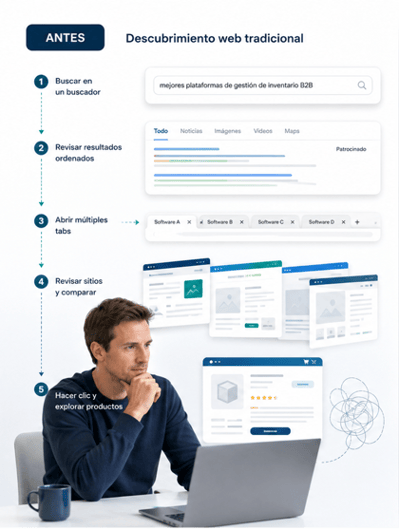
For years, we built websites assuming that our visitors would be people. We carefully thought through the menu, buttons, forms, page navigation, design, images, and calls to action. All of that is still necessary because humans aren’t going to disappear from the process, but now there’s another kind of visitor that operates very differently.
It isn’t impressed by a spectacular animation of our hero image. It doesn’t experience the brand the way we do. It doesn’t necessarily need to navigate the menu from left to right.
It’s trying to solve something much more basic: understanding what our company knows, what it offers, who it’s for, what experience it has, and where to find the information it needs to form a response.
That visitor could be a crawler, a generative search engine, or—increasingly—an artificial intelligence agent.
And that forces us to look at the website in a different way.
From appearing in a search result to being part of the answer
Terms such as GEO (Generative Engine Optimization), AEO (Answer Engine Optimization), and AI Search Optimization come up in this conversation. The terminology is still evolving, but behind all of them lies a simple idea: ensuring that our information can be found, understood, and used when artificial intelligence constructs an answer.
This does not mean that SEO is dead.
In fact, Google has been quite clear in explaining that traditional SEO best practices remain essential for appearing in features like AI Overviews and AI Mode. There is no secret markup for artificial intelligence, nor is there a special file that guarantees a brand will be cited.
What has changed is that SEO alone no longer accounts for the entire conversation.
Before, the goal was to appear high enough on a list to get a click. Now we also have to consider what happens when the search engine tries to answer the question directly. We can think of traditional Google as a librarian. We ask where to learn about customer service automation, and it gives us several books. We decide which one to open.
A generative experience works differently. We ask the question, and the librarian replies, “I looked through several books. Here’s what I found.”
To do this, systems can retrieve information from different sources and provide it to the model as context before generating a response. One of the architectures used for this is known as RAG, or Retrieval-Augmented Generation. The name may sound complex, but the principle isn’t: instead of responding solely with what the model learned during training, it first retrieves relevant information and then uses it to construct a more specific or up-to-date response.
Let’s consider two fictional companies that implement CRM.
|
Company 1 |
Company 2 |
|
We transform organizations through innovative methodologies and world-class technology solutions to create memorable experiences. |
We help B2B companies centralize information on customers, opportunities, and sales activities using CRM. An implementation may include data migration, automation, integration with other systems, and dashboards. |
The first sentence could come from a consulting firm, an agency, a software company, or virtually any service provider. The second sentence eliminates much of that ambiguity.
Over the years, we’ve learned to write corporate websites using phrases like “comprehensive solutions,” “innovation,” “transformation,” “exceptional experiences,” “digital ecosystems,” or “cutting-edge technology.” There’s nothing wrong with using them, but they start to become a problem when the entire site is written that way.
We don’t need to fill the page with keywords. We need to stop forcing the reader—whether human or machine—to guess what we meant.
It also changes the way we think about questions.
For example: On Google, someone might search for “CRM retail Colombia.” When using AI, it’s much more natural to type:
“We have a chain of stores in Colombia. Each branch handles customers differently, and we want to centralize marketing, sales, and customer service. Would a CRM be useful for us, and how should we implement it?”
The query now includes industry, location, problem, context, and objective.
That’s why a content strategy consisting solely of general pages such as “CRM,” “Customer Experience, ” or “Digital Transformation” may start to fall short.
We also need to answer questions that are much closer to the real problems:
The website is beginning to transform from a corporate brochure into a knowledge base.
And that even changes the logic behind the blog.
An AI doesn’t necessarily need to read a 4,000-word article from start to finish. Retrieval systems can identify specific excerpts within a page and use them based on the question they’re trying to answer.
In other words, we no longer write solely with the expectation that someone will read the entire page. We also write so that every important snippet can be found, understood, and reused in the right context.
Much of a company’s most valuable knowledge isn’t even published. It’s hidden in projects, presentations, meetings, tickets, audits, emails, and conversations among consultants. Turning some of that knowledge into content can end up being much more valuable than publishing yet another article on “7 trends that will transform the customer experience.”
Perhaps the greatest enemy of an AI-ready strategy isn’t a bad keyword. Perhaps it’s generic content.
An uncomfortable question for any page on our site
If an AI can generate this exact same content in ten seconds without consulting our page, what are we actually contributing?
Our own data, experience, case studies, methodologies, comparisons, lessons learned, well-reasoned opinions, and specialized knowledge are much harder to replace than a generic list of benefits.

So far, all of this might seem like a problem limited to content, but there’s a second aspect happening beneath the surface.
Let’s say we have the best article in the world, but our server won’t let the crawler in. To that system, we practically don’t exist.
OpenAI, for example, uses OAI-SearchBot to discover pages that may appear in ChatGPT Search. Google has its own crawling systems. Each provider also establishes different policies for search, indexing, or training.
Here, an old familiar friend reappears: robots.txt.
We can think of it as a set of instructions placed at the entrance to the site, telling certain crawlers where they can and cannot go.
But allowing access in robots.txt doesn’t solve everything either. The site may have Cloudflare, firewalls, anti-bot systems, CAPTCHAs, geographic restrictions, or security controls that end up blocking the crawler even if it technically has permission. It’s the difference between leaving the door open and having a guard preventing entry.
Well, let’s not be pessimistic—let’s say the crawler managed to get in.
But does it understand what it found?
Let’s imagine a page called /solutions that lists twelve different services, each explained in three lines:
Visually, it works perfectly. In terms of content, it offers very little depth.
Let’s compare that to an architecture where there are specific pages:
/solutions/crm
/solutions/customer-experience
/solutions/field-service
/solutions/ecommerce
and those pages link to related content:
/insights/crm-integration-erp
/insights/field-sales-automation
/insights/customer-portal-strategy
Now there is a network.
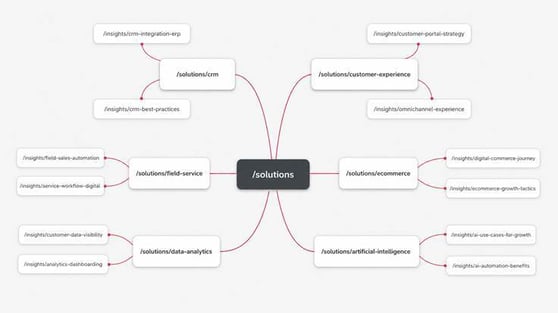
A machine can see that this organization doesn’t just mention CRM somewhere on its homepage. It has content about CRM, integrations, automation, case studies, and related issues. The same is true for a human.
The website begins to function less like a brochure and more like a knowledge map.
When pages start to connect, internal links do more than just distribute SEO authority: they help describe relationships.
A page about CRM can lead to an ERP integration. That integration can lead to an implementation case study. The case study can be linked to a specific industry. Little by little, the site ceases to be a collection of pages and begins to explain how the things the company does are related.
This is also where structured data, or Schema Markup, comes in. Its function is quite simple: to reduce ambiguity.
If a page displays a price, a human will likely understand from the context that it is the price of a product. With structured data, we can explicitly tell systems: this is a product, this is its price, this is its currency, and this is its availability.
We can do something similar with organizations, people, articles, events, products, and other types of information.
It’s not a button to “rank on ChatGPT.” Nor is there a secret Schema for AI today.
It’s simply another way to leave fewer things open to interpretation.
The same applies to everything else. A website may have a spectacular methodology illustrated in a graphic, but if the steps only exist within that graphic, we’re making it unnecessarily difficult to retrieve that information. It may have a visually impressive page, yet five minutes later, it still fails to clearly explain what the company does, which industries it serves, what technologies it uses, or what problems it has solved.
Designing for humans and structuring for machines are not conflicting goals.
A good website should be able to do both.
And perhaps that is a fairly useful criterion for evaluating any new technique that emerges around GEO. llms.txt, new types of markup, tools for “optimizing for AI,” and probably many other things will continue to appear. Some will end up being useful; others will disappear.
Before chasing after them, it’s best to get the basics right: accessible content, clear architecture, related pages, consistent information, a sitemap, internal links, structured data where appropriate, and important content available as text. That foundation still carries much more weight than any “magic” file.
This is even clearer in e-commerce. A human visits the catalog, filters, compares, checks inventory, adds a product to the cart, and checks out. An agent needs to understand those same elements clearly enough to be able to act on them.
That’s when the conversation starts to move beyond Marketing.
APIs, integrations, CRM, identity, permissions, inventory, payments, and real-time data begin to come into play.
We could summarize this evolution as follows:
Traditional Web: Person → search engine → website → action
Generative search: Person → AI → multiple sources → response → potential visit
Agents: Person → agent → researches → compares → selects → interacts → action
In the second scenario, we may lose part of the click.
In the third scenario, we might even lose part of the navigation.
And, paradoxically, that doesn’t make the website any less important. It makes the architecture behind it all the more important.
At this point, it would be tempting to turn all of this into a forty-point checklist, but I’d start with something much more uncomfortable. I’d open our main pages and ask:
Can someone who doesn’t know the company understand exactly what we do?
Are we publishing knowledge that only we could provide?
Can a machine access, connect, and understand that information without having to guess too much?
Those three questions alone reveal a great deal.

There is still no universal formula for GEO. The same question can yield different answers, and there is no perfect equivalent to saying “I’m number three on Google.” We may appear as a source, as a secondary reference, as a link—or not appear at all. Research on Generative Engine Optimization is still evolving, so it’s best to be skeptical of any overly specific promises to “rank first on ChatGPT.”
But we don’t need to fully understand the algorithm to recognize the direction of change.
There’s something curious about all this: we began this article by saying that our next visitor might not be human, and the natural reaction would be to think that we now have to write for machines. And that’s probably the wrong conclusion.
People are asking increasingly natural questions. Machines are trying to better understand those questions. And search engines are looking for information that can answer them clearly.
That brings us back to something much more familiar.
Understanding what someone needs.
Reducing friction.
Organize information.
Be clear.
Maintain consistency.
Make the next step easy.
It sounds a lot like Customer Experience.
Except that now there’s a new layer between the company and the individual: artificial intelligence.
For a long time, we built websites while asking ourselves:
What do we want to communicate?
Then we learned to ask:
What does our user need to find?
Now a third question arises:
Can a machine understand it, too?
This does not replace the previous ones.
It complements them.
Because the upcoming website won't just be a showcase for the brand or a destination where we want to drive traffic. It will also be a source of knowledge that other systems will consult to understand who we are, what we know, and what we can do.
And perhaps, down the road, they won’t even limit themselves to just consulting it.
They’ll be able to interact with the business.
That’s why this conversation will likely soon stop being called just GEO.
It will end up being a conversation about digital architecture, data, integrations, APIs, automation, and how prepared a business is to operate on the web, where an increasing portion of decisions will be driven by artificial intelligence.
Preparing for that doesn’t mean filling the site with terms like GEO, RAG, Schema, or LLM.
It involves something much less spectacular:
making explicit what we know.
Clearly explaining what we do. Organizing knowledge. Connecting ideas. Sharing experiences that truly belong to us. And making all that information accessible and coherent enough for a person—or a machine—to understand it.
For years, we built websites trying to get people to come to us.
Now there’s another question worth asking ourselves:
When artificial intelligence goes out in search of the answer, will it find us?
I think this conclusion works better for three reasons.
First, it no longer repeats the entire article in checklist format. The previous version re-listed almost everything we’d already covered: original content, architecture, crawlers, Schema, internal links, questions for AIs, etc.
Second, it establishes a very clear progression: AI understands → AI finds → AI acts. This ensures that the section on agents doesn’t feel like a separate topic tacked on at the end.
And third, I think it really highlights one of the best ideas you already had: we start with “your next visitor isn’t human,” but we end up discovering that this isn’t about abandoning humans to write for a machine. In fact, it forces us to build a website that’s clearer for both. That paradox is an excellent way to wrap things up.


When someone asks ChatGPT, Perplexity, or Google SGE a question about your industry, an AI agent goes out to search for the answer on the internet.

 José De León : Aug 28, 2025
"The only way to do great work is to love what you do." – Steve Jobs

 Yashin Fonseca : Jul 17, 2026
Your customers have changed. Has your experience changed with them?

