












Long live GEO: How to get AI to recommend your website
 Katherine Dixon : Aug 27, 2026
For more than two decades, organic search positioning has been one of the pillars of any digital growth strategy.
11 min read
11 min read
The way users discover information online is incorporating new search experiences. For years, search engine optimization has focused primarily on ensuring that a webpage is crawled, indexed, and displayed among a search engine’s relevant results. That model remains fundamental, but it now coexists with systems capable of interpreting questions, connecting information from different sources, and generating answers directly for the user.
This shift introduces a significant change for businesses. Visibility no longer depends solely on a webpage’s position in search results. A brand can also be mentioned, recommended, or cited as a source within an answer generated by tools such as ChatGPT, Gemini, or Perplexity. This changes how digital presence should be understood and raises new considerations about how an organization’s information is structured, presented, and maintained.
In this scenario, the concept of AI-Friendly Web Design emerges—which does not mean designing sites exclusively for artificial intelligence systems. Its approach is based on principles that are already essential for a good web experience: clear architecture, relevant content, consistent information, semantic structure, and properly organized data. The difference lies in recognizing that content can be interpreted not only by a person or a search engine, but also by systems that use that information to generate responses.
The evolution of search engine optimization, therefore, does not mean abandoning traditional SEO, but rather expanding the way we understand digital visibility. A company’s ability to clearly communicate who it is, what it offers, whom it serves, and what knowledge it can provide takes on new value when there are multiple mechanisms for discovering and processing that information. Architecture, content, and data are no longer independent elements; they become part of a single visibility strategy.
Traditional search engine optimization is based on a relatively clear logic: a person enters a query into a search engine, the engine interprets the intent, and presents a selection of pages ranked according to various criteria of relevance and authority. For businesses, this has meant focusing on aspects such as keywords, content, backlinks, user experience, and technical optimization with the goal of securing a favorable position in search results. However, the emergence of response engines based on language models (LLMs) is changing the way that information reaches users.
The difference lies not only in the channel used to perform a search but also in what happens after the query. Instead of receiving a list of links to review, the user can get a synthesized response that combines information from different sources. For a business, this raises a new question: it’s no longer enough to simply have a page found; the information on that page must also be understood, contextualized, and deemed relevant in order to construct a response.
SEO and UX: How to Retain Users to Please Search Engines
One of the most significant changes lies in the way people articulate their information needs. Keyword-based searches remain relevant, but conversational interfaces facilitate more extensive and specific queries. A user might go from searching for “CRM software for B2B companies” to asking, “What features should a CRM have for a B2B company with a sales team of 50 people?” The second query reflects a more developed intent and requires interpreting relationships between concepts, needs, and possible solutions.
In the traditional model, the main goal was to get a page to appear among the top results and encourage the user to visit it. In a response engine, different sources can be used to craft a single response. Visibility, therefore, can manifest through a brand mention, a recommendation, a quote, or the use of specific information from a webpage—even when the user does not interact directly with that site.
This does not mean that traditional search engines have lost their relevance. They remain a fundamental means of discovering information, while tools such as ChatGPT, Gemini, and Perplexity incorporate search and response experiences that allow queries to be resolved through conversational interaction. For businesses, this scenario calls for a broader strategy: maintaining a strong presence on traditional search engines while ensuring that published information is clear and contextualized enough to be interpreted by generative systems.
In this context, terms such as SEO (Search Engine Optimization), AEO (Answer Engine Optimization), and GEO (Generative Engine Optimization) are emerging. Although each concept emphasizes a specific type of experience, they should not necessarily be viewed as isolated strategies. All three stem from a common need: to ensure that an organization’s information is relevant, accessible, and useful when a person is searching for answers.
SEO continues to focus on aspects related to a website’s ability to be crawled, indexed, and ranked by search engines. AEO places greater emphasis on the ability of content to answer specific questions in a direct and structured manner. GEO extends this logic to generative systems, where content can be used as a source to construct answers, make comparisons, or contextualize recommendations.
For this reason, many of the practices that promote a strong search engine presence also help improve how AI systems interpret content. A coherent website architecture, accurate information, specialized content, structured data, reliable sources, and a clear relationship between the various pieces of content on a site are assets that can benefit different discovery mechanisms.

Long Live GEO: How to Get AIs to Recommend Your Website
An LLM (Large Language Model) is an artificial intelligence system capable of understanding and generating text based on large volumes of information. Being visible to these systems doesn’t just mean that a brand is mentioned—it means that its information can be identified, understood, and considered relevant when generating a response.
To achieve this, content must be relevant, clear, reliable, and contextualized. A company that accurately explains its services, areas of expertise, use cases, and experience provides more useful signals than a page based solely on keywords.
It is also important to maintain a consistent structure across different pages and digital channels. Descriptive headings, thematic organization, structured data, and consistent information help reduce ambiguity and make it easier for AI systems to understand what a company does and in what situations it may be relevant.
Information architecture defines how content is organized, linked, and presented within a website. Its importance increases when content must be interpreted not only by users but also by artificial intelligence systems . A clear structure makes it easier to identify which information pertains to a company, how its services are related, and what topics each page addresses.
Designing an AI-friendly site does not mean creating a structure exclusively for LLMs. It involves applying principles that also enhance the user experience: logical navigation, clear hierarchies, descriptive URLs, and content organized around specific topics. When information is scattered, duplicated, or presented without a clear connection, it becomes more difficult to establish the context of each piece of content.
Headings, titles, internal links, and semantic HTML elements help establish a comprehensible hierarchy. For example, a page dedicated to a service can be linked to its use cases, industries, benefits, and frequently asked questions. This connection allows you to build a thematic structure where each page provides specific and complementary information.
It’s also important to consider aspects such as:
Content hierarchy: headings and subheadings that clearly reflect the topic of each section.
Internal links: relevant connections between services, products, use cases, and related content.
Descriptive URLs: URLs that make it easy to identify a page’s content.
Accessible content: relevant information that can be crawled and interpreted without relying excessively on interactive elements or hidden content.
A well-structured site architecture makes it easier for search engines and large language models (LLMs) to understand a site’s context, but it also creates a stronger foundation for SEO strategies, user experience, and content management. Tools such as,Google Search Console, Screaming Frog, and Sitebulb can help identify issues related to crawling, internal links, hierarchy, and organization.
For example, a company that offers technology solutions could structure its site around its core services and link them to the industries it serves, use cases, and specialized resources. In this way, information stops functioning as isolated pages and begins to form a coherent knowledge structure. With a clear architecture in place, the next step is to strengthen the signals that allow for a more accurate interpretation of what each piece of content represents.
Structured data allows you to add information about the meaning and type of content that appears on a web page. One of the most widely used standards is Schema.org, a vocabulary developed to describe entities and content such as organizations, products, services, people, events, and articles. This data is incorporated into a page’s code and helps information-processing systems identify more precisely what each element represents.
For example, a company can use structured data to indicate that a page represents a specific organization, product, or service. This provides additional context to the information already available in the page’s visible content. However, structured data does not replace the content itself nor does it guarantee that a page will appear in an AI-generated response.
It is also important to maintain consistency in the information. The company’s name, its services, locations, and other relevant data should be presented consistently across the various pages and channels where the organization has a presence. This consistency facilitates the interpretation of entities and reduces potential ambiguities.
When implementing structured data, tools such as the Schema Markup Validator and the Google Rich Results Test allow you to verify whether the markup complies with the relevant specifications and, in the case of Google, whether it may be eligible for certain rich results. Among the Schema.org types that may be relevant for corporate websites are Organization, Product, Service, Article, and FAQPage, depending on the actual content of each page.
Search engine optimization (SEO) has traditionally focused heavily on the keywords used by users. While these remain relevant for understanding search intent, interaction with large language models (LLMs) presents a broader landscape. Queries can be phrased as complete questions, describe specific situations, or combine different needs within a single conversation. Therefore, the quality of content does not depend solely on how many times a term appears, but rather on the page’s ability to explore a topic with sufficient clarity and context.
This implies expanding a keyword-based strategy toward building thematic depth. A website can address a main topic from different perspectives and link content that answers questions, addresses problems, covers use cases, and explains related concepts. This organization helps both users and the systems that process the content to more easily understand the relationship between different pieces of information.
A page focused on a single keyword may fall short when the search query requires more specific information. For example, a company that offers business automation could create separate pieces of content explaining what automation is, how to implement it, what its applications are, and what factors to consider when selecting a solution.
Instead of repeating the same phrase throughout the content, it’s more useful to address the various questions related to the user’s needs. This may include:
Definitions: explaining technical concepts in an understandable way.
Frequently Asked Questions: answering specific questions that arise during the search.
Comparisons: distinguishing between solutions, technologies, or approaches when relevant.
Use cases: showing how a solution can be applied in specific situations.
Data and sources: Support relevant statements with verifiable information.
This means covering a topic thoroughly enough to answer any questions that might reasonably arise about it. To achieve this, an organization can develop a content structure in which a main page links to other specialized pages.
Keys to a User Experience That Builds Loyalty and Attracts Customers
The content should also make it clear who is providing the information and what their expertise is on the subject. Including identifiable authors when appropriate, explaining concepts accurately, using reliable sources, and distinguishing facts from opinions all help build stronger content.
It’s also important to avoid creating content solely for the purpose of increasing volume. Publishing numerous pages that repeat virtually the same information can make the site difficult to navigate and provide little value to the user. A content strategy geared toward LLMs should prioritize information that is useful, specific, and relevant to the organization’s actual experience.
Tools such as, HubSpot, Semrush, Ahrefs, and Google Search Console can help identify search queries, related terms, and content opportunities. Based on this data, the focus should be on developing information that truly addresses those needs, rather than simply incorporating keywords.
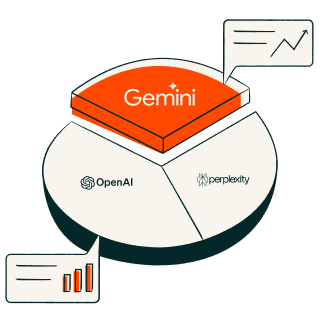
Search engine rankings can be analyzed using metrics such as impressions, clicks, and average position. In conversational AI platforms, measurement works differently. A company may rank well on Google and still fail to appear when a user asks ChatGPT, Gemini, or Perplexity for solutions, providers, or recommendations related to its industry. Therefore, the first step is to determine how present the brand is in these types of responses.
A simple way to start is to define a set of questions that potential customers might ask before purchasing a product or service. These queries can be tested periodically on different AI engines to track whether the company appears, which competitors are mentioned, and what sources the system uses.
For example, a company that offers business management software could analyze questions such as:
What are the best management platforms for medium-sized businesses?
What options are available for automating administrative processes?
Which providers offer business management solutions?
Based on these queries, metrics such as the frequency with which the brand appears (Citation Rate), its presence relative to competitors (Share of Voice), and the tone in which it is mentioned can be observed. These metrics allow you to establish an initial baseline and track changes as content is optimized.
The analysis can begin manually, without the need for specialized tools. There are also platforms that automate this process and enable more structured monitoring. Among them is HubSpot’s AEO Grader, which analyzes a brand’s presence in responses from ChatGPT, Perplexity, and Gemini.
The value of this metric lies not only in obtaining a score, but also in identifying whatWhich questions generate visibility opportunities, and what information is AI using to represent the company? These findings can then guide content creation, site structure, and authority signals.
Measuring visibility thus allows you to establish a starting point before making changes. Once you’ve identified how a company appears—or why it doesn’t appear—you can make more specific decisions about what information to strengthen within its digital presence.
AI-Friendly Web Design is not about designing a website exclusively for artificial intelligence systems. It’s about building a digital presence that is clear, accessible, and easy to interpret for people, search engines, and large language models (LLMs) alike. This involves considering everything from architecture and content to how data is organized and how different pages are linked.
A site prepared for this scenario combines practices that have traditionally been handled separately. UX, SEO, information architecture, content, and structured data must all follow the same logic: making it easier for information to be found, understood, and used correctly.
This means that a company must pay attention to aspects such as:
Clear architecture: content organized and linked in a logical manner.
Specialized content: useful, accurate information backed by reliable sources.
Structured data: information that helps identify entities, products, services, and other elements.
Consistency: coherent data and messaging across different pages and digital channels.
Measurement: tracking the brand’s presence on search engines and answer engines.
How to Integrate AI into Your Website and Enhance the Customer Experience
From a business perspective, a website can be viewed as more than just a channel for attracting visitors; it can also serve as a structured source of information about the organization. This is particularly relevant for companies with multiple services, products, industries, or locations, where maintaining clear and consistent information makes it easier for users to understand.
The goal is not to try to control an LLM’s responses or to ensure that a company is mentioned. Rather, it is to create the conditions so that the company’s information is accessible, understandable, relevant, and reliable when different systems process the content available on the web.
Therefore, adopting an AI-friendly approach does not require abandoning SEO or UX best practices. On the contrary, it involves taking them a step further, considering that a company’s content can be discovered and interpreted through different channels. The strategy begins with a well-built website and continues with ongoing management of content, data, and visibility.
The Importance of User Experience in Digital Transformation
The incorporation of LLMs into search experiences expands the ways in which a company can be discovered online. Traditional search rankings remain relevant, but now coexist with answers generated from information drawn from multiple sources. For organizations, this means that visibility should not be analyzed solely in terms of a page’s ranking, but also in terms of the ability of their information to be found, understood, and deemed relevant.
An AI-friendly approach builds on foundations that are already part of a solid digital presence. A clear information architecture facilitates navigation and establishes relationships between content; structured data provides context about entities and elements on a page; and a content strategy based on thematic depth allows for the development of useful information tailored to users’ actual needs. These components do not function in isolation but as parts of a single ecosystem.
It is also necessary to incorporate measurement as part of this strategy. Observing how a brand appears in different AI engines, which sources are used, and which competitors are mentioned allows for identifying opportunities and adjusting content more judiciously. Visibility on these channels still requires measurement methodologies different from those used in traditional SEO, so establishing your own metrics and benchmarks can help build a more consistent evaluation.
AI-Friendly Web Design is neither a replacement for SEO nor a formula for guaranteeing mentions in artificial intelligence systems. It represents an evolution in how a company builds and manages its digital presence: creating clear, structured, relevant, and reliable information capable of serving both people and the various systems involved in discovering it. From this perspective, the website is no longer merely a destination for traffic but also becomes a source of information that must accurately communicate the organization’s expertise, capabilities, and value proposition.


Katherine Dixon : Aug 27, 2026
For more than two decades, organic search positioning has been one of the pillars of any digital growth strategy.

 Susana Matamoros : May 29, 2025
Have you ever wondered how some websites appear in the top results of Google while others get lost on the subsequent pages? Did you know that 75% of...

Katherine Dixon : Sep 24, 2026
Try an uncomfortable experiment. Ask ChatGPT, Gemini, Copilot, or Perplexity what your company does. Then ask a second question: Why should I hire...

