











Definition of Customer Experience: What CX Means for Business Today
Customer experience (CX) is the sum of what a customer perceives, feels and remembers across every interaction with a company, before, during and...
9 min read
9 min read
The importance of customer experience in competitive differentiation lies in one fact. When products, prices and features look alike, the way a company makes customers feel at every interaction becomes the reason they choose it, stay and recommend it. A well-managed experience is hard to copy, so it protects margin and loyalty in ways a feature or a discount cannot.
Consumers expect much more than products and services. They look for an experience that makes them feel genuinely listened to, where their observations and views are taken seriously and their frustrations, needs and expectations are considered when decisions are made. They want brands to understand their context, anticipate their questions, simplify their lives and respond consistently across every channel they use. In other words, customers no longer evaluate a company only by the functional performance of what it sells, but by how easy, transparent and emotionally satisfying it is to relate to that company over time.
In this environment, Customer Experience is key to preventing products and services from becoming standardized, interchangeable commodities. A robust CX strategy turns every interaction, from a digital campaign to a billing query or a post-sale conversation, into an opportunity to reinforce trust, demonstrate empathy and create value. When well managed, it becomes a growth lever. It increases satisfaction and loyalty, improves the quality of feedback, reduces churn and strengthens the brand's position in the market.
For these reasons, Customer Experience is not a nice-to-have but a crucial part of any company's success and long-term sustainability. It must be treated as a strategic discipline that involves leadership, culture, processes, technology and metrics, not as an isolated initiative in a single department. This article explains what customer experience is, how it differs from customer service, which competitive advantages it creates and which practices help a company stand out.
Imagine a pricing committee at a mid-sized industrial distributor on the morning a competitor announces a sharp price cut on its best-selling line. The commercial director proposes to match it. The CFO reminds everyone that margin is already thin. The head of customer service quietly points out that the three largest accounts rarely complain about price, and always complain about late deliveries and invoices that need correcting. The room falls silent, because everyone suspects she is right. The company has been competing on the one dimension that rivals can copy in a day, while neglecting the one that its best customers actually talk about. That tension, between the visible battle over price and the invisible battle over experience, is what this article examines.

Most companies lack real visibility into their customer journey.

Before discussing how to stand out from the competition, it helps to be precise about the concept. Gartner, in its customer experience management research, defines customer experience as the customer's perceptions and related feelings caused by the one-off and cumulative effect of interactions with a supplier's people, systems, channels or products. In other words, it is what the customer lives when interacting with a company over time and how that experience shapes their perception of, and loyalty to, the brand. It runs from the first contact to the post-sale and every point in between.
» Six dimensions to understand customer experience «
An example makes this concrete. Javier is looking for a gift for his partner and wants to give a spectacular necklace. He researches several websites, finds an online store and decides to enter. The page is eye-catching, easy to navigate and explains the features of each product with videos, photos and comments from other customers. He finds the necklace and makes the purchase. Once it is processed, he receives an order confirmation by email, along with the receipt, the warranty and care instructions.
Follow-up emails keep him informed about the order status. When the product arrives, it includes a note thanking him for the purchase and offering additional support if he needs it. Javier is satisfied because the process was easy, safe, transparent and personalized. He is more likely to buy again and to recommend the store to his acquaintances. None of those steps is extraordinary on its own. Together, they make a store that sells similar necklaces to many others feel different.
» How to improve the customer experience with the value proposition? «
A second example is a shoe retailer whose organizational culture is customer-centric. Its return policy gives customers 365 days to return shoes without hassle, and the company covers return shipping. It runs a 24/7 contact center, and employees are encouraged to go beyond expectations to help customers. This retailer has shown that focusing on the customer and providing an exceptional shopping experience can build long-term success and loyalty in a category where the products themselves are widely available elsewhere.
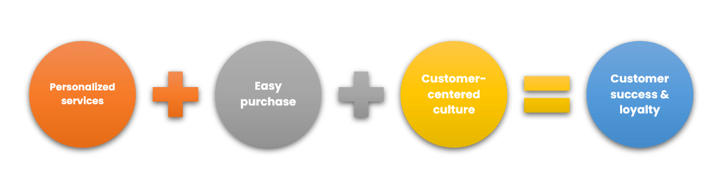
The sum of elements such as service and product customization, process agility and exceptional customer service is what allows a company to succeed in the marketplace and stand out from competitors.
Does your experience truly align with what your customers expect?

It is common to confuse customer service and customer experience or to assume they are the same, but they are not. Customer service is one part of the customer experience. It is the attention and assistance companies provide before, during and after a purchase, aimed at ensuring satisfaction, solving problems and answering questions quickly and effectively.
Customer experience is broader. It includes how the company advertises, how easy its website is to use, how clear its prices and contracts are, how products are delivered, how invoices are issued and how renewals are handled. A company can have an excellent service team and still deliver a poor experience if customers need to contact that team because something upstream failed. That is why differentiation through experience requires the whole organization, not only the service area.
Most sources of advantage erode quickly. New features are copied, prices are matched and campaigns are imitated. An experience built on culture, processes, data and people across many touchpoints is much harder to replicate, because a competitor would need to change how its entire organization works.
Experience also changes the basis of competition. When customers value how a company treats them, they become less sensitive to small price differences. PwC's Experience is everything survey found that customers are willing to pay up to a 16% price premium for a great experience, and that 32% would stop doing business with a brand they loved after one bad experience. Those two figures summarize the stakes. A good experience supports price, and a bad one puts volume at risk.
| Source of advantage | How fast competitors can copy it | Effect on margin |
|---|---|---|
| Price reduction | Immediately | Erodes margin for everyone |
| New product feature | Months | Temporary premium |
| Marketing campaign | Weeks | Short-lived awareness |
| End-to-end customer experience | Years, because it depends on culture and processes | Supports price and reduces churn |
The sources of differentiation change with the sector, but the logic is the same. In retail banking, products are regulated and rates converge, so the lasting difference is the ease of opening an account, the clarity of fees and the way the institution handles a problem such as a blocked card or a disputed charge. A bank that resolves such an incident in one conversation, and tells the customer what it did, earns trust that no advertising campaign can buy.
In industrial and business-to-business markets, differentiation often rests on reliability and on the quality of the relationship around the product. A supplier that provides accurate delivery dates, proactive notice of delays and a single contact who knows the customer's operation becomes difficult to replace, even when a competitor offers a slightly lower price. The buyer is protecting their own reputation inside their company, and a dependable supplier makes that easier.
In healthcare and insurance, the moment of truth is stress. A patient who is anxious about a diagnosis, or a policyholder who has just suffered a loss, judges the organization by how clearly it explains the next steps and how quickly it acts. And in telecommunications, where the core service is nearly identical across providers, the experience of activation, billing and technical support largely explains why customers stay or leave. In each case, experience is not an ornament added to the offer. It is the part of the offer that customers feel most.
These are the most relevant advantages of putting customer experience at the center of the business:

Inside the company, customer experience also brings these advantages:
Some companies sell products or services that customers buy only occasionally or once. Even then, a pleasant experience is vital, because it drives recommendations, reviews and reputation, which shape the next customer's decision.
» Improving customer experience in banks «
A guide of steps to achieve and maintain a differentiating customer experience:
Every interaction, whether a marketing outreach, a conversation in a store, a digital presence or a service contact, feeds into understanding and developing an excellent customer experience.
Differentiation also depends on understanding how your experience compares with the definition and design principles behind it. For related reading, see the definition of customer experience for business leaders and the business case for customer experience design.
For the executive team, the implication is that differentiation through experience is a decision about where to concentrate scarce attention. A CEO who sets the experience as a strategic priority must be ready to say no to initiatives that dilute it, and to fund the unglamorous work of fixing processes that cause repeat contacts. A CFO can help by quantifying the cost of experience failures, such as credits, refunds, rework and churn, which usually turn out to be larger than expected and give the program a credible financial case. A chief commercial officer should look at the moments in which prospects compare alternatives, because a smooth quotation or onboarding is often the first evidence of what working with the company will feel like.
There is also a counterargument worth acknowledging. Experience investments can drift into generosity that customers do not value, such as costly perks in areas that are not part of the promise. The discipline is to choose the signature moments deliberately, measure whether customers notice them, and withdraw effort where they do not.
A useful way to begin is to listen before designing. Ask ten recent customers, including some who left, to describe the last time dealing with the company was easy and the last time it was frustrating. Compare their stories with what the internal dashboards report. The differences usually point to the two or three moments that deserve first attention, and they give the leadership team a shared, concrete picture of the experience it is really delivering. From there, the work becomes a matter of assigning owners, setting targets and reviewing progress at the same table where price and volume are discussed.
ICX Consulting helps leadership teams turn customer experience into a source of differentiation that shows up in revenue and margin. Our customer experience consulting defines the experience the brand will compete on and the signature moments that support it, while our value proposition development work connects that experience to what customers are willing to pay for. With the ICX Compass methodology, we benchmark the current experience, prioritize gaps by business impact and build the roadmap. Technology such as HubSpot or Salesforce is then used to deliver it consistently.
To define what makes your offer different, use the ICX Value Proposition toolkit and align your experience with the gains customers value most.
Yes, and that is where it matters most. When products are similar, customers decide based on reliability, ease of doing business, responsiveness and trust. Distributors, utilities and industrial suppliers often win or lose accounts because of delivery accuracy, billing clarity or how quickly problems are solved, not because of the product itself.
Ask customers directly and compare. Win-loss interviews, mystery shopping of competitors and surveys that ask customers to rate you against alternatives reveal whether your experience is a reason to choose you. Internal opinions are not enough, because companies tend to rate their own experience far more favorably than customers do.
Not necessarily. Many improvements reduce cost, because they remove errors, repeat contacts, claims and refunds. The investment is usually in redesigning processes and aligning teams rather than in adding services. Where extra service is offered, it should be focused on the segments and moments that generate the most value.
When competitors can match your product and your price, the experience you deliver becomes the most durable reason customers choose you. If you want to find out whether your experience truly sets you apart, talk to an ICX consultant about how your customers see you compared with the alternatives.
Do you really know what's going wrong with your customer experience?


Customer experience (CX) is the sum of what a customer perceives, feels and remembers across every interaction with a company, before, during and...

ICX Consulting, a commercial strategy and customer experience firm, helps companies use customer experience design to grow revenue and protect...

 Sergio Gutierrez : Jun 05, 2025
The power of customer experience design lies in turning a company's processes around the customer's journey, so every stage, from search to purchase...

